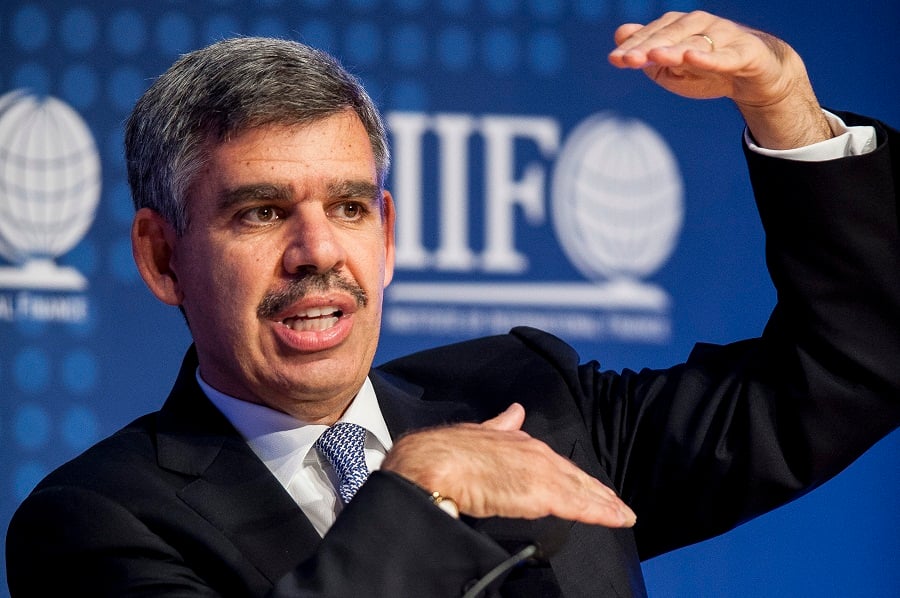
Mohamed A. El-Erian, former CEO of Pacific Investment Management Co. and now chief economic adviser at Pimco parent Allianz SE, said Tuesday that volatile global markets are providing a buying opportunity for investors.
But Mr. El-Erian warned that investors' optimism is grounded in debatable beliefs, including in the ability of the
Federal Reserve to unravel its near-zero interest-rate policy without making mistakes or causing the markets to tumble.
Speaking in
an InvestmentNews webcast, Mr. El-Erian said a stumble by the Federal Reserve could lead to volatility, which in turn could lead to investors choosing to reduce debt, which could hurt asset prices.
There are a number of positive signs, according to Mr. El-Erian. The decreasing price of oil and increasing relative value of the U.S. dollar could have the positive effect of stimulating spending around the world and making relatively weak European and Japanese economies sell more goods abroad.
But Mr. El-Erian said central banks “will find it much harder to repress volatility.” And the sinking price of oil — driven by “a fundamental global realignment” away from a market dominated by the Organization of the Petroleum Exporting Countries — could lead an oil-dependent Russia to stoke more tensions and possibly destabilize Europe's most crucial source of energy.
“What investors should focus on a lot is the weakest link in the oil chain, which is Russia,” said Mr. El-Erian. “The biggest threat is that we get hit by a combination of technical adjustments [in the market] and countries tipping over … Next thing you know you have an emerging-markets crisis.”
FED-DRIVEN BULL MARKET
The Fed's easy-money policy has formed the basis of a multiyear bull market in U.S. stocks and in sinking Treasury yields.
“This is the least-believed equity bull market of my career,” said Robert C. Doll, chief equity strategist for
Nuveen Asset Management, who also sat on the panel. “This will be the year when the American investor moves from skeptical to more optimistic, meaning more maturity in the bull market, but by no means is it over.”
Mr. Doll, who is far less bullish about the economic growth prospects of the eurozone and Japan, recommended globally focused investors focus on multinational companies, rather than those with a domestic focus in those countries.
Quincy Krosby, chief market strategist for Prudential Annuities, who also spoke on the panel, made the case for active investment management this year.
She said the disappearance of monetary stimulus by the Federal Reserve meant the absence of the “magic wand” that swept volatility away as stocks climbed.
But central bank policy will diverge next year as the Federal Reserve likely moves to raise interest rates while Europe and Japan keep rates low to help combat deflation. At the same time, dislocations in currency and oil prices
will continue to have unpredictable effects on markets.
“Because of the divergence, because of the Fed's policy and because of the possibility of technical breakdowns in the market, I think an active manager does a better job,” said Ms. Krosby. “It doesn't mean you get rid of your index funds, absolutely not, but you do need a fundamental basis for the positions you're going to take and it needs bottom-up analysis.”
Even for those managers, the market's continued uptick shouldn't be taken for granted.
“Don't assume the returns we had over the last number of years,” Ms. Krosby said. “We're going to work for it this year.”