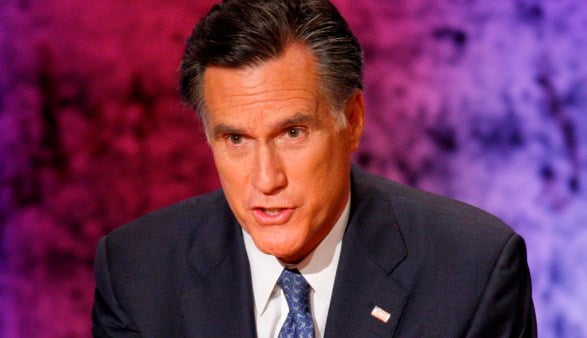
Republicans are pitching their tax overhaul plan on the appeal of lower rates and a simpler system -- and figuring that voters won't mind the lack of details about the potential pain.
Republican presidential candidate Mitt Romney, vice presidential candidate Paul Ryan and U.S. House members don't say what tax breaks they would limit or eliminate to offset the more than $4 trillion cost of cutting individual and corporate income tax rates. The approach lets Republicans deflect criticism now and iron out the specifics after the election.
“We have to have something broad enough that sets our principles in play but understand that when push comes to shove, we're going to have a process in place to fill in the blanks,” said Representative Patrick Tiberi, an Ohio Republican on the tax-writing House Ways and Means Committee.
Republicans would need to retain their House majority while winning control of the Senate and taking the presidency in the Nov. 6 election to control the overhaul of the tax system that's a major part of their 2013 agenda. The details that Romney and Ryan have refused to offer are the ones that could provoke the most objections from voters, companies and members of Congress.
Lanhee Chen, Romney's policy director, said yesterday on Bloomberg Television's “Street Smart” that the candidate doesn't want to “prejudge” how a tax overhaul should be written in Congress.
'Political Process'
“Part of it is a process of negotiation to say: Here are my goals, here are the things I want to accomplish, let's work this out in the political process,” Chen said.
Proposing cutbacks in tax breaks for charitable contributions, mortgage interest and employer-provided health insurance could mobilize well-organized opponents, said Phil English, a former Republican congressman from Pennsylvania.
“Anybody is taking their life into their hands by offering very much specific detail,” said English, now a lobbyist at Arent Fox LLP in Washington. “Fundamental tax reform is for Republicans what fundamental health-care reform has been for Democrats,” central to the party's agenda though the details are “very difficult to explain in the context of a campaign that involves 30-second TV spots.”
Romney's plan would cut individual rates by 20 percent and eliminate the estate tax and alternative minimum tax, which is a parallel calculation originally designed to keep high-income people from legally avoiding all taxes. He would leave the top rates on capital gains and
dividend income at 15 percent and cut them to zero for households making less than $200,000 a year.
Overseas Profits
For corporations, Romney would cut the rate to 25 percent from 35 percent, keep a research tax credit and impose lighter taxes on the profits U.S. companies earn overseas.
Romney says he would broaden the tax base by reducing deductions and other tax breaks to ensure his plan generates as much revenue as the current system, and avoids shifting the tax burden from high earners to the rest of the population.
The Romney campaign has resisted explaining how it would do that, even after an Aug. 1 study by the nonpartisan Tax Policy Center showed that achieving all of his goals would be almost impossible, given that the rate cuts for top earners would cost the U.S. government $360 billion in revenue in 2015.
Only Hints
Romney has offered only hints. In remarks overheard at an April 15 fundraiser, he said he was considering eliminating mortgage interest deductions for second homes and the deduction for state and local taxes.
Those changes alone wouldn't come up with enough money to offset the rate cuts. Ending the state and local tax deduction could generate $862.2 billion over the next decade, the Congressional Budget Office estimated last year. Phasing out the mortgage interest deduction over that period would yield $214.6 billion. The estimates would be lower if tax rates also were cut.
Eliminating tax breaks is politically difficult; the breaks for mortgage interest, state and local taxes and charitable contributions survived the 1986 tax overhaul that broadened the tax base. Still, in an indication that Romney wants to keep his options open, Republican platform drafters refused to endorse a proposal that would have called for preserving the mortgage- interest deduction.
The tax overhaul promoted by House Republicans is slightly different from Romney's plan. The plan that Ryan advanced would condense the six individual brackets into two and set a top rate of 25 percent. Offsetting those rate cuts would require $4.5 trillion in tax-base broadening over the next decade, according to the Tax Policy Center.
Top Earners
“The math just doesn't work,” said Seth Hanlon, director of fiscal reform at the Center for American Progress, a Washington group typically aligned with Democrats. “So there's either an enormous revenue hole or huge shifts of the tax burden down the income scale.”
Republicans, while not spelling out more details, want to be ready to move quickly next year. The House passed a tax overhaul process bill Aug. 2 that calls for Ways and Means Committee Chairman Dave Camp of Michigan to produce legislation by April 30, 2013.
Ryan, the chairman of the House Budget Committee, said in a Bloomberg Television interview June 8 that Ways and Means would decide which tax breaks to cut. The panel has been holding hearings for more than a year on a tax overhaul.
No 'Backroom Deal'
“What we don't want to do is cut some backroom deal and then tell the country what we're going to do,” said Ryan, of Wisconsin.
The House framework doesn't include any guidelines on how progressive the tax code should be, and it doesn't rule out higher rates on capital gains and dividends.
“That's part of the larger discussion,” said Representative Peter Roskam, an Illinois Republican on the Ways and Means panel. “I don't think there's much of an appetite for raising those rates, but that's why you have a deliberative process to really walk it through.”
First-term House Republicans, Roskam said, are particularly interested in overhauling the tax code as boldly and as quickly as possible.
“I'm willing to be incredibly aggressive in terms of putting everything on the table,” said Representative Todd Young, an Indiana Republican elected in 2010. “That's really the only way to fairly come up with a simpler code that receives broad support.”
That formulation -- expressing a willingness to consider alternatives without specifying them until after the election -- is exactly what Republicans should keep doing, English said.
“I don't think in offering tax reform that you need to pretend to fill in all the gaps,” he said.
--Bloomberg News--