
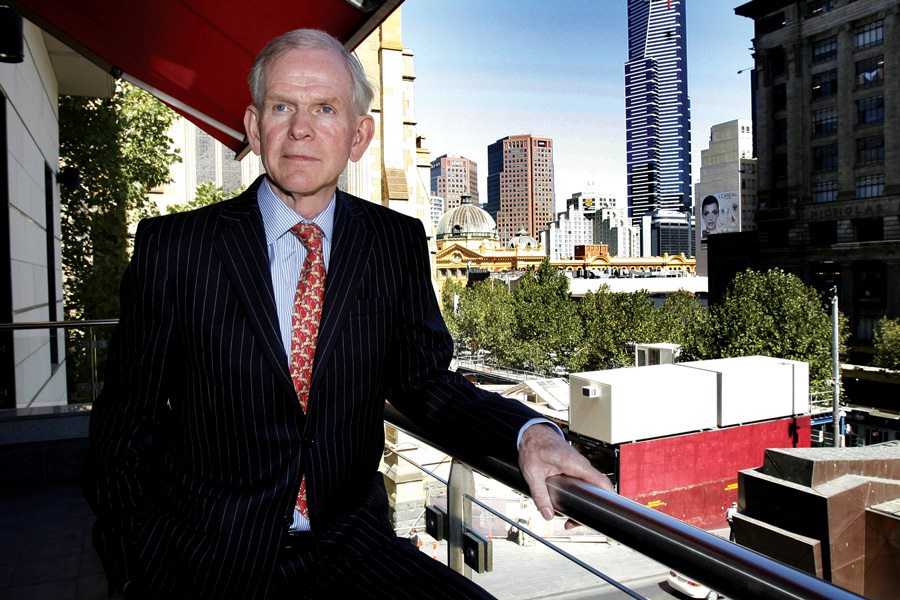
Jeremy Grantham got the market’s attention with his “super bubble” call on U.S. stocks. Now he wants to get an even more alarming and urgent message out, one his critics may find harder to accept.
The “Goldilocks” period of the past 25 years is ending, and the world needs to prepare for a future of inflation, slower growth and labor shortages, the renowned value investor said in a Bloomberg “Front Row” interview.
“There’s only a certain amount of cheap oil, cheap nickel, cheap copper, and we are beginning to hit some of those boundaries,” said Grantham, co-founder of Boston asset manager GMO. “Climate change is coming with heavy floods, serious droughts and higher temperatures— none of these make farming easier. So, we’re going to live in a world of bottlenecks and shortages and price spikes everywhere.”
Grantham, 83, insists that’s all inevitable because, along with the scarcity of raw materials, baby boomers are retiring, birth rates are declining, emerging markets are maturing, and geopolitical tensions are flaring — all trends decades in the making and almost unstoppable.
Last week, Grantham described what he considers only the fourth super bubble in U.S. history, reiterated that a crash is imminent and advised exiting U.S. stocks altogether. He predicted a drop of almost 50% in the S&P 500 and said no amount of Federal Reserve intervention could prevent it.
His prediction was timely, preceding a volatile few days for the markets.
Grantham contends that the excesses — and costs — of the super bubble are symptomatic of humanity’s tendency to live beyond its means: the demand for easy money that drove up asset prices and, in doing so, exacerbated inequality is now taking its toll in the form of economic stresses and societal fragmentation.
Similarly, the growth of the past century in pursuit of ever-higher standards of living left depleted soils, poisoned ecosystems and a changing climate, he said. That’s why wildlife is disappearing, biodiversity is in jeopardy and human reproductivity is slowing.
“We have simply shot way beyond the long-term capacity of the planet to deal with us,” said Grantham, who operates a $1.5 billion foundation to protect the environment. “Nature is beginning to fail. And in the end, if we don’t fix that, we begin to fail as well.”
Those views are likely to resonate with Grantham’s fellow conservationists. To his doubters, he’s already too much of a Chicken Little.
For most of the past decade, Grantham has been skeptical of stock valuations and dismissive of the fervent enthusiasm that accompanied the bull market. After his latest crash call, one post on Twitter listed his sky-is-falling warnings to suggest he’s wrong too often to be taken seriously.
At GMO, which manages about $65 billion, value has been a costly strategy for clients. Only one of firm’s nine equity funds with a five-year track record has outperformed the MSCI World Index, according to Bloomberg data.
Since he first predicted a collapse in stocks a year ago, Grantham has been preparing for the worst. At the Grantham Foundation, which has venture-capital investments in everything from renewable energy to carbon capture, he shorted the Nasdaq Composite and Russell 2000 indexes as a hedge.
Personally, he invested in GMO’s so-called equity dislocation strategy, a vehicle that also uses shorts to profit from a narrowing valuation gap between cheap and expensive stocks.
Short positions aren’t usually part of Grantham’s script. He said he targeted the Russell 2000 because it has a “high density of flaky companies that aren’t making any money” and the Nasdaq because it too contains many unprofitable names.
Not selling is always an option, Grantham said. But he pointed out, those who held through past crashes endured an agonizing wait to recoup their losses: 25 years in the case of the Dow Jones Industrial Average in 1929, almost 15 years for the Nasdaq Composite in 2000, and 5 1/2 years for the S&P 500 in 2007.
“If you think you can stand it for 10 or 20 or even 30 years, be my guest,” Grantham said. “But history says a lot of you will not stand it.”

Elsewhere, Wells Fargo Advisors adds a $400 million Morgan Stanley veteran in Naples as an ex-Cetera advisor goes independent with LPL

According to a federal charges Bradley Heppner, 60, received more than $150 million in payments through funneling money from GWG Holdings to a shell company.

A $1B fund allegedly skimmed 30% off the top, then swapped cash for locked-up stock.

Insiders allegedly rewrote projections three times in four days.

TCI Wealth Advisors also has also tapped JIFFYAI to unify onboarding and servicing, while TradePMR adds ICE market data to its Fusion advisor platform
Knighthead Life entered the market with a competitive MYGA. A strong launch earned advisor confidence and paved the way for FIAs.
As AI makes financial information more accessible than ever, Lana Hock explains why human judgment, trust, and empathy remain the qualities clients value most in a financial advisor

