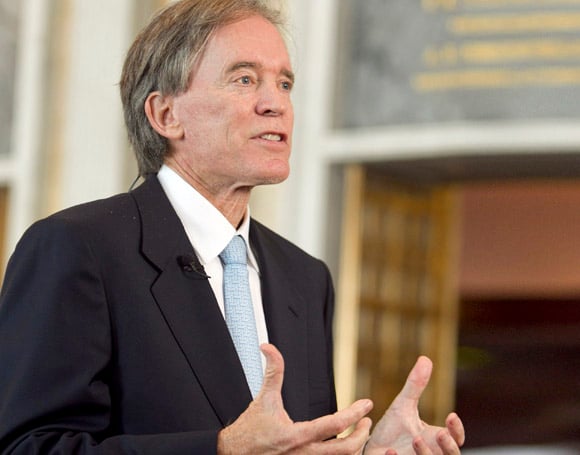
Bill Gross, head of the world's biggest mutual fund, put $17 million of his own wealth into closed-end bond funds in the past week as a debt selloff spurred investors to flee taxable fixed-income funds for the first time in two years.
Gross, who manages the $250 billion Pimco Total Return Fund, bought five closed-end corporate bond funds this week after purchasing five municipal bond funds a week earlier, according to filings with the U.S. Securities and Exchange Commission.
The purchases suggest Gross sees value in debt even after investors pulled money from taxable bond mutual funds for the first time since December 2008. A selloff in bonds has lifted the yield on 10-year Treasuries by more than a percentage point since Nov. 4, the day after the
Federal Reserve pledged to buy $600 billion in assets to try to revive the economy. U.S. investors poured $252 billion into taxable funds in the first 11 months of the year.
“The question is whether this is a bond market turning point,” Eric Jacobson, a Morningstar Inc. fund analyst in Chicago, said in a telephone interview.
Gross, who reduced his fund's holdings of government debt for four straight months, said in October that asset purchases by the Fed will probably signify the end of the 30-year rally in bonds. The yield on the 10-year note touched a seven-month high yesterday on evidence the economy is recovering, encouraging investors to unwind bets the securities will rise. Bond yields and prices move in the opposite direction.
Investors pulled $401 million from taxable bond funds in the week ended Dec. 8, the first net redemptions since the week ended Dec. 10, 2008, according to data released yesterday by the Investment Company Institute, a Washington-based trade group for the mutual funds industry.
$1.7 Billion Withdrawn
All bond mutual funds lost $1.7 billion to withdrawals in the week. Investors took out $2.7 billion from domestic stock funds, their 32nd straight week of redemptions, while stock funds that invest outside the U.S. attracted $1.3 billion, the ICI said.
Gross purchased shares of Pimco Income Strategy Fund, Pimco Income Strategy Fund II, Pimco High Income Fund, Pimco Corporate Income Fund and Pimco Corporate Opportunity Fund on Dec. 14, according to an SEC filing yesterday. On Dec. 13 and 14, he more than doubled his holdings in the funds to 2.37 million shares, filings show.
The week before, Gross also spent $4.4 million of his own money to purchase shares of five municipal-bond funds run by Pimco. Gross added to shares in Pimco California Municipal Income Fund, Pimco California Municipal Income Fund II, Pimco California Municipal Income Fund III, Pimco Municipal Income Fund and Pimco Municipal Income Fund III on Dec. 9 and Dec. 10, according to SEC filings.
That brings the fund manager's bond-binge tally this month to $21.4 million.
Mark Porterfield, a spokesman for Pacific Investment Management Co. in Newport Beach, California, which runs the Pimco funds, declined to comment.
8.9% Slump
Shares of Pimco Municipal Income Fund III have declined 8.9 percent in price since Nov. 4. The shares are trading at about an 18 percent premium to the value of its underlying assets, according to data compiled by Bloomberg.
Pimco Corporate Income Fund has dropped 7.5 percent since the Fed's quantitative easing plan was announced. The shares trade at less than a 1 percent discount to net asset value.
Gross, 66, has beaten 98 percent of his peers in the past five years overseeing Pimco Total Return. The fund lost 2.4 percent, including reinvested interest, in the month ended Dec. 14. It had its first withdrawals by investors in two years in November.
Pimco, a unit of Munich-based insurer Allianz SE, manages about $1.2 trillion in assets.
Inflation Expectations
Benchmark 10-year Treasuries have slumped since signs of an economic recovery and planned asset purchases by the Fed fueled expectations inflation will accelerate.
Investors began pulling out of municipal-bond funds in November amid concerns about renewed inflation and a flood of supply from issuers. Withdrawals from municipal-bond funds in the week ended Nov. 17 were $3 billion, according to Lipper FMI, the highest amount in almost 19 years.
High-yield managers including
Fidelity Investments' Mark Notkin in Boston and Margaret Patel at San Francisco-based
Wells Fargo & Co. said last month that they believe the bond fund rally is over and stocks represent a better buy.