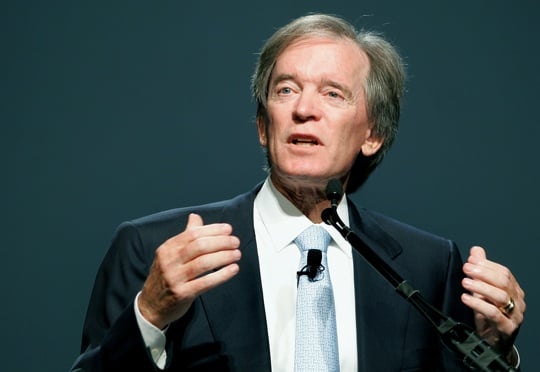
At the Morningstar conference, bond king and occasional buzzkill Bill Gross stayed on point, labeling the government's $100 trillion entitlement liability 'a staggering obituary.' He also defended his bearish views on Treasuries, despite the recent rally in the instruments.
The United State's current level of unfunded entitlement liabilities of around $100 trillion is like a “staggering obituary,” said Bill Gross, founder and co-chief investment officer of Pacific Investment Management Co., during his keynote speech Wednesday at Morningstar Inc.'s investment conference. “It is only a question of when, unless something is done” to bring that number down, he said.
He said inflation is the most likely immediate consequence of two rounds of Federal Reserve “quantitative easing,” or buying up Treasuries at a rate of $100 billion a month, a program which is scheduled to end at the end of June. Mr. Gross has said it is an open question of who will buy U.S. Treasuries at their current low yields. He also noted that the current real interest rate on 5-year TIP bonds is now about –0.5%
"What happens at the end of QE 2?" asked Mr. Gross, who runs the world's largest bond fund. "I think there are too many dissenters on the Fed" and it will be difficult to initiate another round of quantitative easing, and the central bank will instead keep yields low on Treasuries. He expects the Fed to suggest that real interest rates will be subdued for several years, thus making Treasury yields more attractive to investors.
A subdued Mr. Gross joked that it was a good thing his podium was fairly far removed from the audience, or “fresh tomatoes and shoes” might be coming his way, given his bearish view on U.S. Treasuries in the face of a recent rally.
In recent months, Mr. Gross has been sharply critical of what he says are artificially low yields on U.S Treasury bonds. He said U.S monetary policy currently is to keep interest rates low while allowing rising inflation to reduce the value of money and effectively reduce the U.S.'s own massive debt burden. Investors in U.S. Treasuries effectively get their pockets picked for the benefit of borrowers as the returns on the bonds fall below the rate of inflation.
Pimco sold off its U.S. Treasuries earlier this year. In fact, Mr. Gross has been betting against government debt.
Meanwhile, Mr. Gross has recommended that investors buy what he calls “cheap bonds,” favoring floating rate to fixed rate notes and investing in more non-dollar emerging market currencies. Conservative stocks such as Procter & Gamble Co. and Merck Co. are another alternative to treasuries, he said in a Bloomberg interview last week.
In his introduction, Morningstar CEO Joe Mansueto called Mr. Gross one of a small handful of investment experts, who, along with Warren Buffett of Berkshire Hathaway Inc. and Vanguard Group found John Bogle, command the most respect from advisers and their peers.