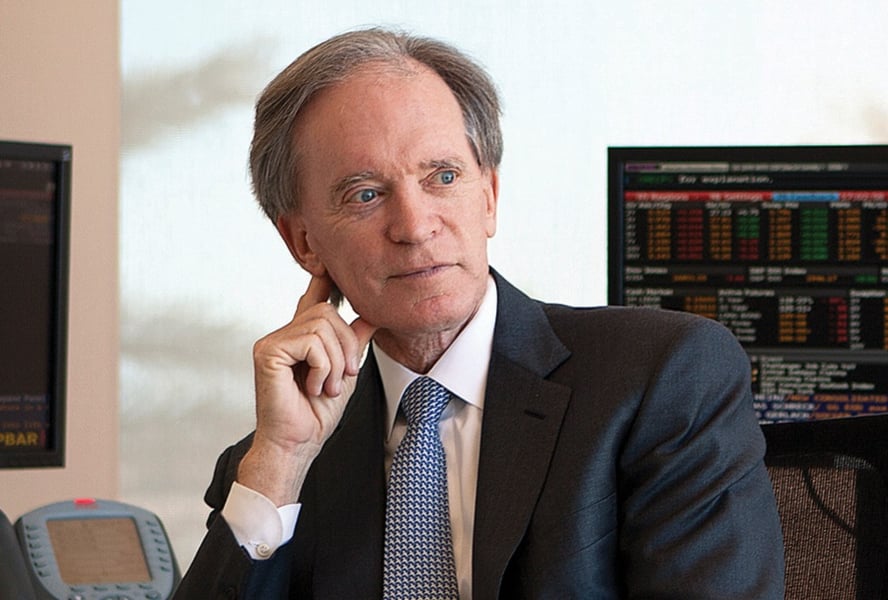
Count Bill Gross among the world's biggest philanthropists.
The bond investor has already given away as much as $700 million and eventually will donate his remaining $2 billion fortune, a figure that's “staggering, even to me,” he said in an interview on Bloomberg Television.
“I define success differently now than five or 10 years ago,” Mr. Gross said in the interview recorded April 29 at his office in Newport Beach, Calif. “Success in the early years was business-related, and asset growth-related, and of course, with family was related to how well your son or daughter was doing on the soccer field.” Today, “success becomes a function of what we can do with the rest of the world, to help others,” he said.
Mr. Gross, 71, amassed his wealth as co-founder of Pacific Investment Management Co. and built his reputation as the “Bond King” by generating years of industry-leading returns as manager of the Pimco Total Return Fund. In 2013, when the firm's assets approached $2 trillion, Pimco paid him a bonus of $290 million.
The same year,
hedge fund manager
Carl Icahn, in a taunt on Twitter, challenged Gross to join other billionaires in leaving the bulk of his wealth to charity. Two days later, Gross said he and his wife, Sue, would give it all away.
Until now, Mr. Gross hadn't discussed his total giving to date.
“Sue and I try and keep it quiet,” he said. “We're not the type to attend functions and parties and galas. We like to work underneath, so to speak.”
STAMP GALLERY
While Mr. Gross may donate with less fanfare than other billionaires, he's hardly anonymous. There's a William H. Gross Stamp Gallery at the National Postal Museum in Washington; a Sue & Bill Gross Stem Cell Research Center at the University of California, Irvine; and a Sue and Bill Gross Skywalk at the Cedars-Sinai Medical Center's Advanced Health Sciences Pavilion in Los Angeles.
The couple, who live in Laguna Beach, Calif., do most of their giving out of a family foundation that mainly supports health care, medical research and education. They've also made personal gifts to needy American families. More recently, Mr. Gross said he's taken an interest in GiveDirectly, an organization that makes targeted donations via mobile payments to the extremely poor in Africa.
“Most Africans have cell phones, which is hard to believe,” Mr. Gross said in the interview. “So if you can do that and contribute $25 or $50 to someone in Uganda that of course you haven't met, that's almost as good as outperforming the market.”
LESS RESTFUL
In 2005, Bill and Sue Gross gave $23.5 million to Duke University, his alma mater. Other major gifts include $20 million to Hoag Memorial Hospital Presbyterian in Newport Beach, also in 2005; $10 million to the University of California, Irvine, in 2006; $20 million in 2012 to Cedars-Sinai in Los Angeles; $20 million in 2013 to the medical charity Mercy Ships to fund the construction of a floating hospital; and $10 million to Mission Hospital in Laguna Beach in 2014.
These days,
Mr. Gross isn't accumulating wealth like he once did; he now runs a $1.5 billion fund for Janus
Capital Group Inc., tiny compared with the $293 billion flagship he once oversaw at Pimco.
Some of the couple's fortune is invested in that vehicle, the Janus Global Unconstrained Bond Fund. Mr. Gross detailed some of his other investments, personally and on behalf of the foundation. They include closed-end municipal bond funds and stocks such as Procter & Gamble Co. and Johnson & Johnson.
Mr. Gross said he and Sue don't expect to live long enough to give away everything and so his three children will have to finish the job.
Reflecting on mortality in his most recent monthly investment outlook for Janus, Mr. Gross wrote: “The responsibility' for a life's work grows heavier as we age and the 'unrest' less restful by the year.”