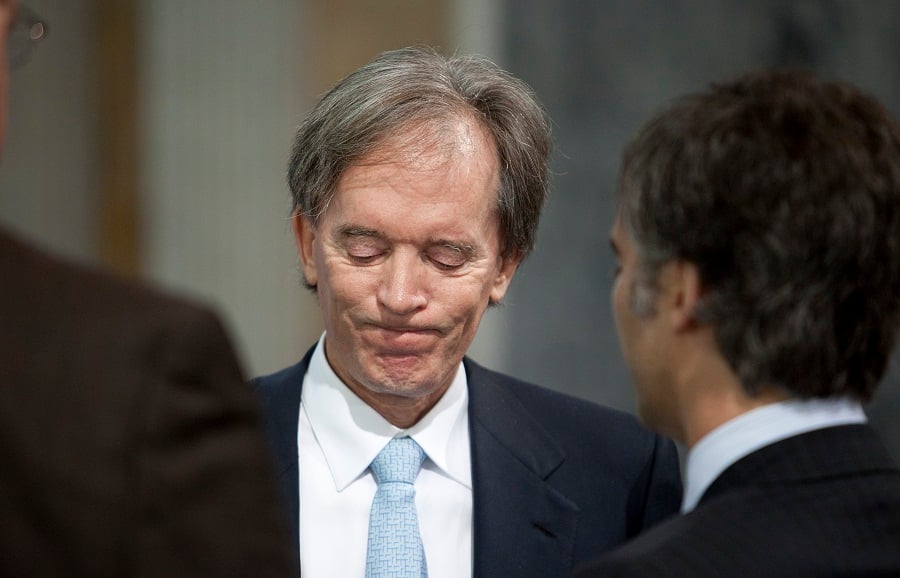
Bill Gross said he was fired from Pacific Investment Management Co., the first time he's publicly confirmed that he was dismissed from the firm he co-founded in 1971.
In an interview with Bloomberg View's Barry Ritholtz, Mr. Gross said he offered to step down from the executive committee and compensation committee and oversee closed-end funds after differences with management over his personality and the firm's business direction.
“For some reason still unbeknownst to me, they didn't think that was a good idea and they did fire me,” Mr. Gross, who managed the world's largest bond fund until
his unexpected departure on Sept. 26 when he joined Janus Capital Group Inc., said in the interview. “In the last few weeks, it blindsided me; I had no idea that an executive committee could fire a founder and the titular leader of the company.”
Mr. Gross stunned the investing world with his surprise exit from Pimco after deputies including now-group Chief Investment Officer Daniel Ivascyn said they would quit, according to people familiar with the matter. Mr. Gross was increasingly diverging from Pimco on strategy, and had spent much of the past year hunting down two money managers he suspected of leaking information to the press, Bloomberg News
reported in December, in an article based on interviews with 25 current and former Pimco employees.
(More: Gross' last defiance stuns Pimco, Allianz)
Mark Porterfield, a spokesman for Newport Beach, Calif.-based Pimco, didn't return e-mails or a telephone message seeking comment on Mr. Gross's remarks.
TOUGH LEADER
“If you don't have a leader looking out for mistakes and berating those that make significant mistakes, then what have you? You've got a loose company that ultimately is not doing a service to its clients,” Mr. Gross said in the interview.
“A leader has to be tough,” he said. “If you sit around a table and you congenially look for a consensus-type of outcome, you're in trouble. You can't manage money that way. At some point somebody has to step in and say, 'We are going in this direction,' and I viewed that as my job and I think I did it well.”
On at least three occasions in the past 13 months, Mr. Gross offered to rescind some responsibilities and take on a smaller role. In August, he proposed stepping back if senior leaders agreed to his demand that two money managers, “Mr. X” and “Mr. Y,” be fired for talking to the media.
By September, Pimco executives were considering his ouster. Rather than suffer the humiliation of being fired, Mr. Gross pre-empted them with the announcement that he was joining Janus.
BETTER FLEXIBILITY
Mr. Gross had managed the Pimco Total Return Fund, the world's biggest bond fund, until the day he left. That fund had more than doubled in size from 2008 to its peak of $293 billion in April 2013.
The fund stumbled when the
Federal Reserve hinted it would unwind stimulus measures, sparking client redemptions. By October, it had ceded the title of biggest mutual fund to an offering from Vanguard Group Inc. The Pimco fund was reduced in size to $143.4 billion as of Dec. 31.
Because of its size, the fund's trades were always large, which attracted attention, so “the street would always know what Pimco was doing,” Mr. Gross said in the interview.
PAID PRICE
“Any trade we did obviously had to be an enormous size relative to the rest of the market and we affected the markets,” he said. “We paid a price for that, in terms of in and out, and ultimately in terms of the street being well-informed and in some cases working against us.”
The relatively small size of Mr. Gross's new vehicle at Janus, which has $1.4 billion in assets, allows more flexibility than the bigger funds at Pimco, he said last month in a Bloomberg Surveillance interview.
Mr. Gross said he visited a neighbor, a retired U.S. Air Force general, after his exit from Pimco. As he was leaving, the retired general said Mr. Gross should have visited six months earlier because he could have taught him the first rule of the military.
“I said, 'What's that?' and he said: 'Watch your back,'” Mr. Gross said.