
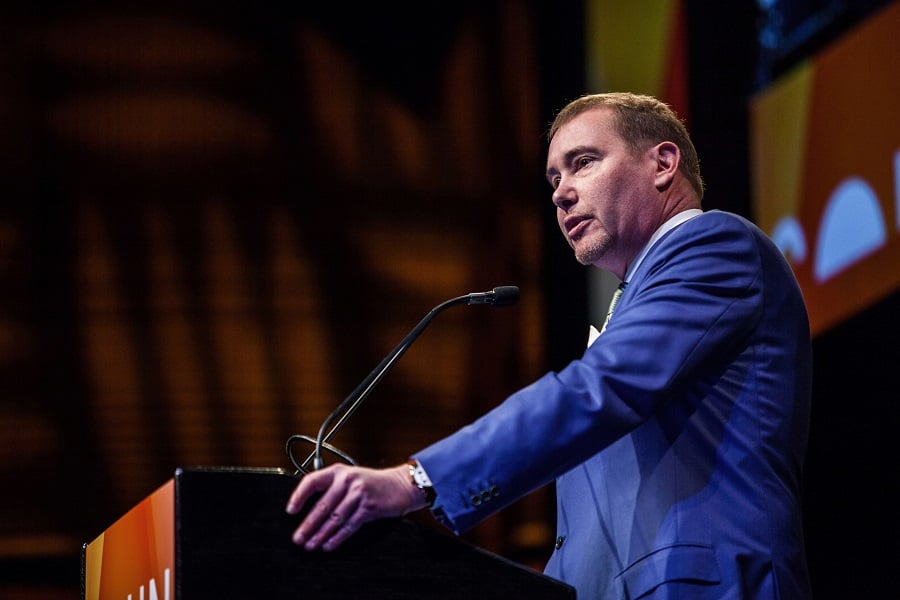
Jeffrey Gundlach said he thinks Donald Trump will win reelection because polls showing otherwise don’t reflect the true support for the president.
“Will Joe Biden beat Donald Trump in November? I don’t think so,” Gundlach, chief investment officer for DoubleLine Capital, said during a webcast Tuesday for his company’s closed-end funds. “I’d bet against that. I think the polls are very, very squishy because of the highly toxic political environment in which we live.”
On Biden’s choice of Sen. Kamala Harris as his running mate, Gundlach said she is “a little too charismatic.”
“I don’t think it’s a good pick,” he said. “She might be a little bit dominant with her personality.”
Gundlach said that much can happen between now and Election Day. “I think there’s a lot of time here, there’s going to be a lot of twists and turns.”
Gundlach, who predicted Trump’s win in 2016, has criticized Biden’s electoral chances -- and those of other Democratic candidates. In January, he said he didn’t think Biden would win the Democratic nomination and in March he called him “unelectable.”
Other highlights from the presentation:
[More: Rising rates may lead to Fed yield-curve control, Gundlach says]

CFP, CFA and CPA holders could gain accredited investor status as regulators weigh wider private market access for advisory clients

DeepVest, Vanilla and Libretto roll out tools to help financial advisors launch firms, close estate plans and sharpen planning skills

“People aren't effectively using their wealth in retirement,” said David Blanchett of Prudential.

Second-generation NFL ref Shawn Hochuli co-founded IWM Partners in Irvine, California, a wealth management practice with more than $500M in client assets
U.S. seniors lose $28.3 billion annually as a result of financial exploitation, according to a 2023 AARP study.
As AI makes financial information more accessible than ever, Lana Hock explains why human judgment, trust, and empathy remain the qualities clients value most in a financial advisor
Northern Trust’s Ken Lassner shows advisors how to convert volatility into after-tax portfolio gains

