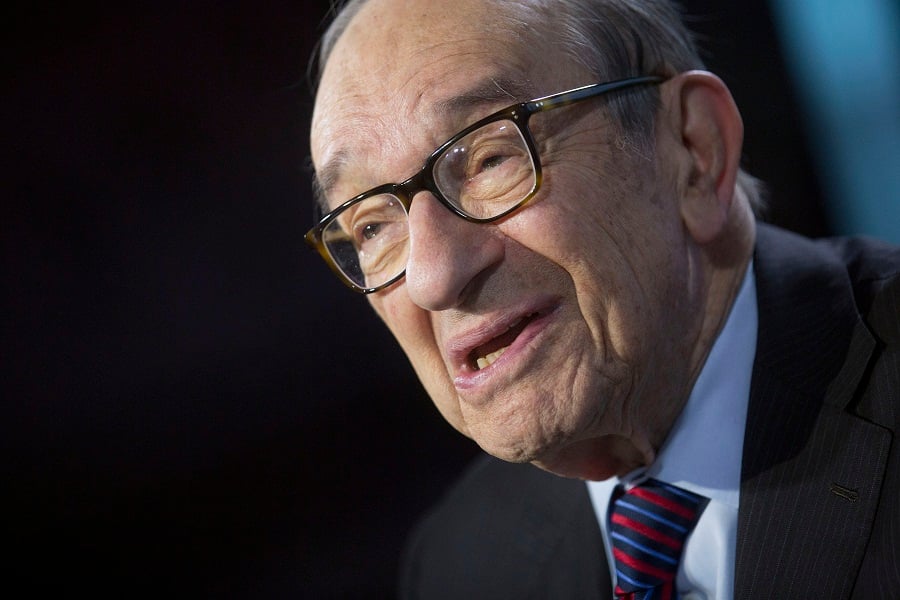
Alan Greenspan is worried bond prices have risen too high.
“We get very nervous when the stock price index goes to high p/e, we ought to be somewhat nervous when the bond rate does the same,” the former
Federal Reserve chairman said in an interview Thursday with Bloomberg Television.
Some bond-market metrics shows prices are getting frothy, after yields on 10-year Treasuries sank to a record 1.32% this month.
The maturity now yields less than stocks pay in dividends. And a measure known as the term premium, which has historically been positive, fell to an unprecedented minus 0.75 percentage point this month for 10-year Treasuries. The metric, which the
Federal Reserve uses in guiding policy, reflects the extra compensation investors demand to hold longer-maturity debt instead of successive short-term securities.
Treasuries have rallied in 2016 as the Fed held off on raising interest rates after liftoff from near zero in December, while central banks in Japan and Europe maintained unprecedented stimulus. Policy makers on Wednesday left the federal funds rate at 0.25% to 0.5% while saying near-term risks to the economic outlook were dissipating, keeping the option to raise rates in September open.
Benchmark U.S. 10-year note yields rose one basis point, or 0.01 percentage point, to 1.51% as of about noon in New York, according to Bloomberg Bond Trader data.
Corporate supply, including offerings from Apple Inc., also weakened investors' appetite for Treasuries.
"We had a big rally after the Fed, even though the Fed sounded hawkish," said Aaron Kohli, a fixed-income strategist in New York at
BMO Capital Markets, one of the 23 primary dealers that trade with Fed. "More importantly, there's expectations of corporate supply today, which is keeping pressure on yields."
This year's rallying market is reminiscent of the bond-market conundrum that Mr. Greenspan identified in 2004, when long-term Treasury yields kept falling even as he raised borrowing costs, hampering the chairman's attempts to tighten credit.
Treasuries also declined as investors prepared for the final leg of the week's $103 billion of coupon-bearing government-debt auctions. The U.S. is selling $28 billion of seven-year notes Thursday, after previous offerings this week drew weak demand.
Mr. Greenspan also said the U.S. may be heading toward
stagflation &mdashl a slow-growth economy coupled with high inflation. That condition isn't compatible with long-term interest rates of 1% to 2%. There's a significant amount of uncertainty and “general sluggishness" in the economy, which is tied to low productivity, he said.
“What I'm concerned about mostly is
stagflation, meaning I think we're seeing the very early signs of inflation beginning finally to pick up as the issue of deflation fades,” Greenspan, 90, said. “We're just in a stagnation state.”