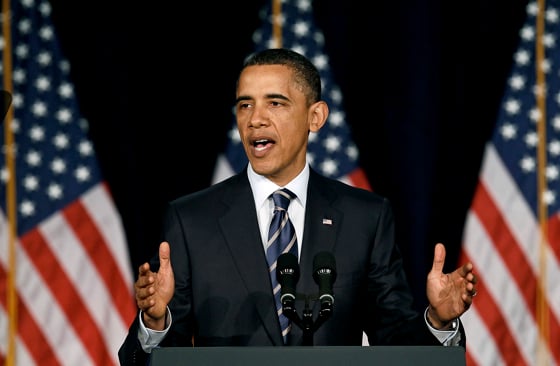
President lambasts Republican resistance to raising rates on the wealthy
Since presenting their budget demands, Republicans have been bold and tough -- sometimes by their own description -- while President Barack Obama has been missing in action and, when present, prone to being bullied.
Whupped like a puppy to avoid a government shutdown last week, Obama proved there's such a thing as being too good a sport. He hailed the agreement to cut $38 billion from the current federal budget as if he'd actually been for “the biggest annual spending cut in history” that brought “Americans of different beliefs” together.
Leave it to the compromiser-in-chief to find a non-existent pony in the manure (to borrow from that incurable optimist, Ronald Reagan) while encouraging the bullies to bully again. Since the 2010 midterm elections, Obama has been at such pains to be seen navigating the ship of state calmly through choppy political waters, giving in on taxes during the lame-duck session to prove it, that he has let the national conversation on budget and taxes proceed on Republican terms -- that is, to ignore revenue and attack spending.
Yesterday, at long last, Obama called a spade a spade. He got to the black heart of the Republican budget plan going forward: They propose to afflict the afflicted, and comfort the comfortable, with a combination of draconian spending cuts that disproportionately hurt the middle and working classes and tax cuts that disproportionately benefit the wealthy, who are taxed at some of the lowest levels since the Great Depression.
Cuts for Billionaires
It's a version of killing the patient to save the patient, raising the deficit to lower it. Of the Republican plan authored by House Budget Committee Chairman Paul Ryan of Wisconsin, Obama said: “There's nothing serious about a plan that claims to reduce the deficit by spending a trillion dollars on tax cuts for millionaires and billionaires. And I don't think there's anything courageous about asking for sacrifice from those who can least afford it and don't have any clout on Capitol Hill.”
The cutters in Congress were negative in their “pre-buttals” and cynical in their remarks after. “I thought to myself, ‘And I missed lunch for this?” quipped Representative Jeb Hensarling of Texas, chairman of the House Republican Conference. His colleagues repeated the word “disappointed,” as if Republicans are the parents taking away Obama's bike for his own good.
Tomorrow they'll cry “class warfare,” as if they aren't the ones waging it. Speaker John Boehner said raising taxes on top earners is a “non-starter.” To the financial institutions that got us into this mess and remain too big to fail, we can now add the wealthy, who are evidently too big to tax.
Specific Enough
They were also critical of a lack of specificity, when, in fact, the president laid out where he would cut, where he would tax, and where he would save money.
To reduce the deficit by $4 trillion over 12 years, he would slice non-security discretionary spending to levels that would save $770 billion by 2023, pare mandatory spending with the goal of saving $360 billion, simplify the tax code by ending breaks that don't go to the great majority of non-itemizing taxpayers, and mandate that Congress pass across-the-board spending reductions if the nation's debt isn't declining as a share of the economy by the second half of the decade.
And he laid out what he would preserve, particularly Medicare.
Medicare was created in 1965 because so many seniors -- a cohort beset by pre-existing conditions -- couldn't find coverage from an industry largely throwing scams at them. Medicare fixed that. In the Republican budget, there's no mending Medicare. There's only ending Medicare, with a voucher program that would send seniors back out into a merciless marketplace that Boehner and Ryan somehow see as benign.
Misplaced Respect
For all the talk of what a profligate country we are, Republicans are playing to our lingering Puritan streak, the misplaced respect for the Donald Trumps in our society who already have the world's breaks tilted in their favor, and the way we fall for focus-grouped phrases such as “adult,” “serious,” and “for our children's sake.”
The president can hardly get the debate back in his court in one speech. The U.S. is splintered into a hundred intellectual and emotional pieces, many with their own facts. Perhaps the biggest point of contention in the threatened shutdown was Planned Parenthood, among the lowest-cost care providers for women. Senator Jon Kyl, Republican of Arizona, claimed that more than 90 percent of Planned Parenthood's work is abortions. It's only 3 percent. His staff said his comment was “not intended to be a factual statement.”
Leave the bubble of Washington and New York and enter a world of foreclosed houses, shuttered stores and 50-year-old former middle managers flipping hamburgers and feeling lucky to do so. The gap between Wall Street enjoying shocking profits and the janitor living in a trailer park has never been greater, each increasingly represented by its own party. It's going to take many more speeches for the president to bridge that divide.
(Margaret Carlson, author of “Anyone Can Grow Up: How George Bush and I Made It to the White House” and former White House correspondent for Time magazine, is a Bloomberg News columnist. The opinions expressed are her own.)