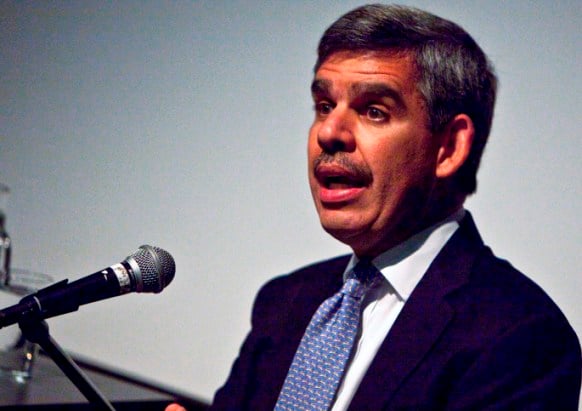
Advanced economies risk a “lost decade” unless policy makers recognize the severity of the wounds left by the financial crisis, said Mohamed El-Erian, chief executive officer of Pacific Investment Management Co.
El-Erian, who popularized the phrase “new normal” to describe how growth will be depressed by consumer retrenchment and financial regulation, said governments and central banks haven't detected the “ongoing paradigm shift” in their economies that will require remedies beyond stimulus programs. Among the fault lines he spots are strained balanced sheets, persistently high unemployment and a misunderstanding of financial markets.
“Having won the war, industrial-country societies are in the process of losing the peace,” El-Erian said in a speech yesterday in Washington during the annual meetings of the International Monetary Fund and World Bank. “If they are not careful, they risk slipping into a lost decade of low growth, high unemployment and welfare destruction.”
Such threats were exposed last week as the U.S. reported its economy lost more jobs than forecast in September and the IMF cut its 2011 economic growth forecast for advanced nations to 2.7 percent from 2.9 percent. To reverse the weaknesses, officials must increasingly look beyond the immediate economic cycle to solve “structural” flaws in their economies, said El- Erian, 52, who helps manage more than $1.1 trillion of assets at Newport Beach, California-based Pimco.
Advanced economies and investors “find themselves in a rather unsettling situation where expectations involve an unusually broad range of potential outcomes and equally unusually high risks,” he said.
He pointed to the Greek-led debt crisis in Europe as an example of the balance-sheet challenges facing advanced economies.
“It is far from assured that some of these countries will be able to grow their way out of their problems,” he said. “In the process, they will discover the disruptive nature of debt overhangs.'
While the European Central Bank is providing liquidity and governments have joined with the IMF to give budgetary aid, new investors are not entering the economies, with Greece and Ireland continuing to face “dangerous” risk spreads in financial markets, El-Erian said.
Investors still demand a yield premium of 754 basis points to lend to Greece rather than Germany for 10 years, the most of any euro nation. That's down from a euro-era record of 973 basis points on May 7. The Irish spread is 422 basis points, just below last month's record.
Without investment, growth and hiring, some economies will find it hard to limit the decline in gross domestic product and subsequent rise in unemployment, while “concerns will mount about the contamination of the ECB's balance sheet,” he said.
“The risk of contagion will grow and the revolving nature of IMF resources will be exposed to considerable risk,” El- Erian said.
Policy makers must also tackle structural changes in their economies, he said, noting how despite their stimulus efforts companies have resisted hiring and investment. American firms added 64,000 jobs last month, less than forecast, and the jobless rate held at 9.6 percent, the Labor Department said Oct. 8.
“Persistently high unemployment is becoming more structural in nature, thereby eroding the skills of the labor force and putting pressure on inadequate social safety nets and already-strained government budgets,” El-Erian said. “Rather than question the limited effectiveness of the cyclical approaches, the response by too many has been just to advocate doing more of the same.”
A third challenge is that policy makers have “too little understanding” of financial services, El-Erian said. They failed to realize how their rescue of banks would spur a recovery in financial markets that outpaces that of households and businesses and that banks will remain reluctant to finance expansion. U.S. stocks advanced last week, sending the Dow Jones Industrial Average above 11,000 for the first time since before the May 6 crash.
“It highlighted once again an outcome that is unacceptable in democratic society: the privatization of massive gains and the socialization of enormous losses,” he said. Markets are reflecting the expectation the
Federal Reserve will ease monetary policy further and the test will be whether further quantitative easing pays off with stronger economies, he said.
The longer policy makers fail to address “secular” changes to their economies, “the greater the difficulties that industrial countries will experience in reducing joblessness, sustaining high growth, strengthening safety nets and overcoming sovereign risk concerns,” El-Erian said.
He called on the IMF to do more to encourage global policy coordination that has been weakening since the Group of 20 nations united to fight the
recession. Recent meetings of international policy makers, including the IMF talks in Washington, have been marred by splits over currencies and budget policies, he said.
“A once-promising global response has now been replaced by inadequately coordinated national economic policies and growing frictions among countries,” he said. “The IMF is still not where we need it to be to fill the growing vacuum at the center of the international system.”