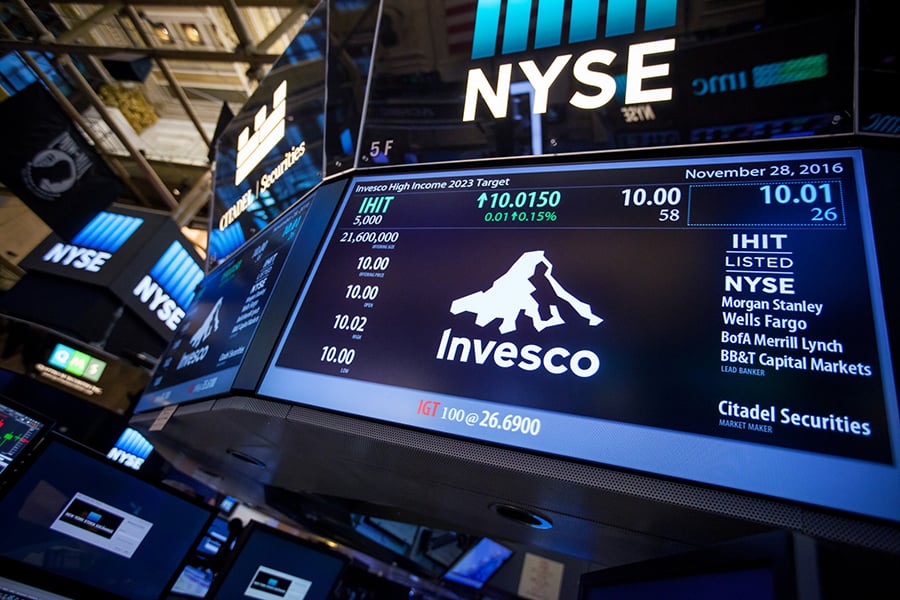
Invesco Ltd. is betting $5.7 billion that active management has a bright future. It agreed to pay about that amount in a deal with Massachusetts Mutual Life Insurance Co. to acquire its OppenheimerFunds, which specializes in picking stocks and bonds, particularly in the international arena.
At a time when many investors are deserting active funds for products that track indexes,
Invesco Chief Executive Officer Martin Flanagan is convinced that active funds will continue to play a critical role in the portfolios of retail and institutional customers.
"Investors are looking for a broad range of ways to have us meet their outcomes — it is high-conviction active management, it is passive and it is alternatives," Mr. Flanagan said in a telephone interview.
Roger Crandall, CEO of
MassMutual, agreed. "We're convinced the entire world doesn't go to one giant, cap-weighted index."
Invesco shares were up 3.8% to $21.74 as of 10:51 a.m. in New York.
Industry Consolidation
The transaction is the latest
consolidation in the asset management industry, which is experiencing intense pressure on revenues as investors flock to low-fee, passive index and exchange-traded funds. Several firms in the past year have sought acquisitions or mergers for scale to survive and grow, with mixed results.
(More: Stocks are doing OK. Asset managers' stocks? Not so much)
The deal would increase Atlanta-based Invesco's assets under management to more than $1.2 trillion as OppenheimerFunds manages more than $246 billion in assets.
Analyst Glenn Schorr of
Evercore ISI said Thursday in a note titled "A Bigger Melting Ice Cube," that the market will likely struggle "with why they should be excited about getting bigger in a product that is in secular decline," even as investors may appreciate the financial accretion and understand the benefits of scale and diversification.
Invesco, the fourth-largest manager of ETFs, will pay $4 billion in preferred shares and 81.9 million of common stock to add the primarily active manager to its offerings. The common stock is valued at about $1.7 billion, based on Invesco's closing stock price Wednesday. The preferred shares will pay a fixed rate of 5.9%.
The transaction is expected to close in the second quarter of 2019. MassMutual will become a significant shareholder in Invesco with about a 15.5% stake.
International Funds
Oppenheimer is best-known for its large stock funds that invest globally and in the emerging markets. Its biggest fund is the $36 billion Oppenheimer Developing Markets Fund, which buys emerging market equities. International funds typically charge higher fees than their domestic counterparts. They have also proven more resistant to the lure of passive investing.
Recent efforts by asset managers to grow through mergers haven't immediately borne fruit. Investors in Janus Henderson Group have lost about 17% through Wednesday since the May 2017 merger of Janus
Capital Group and Henderson Group. Standard Life Aberdeen has fallen more than 31% since Standard Life acquired Aberdeen Asset Management in August 2017.
Invesco has also been active in growing through acquisitions before Thursday's announcement. In April, it closed a
$1.2 billion acquisition of ETFs from
Guggenheim Partners. Mr. Flanagan said his track record of buying and integrating other asset managers will help the company succeed.
"Writing the check is not enough," he said. "What is really important is to execute a combination."
Mr. Flanagan said he expected the combination to yield about $475 million in cost savings over two years.
MassMutual's Mr. Crandall has been reshaping the company's asset management operations. In 2016, he combined some units under the Barings brand led by Tom Finke. Barings, which oversaw more than $306 billion as of June 30, has strategies in sectors including private credit, fixed income, equities and real estate.
(More: Invesco joins the do-it-yourself indexing trend)