

JPMorgan Chase & Co.’s dealmakers posted their best quarter yet, riding what’s on track to be a record year for mergers and acquisitions.
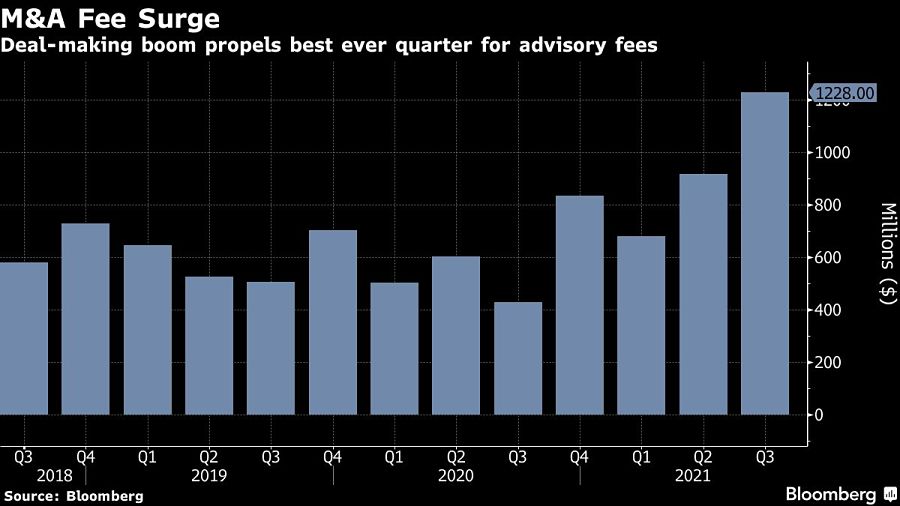
Fees from advising on deals almost tripled in the third quarter, crushing analysts’ estimates and helping to push the firm’s net income to $11.7 billion.
“JPMorgan Chase delivered strong results as the economy continues to show good growth — despite the dampening effect of the delta variant and supply-chain disruptions,” Chief Executive Jamie Dimon said in a statement Wednesday. Investment-banking fees jumped 52%, driven by a “surge in M&A activity and our strong performance in IPOs.”
The report provides a look into how the U.S. economy fared in the Covid-19 pandemic as the delta variant spread across the country, undercutting a return to normalcy. JPMorgan’s results also hint at what’s to come when the rest of Wall Street reports third-quarter results this week.
Loan growth has been a particular focus for bank investors frustrated by a lack of progress in the business. Wall Street executives have begun pointing to early indications that small businesses and individual consumers are taking on debt again after government stimulus checks depressed demand during the Covid-19 crisis.
JPMorgan’s total loans increased 6% from a year earlier, driven by gains in the firm’s asset and wealth management arm and corporate and investment bank. Consumer and commercial loan growth remained elusive, with period-end consumer loans down 2% and commercial loans down 5%.
Shares of JPMorgan, which gained 30% this year through Tuesday, rose 0.3% to $165.80 in early New York trading.
The bank reported $3.3 billion in investment-banking fees, topping analysts’ estimates for $2.8 billion. Debt underwriting revenue rose to $1.04 billion and equity underwriting climbed to $1.03 billion.
Results were also padded by a $2.1 billion reserve release, a benefit Dimon has downplayed as the biggest U.S. bank released large portions of what it set aside at the onset of the pandemic for potential soured loans.
The bank’s traders generated $6.27 billion of revenue in the quarter, down from a year earlier but above the $5.9 billion analysts expected.
[More: JPMorgan chases active ETFs with $10 billion mutual fund switch]

“We needed to become a more agile and efficient organization,” said American Express CEO Stephen Squeri.

Examiners will scrutinize fee conflicts, complex products and super intelligence threats as broker-dealers face fresh Reg BI and AML reviews

New launches tackle succession planning, AI-driven email management and heir retention ahead of the great wealth transfer

For sellers weighing PE deals, due diligence shouldn't end with the offer on the table – the acquiring platform and the M&A advisor deserve a hard look as well.

South Carolina estate planning firm joins Osaic’s IBD network, citing succession planning tools and multigenerational growth resources.
Knighthead Life entered the market with a competitive MYGA. A strong launch earned advisor confidence and paved the way for FIAs.
As AI makes financial information more accessible than ever, Lana Hock explains why human judgment, trust, and empathy remain the qualities clients value most in a financial advisor

