
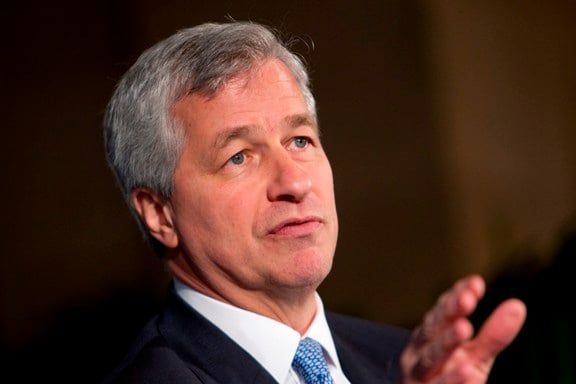
JPMorgan CEO Jamie Dimon has joined a growing group of Wall Street executives expressing concern over the current rapid-fire pace of tariff threats.
Dimon, who previously downplayed concerns over tariffs, is now warning that uncertainty surrounding trade policy could have real consequences for businesses.
“I don’t think the average American consumer who wakes up in the morning and goes to work… changes what they’re going to do because they read about tariffs,” he said in an interview with Semafor. “But I do think companies might."
While Dimon's comments did not mention President Donald Trump by name, they do highlight growing angst around the commander-in-chief's approach to trade policy. Since February, Trump has unleashed a flurry of often contradictory tariff orders at multiple trading partners including China, Mexico, and Canada.
Most recently on Thursday, he threatened to impose a 200 percent tariff on alcoholic beverages from Europe in retaliation for a 50 percent tariff imposed on American spirits.
"Uncertainty is not a good thing,” Dimon said.
His comments mark a shift from his stance earlier this year when he told business leaders at the World Economic Forum in Davos to “get over it” regarding tariffs. At the time, he argued that tariffs could serve as either “an economic tool” or “an economic weapon,” depending on how they were implemented.
Since then, market volatility has intensified. The S&P 500 has gone down more than 7 percent over the past month, though broader markets rebounded on Wednesday. Economic concerns are also mounting, with some executives pointing to tariffs as a factor contributing to a slowdown in business activity.
Larry Fink, CEO of BlackRock, said he is seeing signs of economic weakness linked to trade tensions. “The collective impact in the short run is that people are pausing, they’re pulling back,” Fink told CNN. “Talking to CEOs throughout the economy, I hear that the economy is weakening as we speak.”
Still, Fink suggested that in the long term, the administration’s trade policies could lead to lower tariffs.
“Right now the president is focusing on tariffs, but when he talks about reciprocal tariffs, actually, that may bring down tariffs over the long run,” he said.
Goldman Sachs CEO David Solomon also weighed in, saying policy uncertainty is making businesses hesitant to engage in mergers and capital investments.
“The level of uncertainty is a little bit higher, and that has kept some things on the sidelines,” Solomon said in an interview with Fox Business Wednesday. “The more we can have certainty on the policy agenda as we move forward, the better that’s going to support capital investment and growth.”
Solomon was among the audience of top executives President Donald Trump met with at the Business Roundtable in Washington on Tuesday, where he warned of the potential for more tariffs at possibly higher rates.
"I think the business community understands what the president is trying to do with… tariffs," Solomon said. "The business community is always going to want lower tariffs everywhere… in the world."

What will financial advice look like 20 years from now? Evan Vladem explores how AI may transform wealth management while reinforcing the enduring value of human guidance, trust, and empathy.

The Boston deal is set to push the PE-backed consolidator past $187 billion amid a broad RIA M&A slowdown and a potential shift in its ownership.

Advisors with clients who own second homes in New York City face fresh uncertainty as the city seeks a stay and plans an appeal.

Meanwhile, a deal in the Midwest gives NorthRock Partners a new office in Wisconsin, while two teams join OnePoint BFG in Georgia and Atlanta.
These challenges are “changing the economics we see retirement savers face,” said Christopher Ceder of Goldman Sachs Asset Management
As AI makes financial information more accessible than ever, Lana Hock explains why human judgment, trust, and empathy remain the qualities clients value most in a financial advisor
Northern Trust’s Ken Lassner shows advisors how to convert volatility into after-tax portfolio gains

