The spread of political turmoil to Libya will add “stagflationary winds” to the global economy, according to Mohamed El-Erian, chief executive officer at Pacific Investment Management Co.
The spread of political turmoil to Libya will add “stagflationary winds” to the global economy, according to Mohamed El-Erian, chief executive officer at Pacific Investment Management Co.
Protests in Libya, holder of Africa’s largest oil reserves, poses more “systemic” risk to the global economy as opposed to the upheaval in Egypt and Tunisia, El-Erian said in a Bloomberg Television interview with Tom Keene on the “Surveillance Midday” program. Western nations will face accelerating inflation and smaller demand in the Mideast and North Africa for their exports, on top of the “new normal” of slower growth and lingering higher unemployment, according to El-Erian.
There will be “higher inflation and lower growth because of higher oil prices, which take away purchasing power and transfers wealth somewhere else,” El-Erian said. There will be “higher geopolitical risk, which tends to diminish animal spirits and therefore impacts investments. From an economic perspective, it’s important for the West to understand that these are stagflationary winds.”
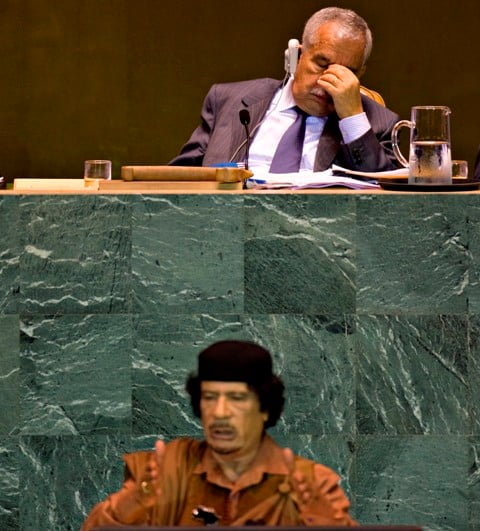
Oil surged to a two-year high as Libyan leader Muammar Qaddafi vowed to fight a growing rebellion until his “last drop of blood.” Speaking in Tripoli, the capital, he also pledged to deploy the army and police tomorrow to impose order and called on supporters to reclaim the streets. Continued protests “will lead to civil war,” Qaddafi said,
Qaddafi’s crackdown on a weeklong uprising has already left more than 200 dead, according to Human Rights Watch.
Crude Oil Gains
Crude oil for March delivery gained $7.37, or 8.6 percent, to $93.57 a barrel on the New York Mercantile Exchange. Prices touched $94.49 a barrel, the highest level since Oct. 3, 2008. Futures have risen 15 percent in the past year.
Libya is the latest nation to be rocked by protests ignited by last month’s ouster of Tunisia’s president and fanned by the Feb. 11 fall of Egyptian President Hosni Mubarak. While violent unrest has also spread to Bahrain, Iran and Yemen, none of those regimes has used as much force to quell protesters as Libya.
The unrest in the Middle East and North Africa will be “stagflationary” for the global economy in the short term because it will increase oil and commodity prices and shrinks the markets in which anti-government demonstrations have taken place, El-Erian said in commentary in the Financial Times today.
“Over time, however, such market apprehension is likely to give way as the impact of greater long-term stability in a key part of the world is felt,” he wrote. “In the long term, after all, democracy and individual freedoms are the best drivers of prosperity.”
Dollar ‘Warning’
The U.S. dollar, which typically rises in times of political unrest, was little changed against the euro, trading at $1.3663, while currencies such as the Swiss franc rallied on demand for a refuge from geopolitical turmoil.
The performance of the dollar is “a warning shot to America that we cannot simply assume flight to quality, flight to safety,” El-Erian said in the Bloomberg TV interview. “People are starting to worry about the fiscal situation in the U.S. They are starting to worry about the level of debt.”
The franc jumped 1.1 percent to 1.2814 versus the euro in New York trading after earlier reaching 1.2792, the strongest level since Jan. 31.
“We cannot assume that we will maintain the standing of the reserve currency as we have done in the past,” El-Erian added.
Pimco, a unit of the Munich-based insurer Allianz SE, manages $1.24 trillion of assets as the world’s biggest manager of bond funds.
--Bloomberg