

Almost half of U.S. adults say they’re worried about the safety of their deposits in banks and other financial institutions — levels of concern as high or higher than during the 2008 financial crisis.
A Gallup poll released Wednesday shows 48% of Americans are very or moderately worried about their money following the worst spate of bank failures in 15 years. Only 20% say they’re not worried at all.
Levels of concern break somewhat among party lines, with 55% of Republicans saying they’re worried about their deposits, compared to 36% of Democrats. That’s nearly a mirror image of the partisan split during the financial crisis when Republican President George W. Bush was in office.
“The same dynamic was in play, but with a Republican in the White House the views were reversed almost exactly,” said Megan Brenan, senior editor of U.S. polls for Gallup. “We know that economic views are largely shaped by politics these days.”
Worries are also significantly higher among those without a college degree and those who make less than $100,000 — even though Federal Deposit Insurance Corp. guarantees deposits up to $250,000.
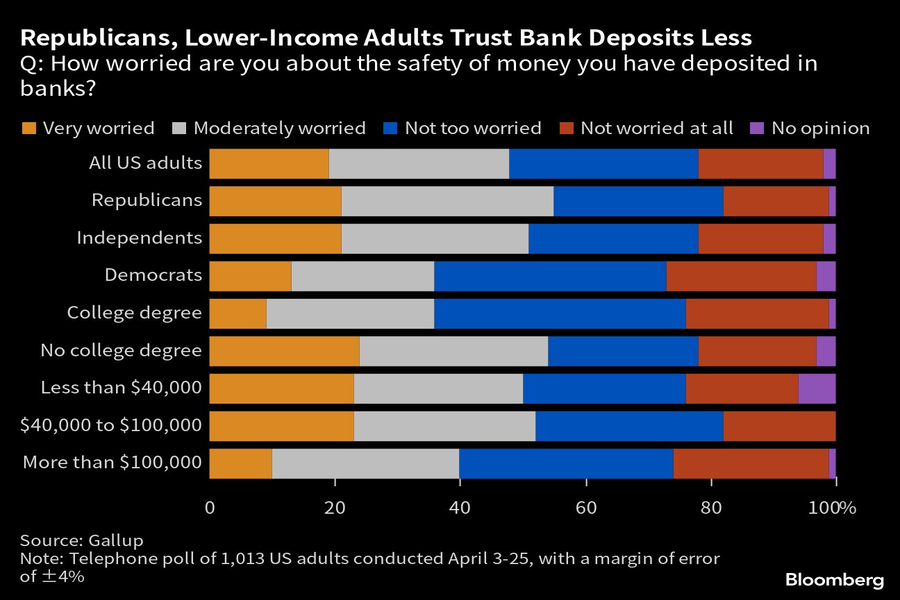
The telephone survey of 1,013 U.S. adults was conducted April 3 to April 25 — following the failures of Silicon Valley Bank and Signature Bank the previous month but before the collapse of First Republic Bank last week. The margin of error is plus or minus 4 percentage points.

South Carolina estate planning firm joins Osaic’s IBD network, citing succession planning tools and multigenerational growth resources.

A new SIFMA and KPMG study of more than 2,100 US investors finds satisfaction high, AI-only trust falling, and demand for human guidance growing across every generation.

Retail banks and private wealth firms scored 40 in Fitch's AI stress test, signaling possible one-notch downgrade risk under an adverse scenario.

Elsewhere, Wells Fargo Advisors adds a $400 million Morgan Stanley veteran in Naples as an ex-Cetera advisor goes independent with LPL

According to a federal charges Bradley Heppner, 60, received more than $150 million in payments through funneling money from GWG Holdings to a shell company.
Knighthead Life entered the market with a competitive MYGA. A strong launch earned advisor confidence and paved the way for FIAs.
As AI makes financial information more accessible than ever, Lana Hock explains why human judgment, trust, and empathy remain the qualities clients value most in a financial advisor

