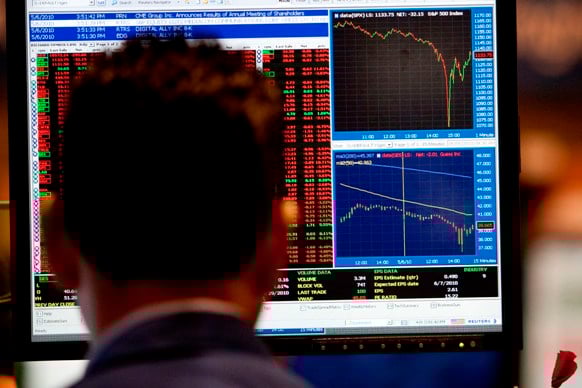
Stocks had another volatile day Friday, swinging widely before closing sharply lower.
The Dow Jones industrials closed with a loss of about 140 points, having been down almost 280 earlier. That followed a brief plunge of nearly 1,000 points on Thursday, the biggest one-day drop in the Dow's history. The erratic trading Friday was no surprise — stocks often fluctuate sharply right after the market suffers a big slide.
Traders were still anxious amid lingering questions about what caused Thursday's sudden drop. Several possibilities were being investigated, but as of late Friday no clear explanation had emerged.
The market looked past a surprisingly strong report on the U.S. jobs market and focused instead on the harrowing plunge the day before and the latest moves in Europe's spreading debt crisis that had helped trigger Thursday's big drop.
Technology stocks were particularly hard hit following reports that Nokia Corp. was broadening its legal fight against rival cell phone maker Apple Inc. to include the iPad, Apple's new hit product. Apple shares fell 4.2 percent in heavy trading.
Meanwhile, Germany's parliament approved Berlin's share of the rescue package after a boisterous debate. However, investors still fear that Greece may not make a May 19 deadline to make a debt repayment.
The concerns go far beyond Greece, the smallest economy in the European Union. A further loss of confidence in European government debt could have an impact on other weak countries like Portugal, potentially requiring another difficult bailout process. The debt crisis has already badly undermined Europe's shared currency, the euro.
"You're not concerned about the kid with the cold, but how he spreads it to the rest of the class," said Len Blum, a managing partner at investment bank Westwood Capital. Blum noted that Greece's debt problem could be similar to the subprime mortgage meltdown in the U.S., which quickly spread to other parts of the financial system.
According to preliminary calculations, the Dow closed down 139.89, or 1.3 percent, at 10,380.43
The Standard & Poor's 500 index fell 17.27, or 1.5 percent, at 1,110.88, while the Nasdaq composite fell 54, or 2.3 percent, to 2,265.64
Falling stocks outpaced gainers two-to-one on the
New York Stock Exchange, where volume was a heavy 2.4 billion shares.
Friday's trading left the Dow down 5.7 percent for the week and erased its gains for the year. The S&P fell about 6.4 percent, while the Nasdaq was off 7.9 percent for the week. The S&P and Nasdaq also went into the red for 2010.
The week's losses would put the market about well toward what experts call a "correction," usually defined as a drop of between 10 percent and 20 percent following a sustained rise. The Dow is now 7.4 percent off its recent high of 11,205.03 reached on April 26. The S&P 500 is down 8.7 percent from its recent high of 1,217.28 reached April 23.
Stocks have been on a nearly uninterrupted upward path since March of last year, when indexes hit 12-year lows. Analysts have been predicting a correction for months, only to see the market bounce back after brief periods of decline.
Long-term market watchers actually welcome occasional pullbacks in stocks, saying that gives investors opportunities to pick up shares at bargain prices.
"We were in the midst of a pullback, we needed one, we got one," said Peter Cardillo, chief market economist at New York-based brokerage house Avalon Partners Inc. Cardillo said the choppy trading after such a drastic decline likely signals the market trying to find a bottom.
"Yesterday's glitch certainly means it's going to take some time for the victims of the decline to sort that out," Cardillo said. "But once we do, the market is probably a buy."
In economic news, the Labor Department reported that employers added 290,000 jobs last month, far more than expected and the biggest jump in four years. However the jobless rate rose to 9.9 percent from 9.7 percent as more people looked for work.
The big improvement in the jobs report brought some clarity to the biggest question remaining for the U.S. economy: When employers would start hiring again. Despite positive signs in manufacturing and housing, job creation has been lagging far behind other sectors of the economy, a worrisome point for economists. Friday's report may help change that perception.
"It's a good-size number and it had a lot of breadth," said John Silvia, chief economist at
Wells Fargo. "There isn't a double-dip out there. The employment situation suggests that we have a sustained economic recovery in the U.S. Companies are hiring people."
Apple fell $10.39, or 4.2 percent, to $235.86.
Oil fell, and gold rose. The dollar was mostly lower against most currencies. The euro clawed back some ground against the dollar after several days of declines.
European markets were broadly lower.
The declines were deepest in France, where the CAC-40 index tumbled 4.6 percent. Germany's DAX fell 3.3 percent and Britain's FTSE 100 fell 2.6 percent. Japan's Nikkei fell 3.1 percent. --Associated Press