

Financial advisers want a shakeup in Washington next year by a wide margin, according to a recent poll by InvestmentNews Research. But the outcome of this year’s midterm elections appears more a matter of personal politics than professional interest.
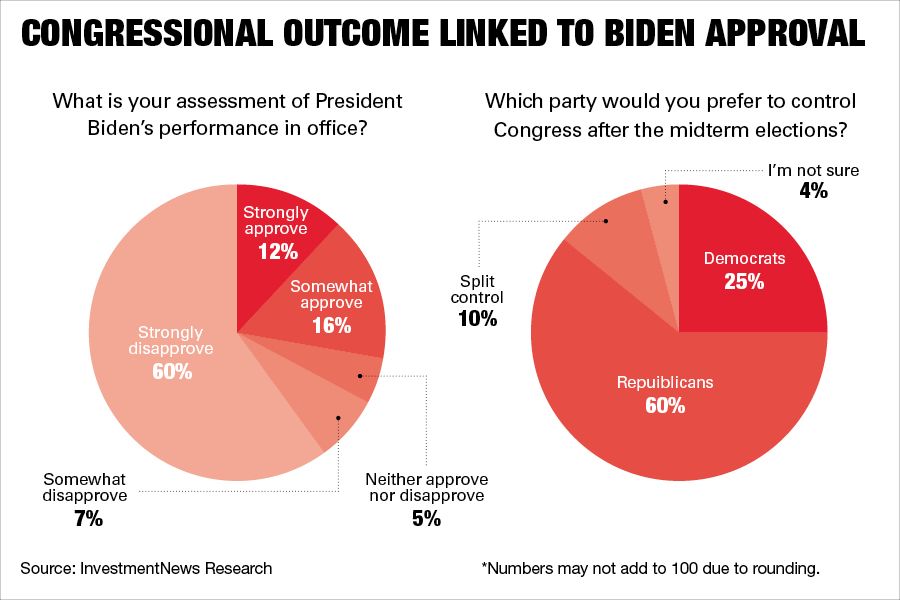
Advisers surveyed preferred that Republicans control Congress when it convenes in 2023, by a margin of 60% to 25%, with others unsure or preferring split control of the chambers. The results were far outside the poll’s margin of error of about 6%.
The partisan split closely resembles the assessment of President Biden, of whose performance in office 67% of survey respondents disapprove. Yet, the survey tilted far more Republican than the general population. According to Real Clear Politics, Democrats led the average generic congressional ballot 45.0% to 43.7% as of mid-September.
Asked what issues a new Congress should focus on, inflation ranked in the top three for 49% of advisers overall. Beyond that, priorities showed a stark partisan divide, with those favoring Republicans listing immigration, crime and taxes as most salient and those with a Democratic preference focused primarily on gun, election and reproductive policy.
Comparatively, industry-adjacent issues like Social Security, retirement policy and financial market regulation were peripheral in the survey.
The president’s party typically loses seats in their first midterm election, and eras of split control in Washington haven’t exactly been ripe for legislation lately. So when it comes to their day-to-day business, advisers aren’t holding their breaths on the ballot count.
Only 22% of advisers surveyed expected that the elections would have a significant impact on the industry.
[More: High stakes in midterm elections]

Elsewhere, Wells Fargo Advisors adds a $400 million Morgan Stanley veteran in Naples as an ex-Cetera advisor goes independent with LPL

According to a federal charges Bradley Heppner, 60, received more than $150 million in payments through funneling money from GWG Holdings to a shell company.

A $1B fund allegedly skimmed 30% off the top, then swapped cash for locked-up stock.

Insiders allegedly rewrote projections three times in four days.

TCI Wealth Advisors also has also tapped JIFFYAI to unify onboarding and servicing, while TradePMR adds ICE market data to its Fusion advisor platform
Knighthead Life entered the market with a competitive MYGA. A strong launch earned advisor confidence and paved the way for FIAs.
As AI makes financial information more accessible than ever, Lana Hock explains why human judgment, trust, and empathy remain the qualities clients value most in a financial advisor

