
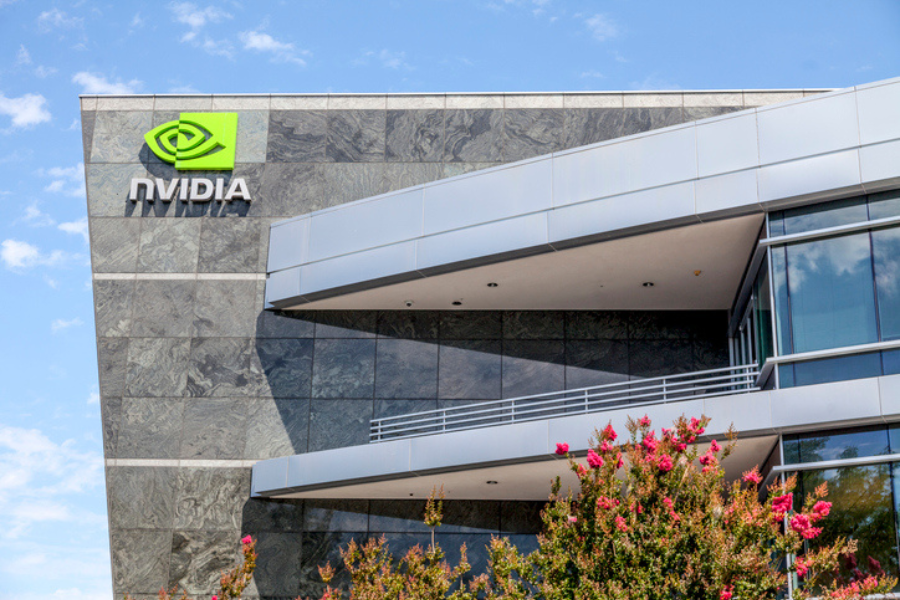
It was the most highly anticipated results of the current earnings season but Nvidia’s release after the markets closed Wednesday failed to hit the target for investors.
The chipmaker that has been a key driver of the AI frenzy in recent months, reported second quarter revenue 15% higher than the previous quarter and up a staggering 122% from a year ago, and at $30 billion it surpassed the $28.9 billion that analysts were expecting. Gross margin was 75.1% (down from 78.1% in the first quarter). Earnings of 68 cents per share also beat the expected 64 cents.
The firm also reported record quarterly Data Center revenue of $26.3 billion, up 16% from Q1 and up 154% from a year ago.
But it was the devil in the detail that concerned investors with Nvidia’s third quarter revenue estimated at around $32.5 billion (plus or minus 2%), above the $31.9 billion average analysts were calling for, but below the highest expectation of $37.9 billion.
Investors have been concerned about some issues with Nvidia’s next-generation Blackwell chip but the company has addressed the issues and Jensen Huang, founder and CEO, said that “the anticipation for Blackwell is incredible,” adding that “Blackwell samples are shipping to our partners and customers.”
The earnings report also revealed that Nvidia had returned $15.4 billion to shareholders in the form of shares repurchased and cash dividends during the first half of fiscal 2025. As of the end of the second quarter, the company had $7.5 billion remaining under its share repurchase authorization, and this week its board approved an additional $50 billion in share repurchase authorization, without expiration.
Nvidia shares were down as much as 5% in premarket trading Thursday before recovering somewhat later on. Overall futures on the S&P 500 and Nasdaq 100 erased earlier losses.
With the end of earnings season the market will now focus on the US economy and the question of whether data, including the jobs report, will require rate cutting from the Fed.
“What investors are looking for now is further confirmation that if economic momentum is weakening, the Federal Reserve are going to ride to the rescue, and provide a series and of substantial cuts,” Brian O’Reilly, head of market strategy at Mediolanum International Funds told Bloomberg.

LPL Financial and Raymond James also add independent advisors from Osaic and Edward Jones in Michigan and Arizona.

The SEC-registered RIA advises on more than $1 billion in client assets, with no advisory fee through 2027 and no human financial advisors.

95.8% of house trades were winners. For clients? The SEC says just 14.9%.

The complaint says Duolingo added friction on purpose, then lied about it.

The four wirehouse firms lost 1,449 experienced advisors and recruited 932 in the first six months of the year, according to Diamond Consultants.
Knighthead Life entered the market with a competitive MYGA. A strong launch earned advisor confidence and paved the way for FIAs.
As AI makes financial information more accessible than ever, Lana Hock explains why human judgment, trust, and empathy remain the qualities clients value most in a financial advisor

