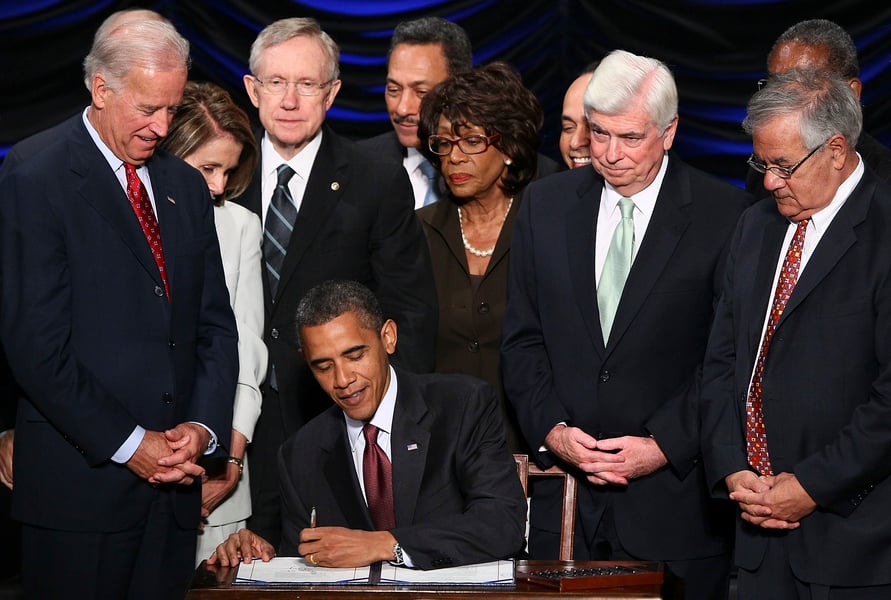
President Barack Obama signed the most sweeping set of financial rules since the Great Depression today, kicking off an election-year fight to define how the law will be put into effect.
“This reform will help foster innovation, not hamper it,” Obama said today during a bill-signing ceremony at the Ronald Reagan Building in downtown Washington. “It is designed to make sure that everyone follows the same set of rules, so that firms compete on price and quality, not tricks and traps.”
With his signature, Obama capped a year-long legislative struggle to draft and pass the measure spurred by the 2008 financial crisis that triggered the collapse of Lehman Brothers Holdings Inc. and dragged down Wall Street and the U.S. economy.
The law, named after its principal authors, Connecticut Senator Christopher Dodd and Massachusetts Representative Barney Frank, gives the government new authority to unwind failing financial firms that may threaten the entire system, imposes new rules on derivatives markets and creates a consumer-protection agency at the
Federal Reserve to monitor everything from home loans to credit cards.
Obama said the new rules will provide “the strongest consumer financial protections in history.” He vowed it will bring an end to taxpayer bailouts of financial firms and said adjustments to the regulation may have to be made along the way.
Writing Rules
Treasury Department and other officials now begin writing the regulations that will give the framework for enforcing the law, a process that may take a year.
Democrats say they expect the bill -- and the Republicans' almost unanimous opposition to it -- will give them an issue to trumpet during their campaigns for the midterm elections, in which analysts from both parties say Obama's party is all-but- assured of losing seats in Congress.
“It falls right into our frame of ‘Whose side are you on?'” said New Jersey Senator Robert Menendez, chairman of the Democratic Senatorial Campaign Committee.
Republican Senate candidates in Arkansas, Illinois, Iowa, Louisiana, Missouri and North Carolina all voted against the bill in either the House or the Senate, so Democrats expect to maintain the drumbeat until November.
“The American people overwhelmingly want to see Wall Street reform,” Menendez said. “Not only did they vote against it, now there are elements of their leadership that want to repeal it. We're happy to go at that.”
Public Skeptical
Almost four out of five Americans surveyed in a Bloomberg National Poll this month say they have just a little or no confidence that the measure will prevent or significantly soften a future crisis. More than three-quarters say they don't have much or any confidence the proposal will make their savings and financial assets more secure.
Forty seven percent of those polled said the bill will do more to protect the financial industry than consumers.
Texas Senator John Cornyn, who heads the National Republican Senatorial Committee, said that opposition to the measure probably won't be the party's rallying cry as the election approaches.
“It would be too early to tell,” he said.
Over time, though, their opposition to what he deemed “a huge power grab” could play to Republicans' advantage.
“That will look to be a pretty good vote a year or two from now, when the economy continues to stumble along, credit's contracted and the only new jobs being added are those of federal government regulators,” he said.
Shaping the Law
For many of those with a stake in the final shape of the bill on Capitol Hill, the final policy implications will be determined in the coming months and years, according to Lawrence Kaplan, an attorney at Paul Hastings Janofsky & Walker LLP in Washington.
Among those attending the ceremony for lawmakers, including Dodd and Frank, and business leaders, including Vikram Pandit, chief executive officer of
Citigroup Inc. Robert Diamond, president of
Barclays Plc and Gerald Hassell, president of the Bank of New York also were among those also invited.
Even with the signing, criticism of the law from business groups continued.
“This is nothing more than a financial regulatory boondoggle,” Tom Donohue, chief executive of the U.S. Chamber of Commerce, said in a statement. “It won't strengthen our capital markets, it won't jumpstart the economy, and it won't help create any new jobs except in government.”
Agency Action
For the banking industry, the battle now shifts to the regulators, where an alphabet soup of federal agencies have been tasked with crafting the new rules mandated by Congress. At the
Commodity Futures Trading Commission, Chairman Gary Gensler has convened 30 teams to construct a new regulatory system for the $615 trillion over-the-counter derivatives market.
Derivatives are financial instruments based on the value of another security or benchmark. Some instruments, including contracts that insured mortgage-backed bonds, have been blamed for fueling a financial crisis that led to the worst
recession since the Great Depression.
Securities and Exchange Commission Chairman Mary Schapiro has requested 800 new employees for the agency's new responsibilities and Sheila Bair, chairman of the Federal Deposit Insurance Corp. said her agency will need up to $50 million more budget as well as new hires with experience in investment banking and insurance as the agency prepares for its role as chief resolver of the largest failing financial institutions.
Banking Rules
For U.S. banks, the stakes could not be higher. International rules on capital and leverage are expected by year's end and the Fed, Office of the Comptroller of the Currency, FDIC, SEC and CFTC will all dictate future earnings with their rulemakings.
“The 2,300 or so pages of Dodd-Frank only provides rough framework for the future regulatory structure,” said Kaplan, a former senior attorney at the Office of Thrift Supervision. “The full impact of the of the act won't be known until the regulatory agencies complete the wiring, plumbing, drywalls and polish the new floors through the issuance of hundreds of regulations and possibly thousands of interpretations.”