
The oil meltdown accelerated Tuesday, with huge losses sweeping through markets as the world runs out of places to store unwanted crude and grapples with negative pricing.
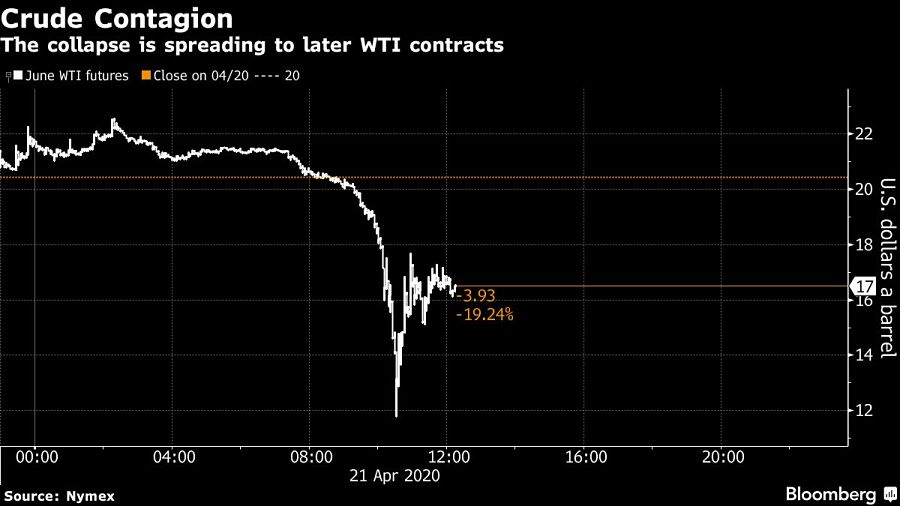
On Monday, West Texas Intermediate plunged below zero for the first time in history as the contract for May neared expiration, leaving traders in a panic as they tried to avoid taking delivery of physical barrels. On Tuesday the losses spread to the next month, highlighting the massive glut in the market causing the rout rather than any technical quirk.
The collapse of later contracts underscored the severity of the crisis. Storage tanks, pipelines and tankers are rapidly being overwhelmed by a vast oversupply caused by slumping fuel demand as countries are locked down to fight the coronavirus. Traders everywhere are having to reassess their risk after Monday’s unprecedented collapse, leading to violent intraday swings.
“Once you have negative prices in crude oil, the limits change totally,” said Olivier Jakob, managing director at Petromatrix. “What happened yesterday was extremely bad for the confidence in the futures market. It’s not just back to normal trading anymore.”
WTI for June delivery dropped as much as 42% to $11.79 a barrel, before recovering slightly to $16.44 as of 7:17 a.m. in New York. The thinly traded May contract remained below zero at -$5.78 a barrel. Brent crude slumped 16% to $21.37, having earlier dropped to as low as $18.10.
Negative prices
The collapse is reverberating across the oil industry, with prices trading below zero across America. WTI Midland in Texas -- a flagship marker for the U.S. shale industry -- was at -$13.13 a barrel, while crude in Alaska was at -$46.63.
There are signs that these stunningly low prices are here to stay as tanks across the globe fill up. Royal Vopak, the world’s biggest independent storage company, said almost all of its space is sold. Crude stockpiles at Cushing -- America’s key storage hub and delivery point of the WTI contract -- have jumped 48% to almost 55 million barrels since the end of February. U.S. nationwide inventories are estimated to have increased another 14 million barrels last week, according to a Bloomberg survey.
Countries fighting the virus pandemic have been on lockdown for weeks, drastically cutting road and air travel and stopping most economic activity. Many governments are extending confinement measures, which is ravaging demand further. That is forcing refineries from Asia to Europe and the U.S. to use far less crude. Portuguese processor Galp Energia SGPS said Tuesday it will suspend operations at its Sines refinery for a month as its storage tanks are nearly full.
The speed and scale of the crash have been so massive that it rendered completely ineffective the plans for unprecedented production cuts by OPEC and its allies. To make matters worse, the supply reductions only start from next month, and the current market remains awash with crude. Russia said that it is monitoring price closely but hasn’t decided on Venezuela’s call for a OPEC+ committee meeting.
“This is the kind of price that focuses minds in oil-producing nations, and minds are so focused they’re probably telekinetic at this point, or at least bending spoons,” said Kevin Book, head of research at ClearView Energy Partners.

Cullen marks the fourth firm the New York-based RIA aggregator has bought in 2026 as deal volume heads for a record year.

The quality of AI ROI measurement depends on pre-deployment decisions around business outcomes, leadership alignment, and establishing trusted information, among other factors.

A state-by-state analysis of retail investor behavior reveals AI-powered research tools are reshaping how clients approach investment decisions.

LPL picks up $1.1B from Wells Fargo's independent channel as the wirehouse gains a $410M family team from UBS.

Most Americans want to age at home but few have a financial plan to pay for it, according to new research.
Knighthead Life entered the market with a competitive MYGA. A strong launch earned advisor confidence and paved the way for FIAs.
As AI makes financial information more accessible than ever, Lana Hock explains why human judgment, trust, and empathy remain the qualities clients value most in a financial advisor

