

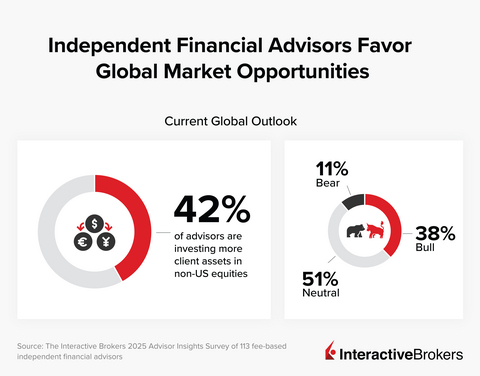
A new survey from broker-dealer giant Interactive Brokers Group claims 42% of independent financial advisors are investing more in non-US equities and 40% have reduced client exposure to US equities in reaction to the current market uncertainty driven by President Donald Trump’s global tariff policies.
The 2025 Interactive Brokers Advisor Insights Survey also found 62% of advisors are more bearish in their outlook today, compared to 12 months ago. Interactive Brokers Group conducted its survey in April with 113 fee-based financial advisors, of whom 65% are based in North America and 35% are based outside of North America.
“I would say that clients outside the US are kind of souring on US markets and investing in them because of the tariffs and the rhetoric right now. This could switch around by next quarter, but for now there seems to be a negative tone on US markets more so than there has been in the past,” said Steve Sanders, EVP of marketing and product development at Interactive Brokers.
Participating firms in the survey indicated having an average of $120 million in assets under management. Malcolm Polley, chief market strategist at Stratos Investment Management, told InvestmentNews that he’s lately recommended international investments for the first time since his financial career began in 1987. Stratos Investment Management operates under the Stratos holding firm, spanning 350 independent advisors and roughly $20 billion in total advisory assets.
“We've made the decision to allocate a larger component of our portfolios to international securities relative to what it has been in the past,” said Polley. “If you really think the dollar is going to do well, you don't invest overseas that much. Given what's going on in Washington in terms of the uncertainty over the budget, over the deficits and trade, it's kind of a triple whammy from a dollar standpoint. We really think, and as do many advisers, the dollar is going to struggle and so this probably makes it a prime time to be looking overseas from an investment standpoint.”
Polley still recommends avoiding emerging markets funds, as they tend to be heavily weighted toward China. Wealthspire Advisors, a national RIA with roughly $30 billion AUM, recently made a modest shift in its model portfolios by increasing its strategic equity allocation to international equities, thereby reducing US equity exposure accordingly, the firm’s managing director Eric Dostal told InvestmentNews over email.
“While we’ve held off on this change for several years due to U.S. dominance in earnings growth and profitability, our Investment Committee now sees a stronger case for diversifying geographically,” Dostal said. “We don't view this change as a directional bet against the U.S., it’s a recalibration meant to enhance diversification and address rising client concerns around domestic concentration risk."
California-based RIA Jackson Square Capital has made a smaller adjustment, making a 2% shift towards European markets over the past three months. The firm’s founder Andrew Graham cautioned that a stronger Euro currency could make it harder for European companies to sell their products globally, but his $550 million RIA has bought dividend-friendly stocks in French bank BNP Paribas, energy firm Engie, German insurance companies Allianz and Munich RE.
“European companies pay really fat dividend deals, so we have a dividend-centric strategy,” said Graham. “I don't think the Europe thing is a layup. I'd be careful. I would grab the highest quality dividends you can, and just live with that.”
The Interactive Brokers Group survey also found 29% of advisors have increased their fixed income investments and 37% increased their cash holdings in U.S. dollars. Despite the volatile U.S. market, 61% of surveyed RIAs are confident their business will grow this year. But the wealth services giant Stratos is still preparing for a multi-year shift away from U.S. equities.
"It's probably going to be longer than the balance of this year. Is it going to be three years, five years — maybe,” Polley said. “Markets and advisors are going to have to take a look at how well the US addresses its structural deficits and debt. If they begin to address those items in a real manner, then you might be able to re-focus on the US.”
The $42 billion mega-RIA Carson Group has "slightly increased" its international equity allocation amid the weakening U.S. dollar. "From a long-term perspective, we still have high conviction in US equities given the broad exposure to technology," said Carson Wealth advisor John McGowan. "The world economy will continue to rely on innovation of new technologies where the US is best positioned to benefit.
Update: Wealthspire Advisors clarified its model portfolios in its comments about strategic equity allocation.

The combination adds two veteran New York City practices with decades-long client relationships to Cerity's fast-growing national platform.

Regulator says contracts tied to a person's words or attendance will face heightened scrutiny before they can be listed.

Citi Wealth survey of 351 family offices finds inflation concern rising and next-gen transitions now an immediate operational challenge.

The Wauwatosa-based fiduciary team brings $145 million in client assets to Carson Wealth's Great Lakes platform.

Texas securities regulators initially accused Lasater RE Fund of fraud in June but later dropped those claims.
As AI makes financial information more accessible than ever, Lana Hock explains why human judgment, trust, and empathy remain the qualities clients value most in a financial advisor
Northern Trust’s Ken Lassner shows advisors how to convert volatility into after-tax portfolio gains

