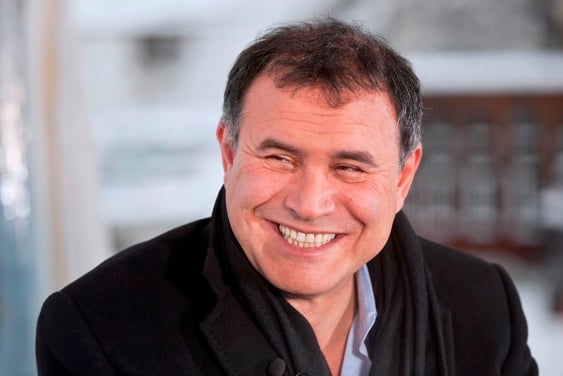
All asset classes still subject to uncertainties that plagued 2011, says Dr. Doom
The risks that spurred market volatility last year will keep swaying asset prices and the global economy, according to Nouriel Roubini, the economist who predicted the 2008 financial crisis.
Roubini, co-founder of Roubini Global Economics LLC, said in a talk today at Bloomberg's headquarters in New York that rising commodity prices, uncertainty in the Middle East, the spreading European debt crisis, increased frequency of “extreme weather events” and U.S. fiscal issues are “persistent” problems that will “stay with us.”
Some of the most volatile days on record occurred in 2011, with the Dow Jones Industrial Average (INDU) posting four consecutive days of 400-point swings, the longest streak since data began in 1896. The S&P 500's average daily price move since its 2011 high in April was 1.2 percentage points, or about twice the 50-year average before Lehman Brothers Holdings Inc. collapsed in September 2008.
“Last year was a year of risk, volatility, uncertainty and surprises and the question is, ‘Are they going to happen again?'” Roubini said. “If you think about all these tail risks about the global economy, the reality is many of them are not temporary. Many of them are not transitory and many of them are not random events,” he said. “They're going to be sources of volatility.”
He said he'd buy the U.S. dollar and Treasuries since these assets tend to perform better during periods of risk aversion. While the U.S. has a “large fiscal deficit,” it's “the less dirty shirt in a very dirty laundry bag,” Roubini said. Last year, Treasuries had the biggest annual return since the depths of the financial crisis in 2008 as Europe's debt turmoil spurred investor demand for refuge.
Roubini, a New York University professor, predicted the U.S. housing bubble before the market peaked in 2006, while failing to foresee a rebound in global stocks in 2009.
Bloomberg News--