
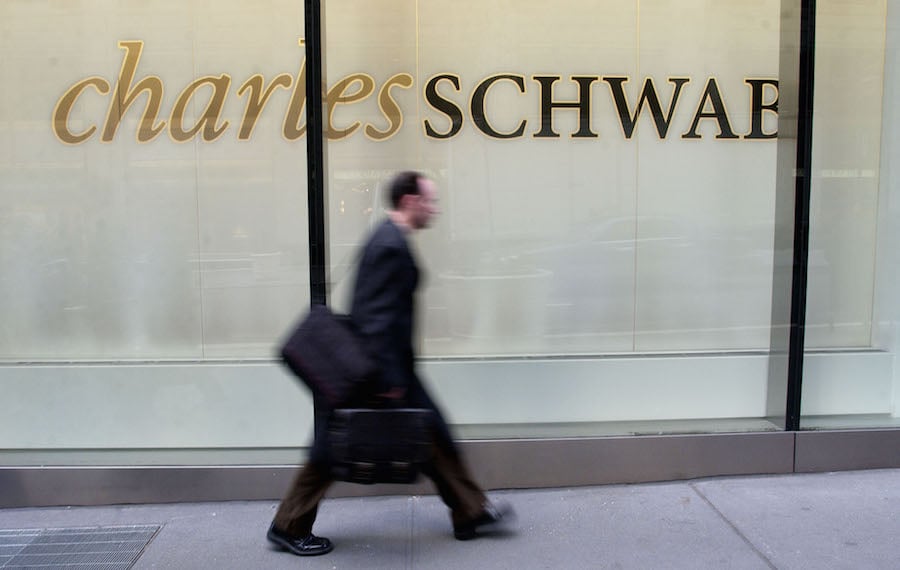
Charles Schwab Corp. said it’s rushing to get more employees working from home but conceded its systems weren’t built to withstand the stresses on the business that the coronavirus outbreak has caused.
Separately, the company said Thursday that it will close all its branches to the public, after announcing Wednesday that it was temporarily closing its Bay Area branches.
"After careful consideration we have made the decision to temporarily close all our branches to public access and walk-in traffic until April 7 as a result of COVID-19," spokesman Michael Cianfrocca said in an email. "We are committed to balancing the health of our employees and representatives and the important need to be there for our clients during this difficult time, so branch teams will continue to support clients virtually from our branch locations, using appropriate social distancing with their colleagues."
In a memo to employees on Tuesday, Nigel Murtagh, executive vice president of corporate risk, said more than 7,000 of the company’s 20,000 employees are working from home and it is trying to accommodate even more.
“Even with our plans in place, this crisis has brought forth some unpredictable issues that we are working to address now,” Mr. Murtagh wrote. “Like many companies, we simply did not build into our plan the need to have the majority of employees work from home at the same time. So we are in the process of building out that capability now, as quickly as possible.”
Corporations across the globe have instituted plans to keep their businesses up and running during the pandemic. Schwab is addressing the issue as San Francisco, where it’s based, orders people to stay home except for essential needs -- one of the strongest local efforts to contain the virus in the U.S.
“Starting tomorrow, all employees who have the ability to work remotely may do so,” Schwab spokeswoman Mayura Hooper said in an email Wednesday. “There are certain critical functions that will need to be performed on site -- like any large financial institution. This includes some roles in network operations, cybersecurity, trading, call centers, and other areas.”
Employees required to report to offices will be expected to follow recommended health guidelines and enhanced social distancing practices, she said. The company had 360 offices in 48 states as of Dec. 31.
Schwab, which oversaw $3.86 trillion as of Feb. 29 from multiple locations around the country, experienced record volume of client trades last month, according to a March 13 memo from chief financial of. ficer Peter Crawford.

To build a truly self-sustaining practice, enterprising advisors have to start with a vision of what they want to be – and accept the realities that come with building toward it.

Serial acquirers add a 35-year-old Oregon wealth manager and a New York practice focused on women navigating life transitions.

Mara Glassel and Julie Fox will co-lead the fast-growing hybrid RIA’s ultra-high-net-worth and private wealth businesses.

The banking giant's wealth arm extends its revenue streak as it pushes to exit consent orders weighing on growth since 2020.

New Allspring research finds 401(k) participants want guidance on income and rollovers, not just portfolio automation.
Knighthead Life entered the market with a competitive MYGA. A strong launch earned advisor confidence and paved the way for FIAs.
As AI makes financial information more accessible than ever, Lana Hock explains why human judgment, trust, and empathy remain the qualities clients value most in a financial advisor

