
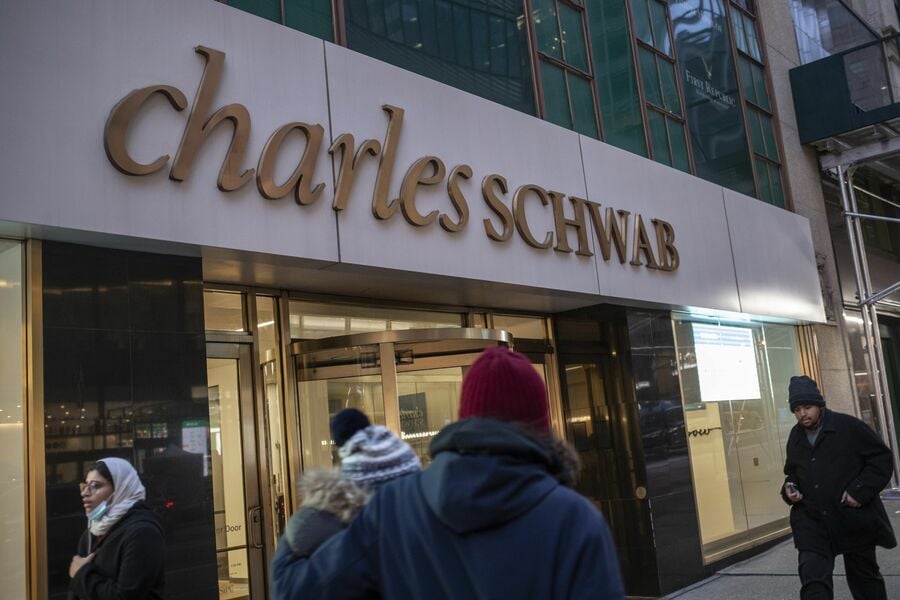
On the surface, Charles Schwab Corp. being swept up in the worst U.S. banking crisis since 2008 makes little sense.
The firm, a half-century mainstay in the brokerage industry, isn’t overexposed to crypto like Silvergate Capital and Signature Bank, nor to startups and venture capital, which felled Silicon Valley Bank. Fewer than 20% of Schwab’s depositors exceed the FDIC’s $250,000 insurance cap, compared with about 90% at SVB. And with 34 million accounts, a phalanx of financial advisors and more than $7 trillion of assets across all of its businesses, it towers over regional institutions.
Yet the questions around Schwab won’t go away.
Rather, as the crisis drags on, investors are starting to unearth risks that have been hiding in plain sight. Unrealized losses on the Westlake, Texas-based firm’s balance sheet, loaded with long-dated bonds, ballooned to more than $29 billion last year. At the same time, higher interest rates are encouraging customers to move their cash out of certain accounts that underpin Schwab’s business and bolster its bottom line.
It’s another indication that the Federal Reserve’s rapid policy tightening caught the financial world flat-footed after decades of declining rates. Schwab shares have lost more than a quarter of their value since March 8, with some Wall Street analysts expecting earnings to suffer.
“In hindsight, they arguably could have had more prudent investment choices,” said Morningstar analyst Michael Wong.
Chief Executive Walt Bettinger and the brokerage’s founder and namesake, billionaire Charles Schwab, have said the firm is healthy and prepared to withstand the broader turmoil.
The business is “misunderstood,” and it’s “misleading” to focus on paper losses, which the company may never have to incur, they said last week in a statement.
“There would be a sufficient amount of liquidity right there to cover if 100% of our bank’s deposits ran off,” Bettinger told the Wall Street Journal in an interview published Thursday, adding that the firm could borrow from the Federal Home Loan Bank and issue certificates of deposit to address any funding shortfall.
Through a representative, Bettinger declined to comment for this story. A Schwab spokesperson declined to comment beyond the Thursday statement.
The broader crisis showed signs of easing on Monday, after First Citizens BancShares Inc. agreed to buy SVB, buoying shares of financial firms including Schwab, which was up 3.1% at 2:29 p.m. in New York. The stock is still down 42% from its peak in February 2022, a month before the Fed started raising interest rates.
Schwab is unusual among peers. It operates one of the largest U.S. banks, grafted on to the biggest publicly traded brokerage. Both divisions are sensitive to interest-rate fluctuations.
Like SVB, Schwab gobbled up longer-dated bonds at low yields in 2020 and 2021. That meant paper losses mounted in a short period as the Fed began boosting rates to stamp out inflation.
Three years ago, Schwab’s main bank had no unrealized losses on long-term debt that it planned to hold until maturity. By last March, the firm had more than $5 billion of such paper losses — a figure that climbed to more than $13 billion at year-end.
It shifted $189 billion of agency mortgage-backed securities from “available-for-sale” to “held-to-maturity” on its balance sheet last year, a move that effectively shields those unrealized losses from impacting stockholder equity.
“They basically saw higher interest rates coming,” Stephen Ryan, an accounting professor at New York University’s Stern School of Business, said in a phone interview. “They didn’t know how long they would last or how big they would be, but they protected the equity by making the transfer.”
The rules governing such balance sheet moves are stringent. It means Schwab plans to hold more than $150 billion worth of debt to maturity with a weighted-average yield of 1.74%. The lion’s share of the securities — $114 billion at the end of 2022 — won’t mature for more than a decade.
The benchmark 10-year Treasury yield now: 3.5%.
Schwab’s other headache from higher interest rates stems from cash.
At the root of Schwab’s income is idle client money. The firm “sweeps” cash deposits from brokerage accounts to its bank, where it can reinvest in higher-yielding products. The difference between what Schwab earns and what it pays out in interest to customers is its net interest income, among the most important metrics for a bank.
Net interest income accounted for 51% of Schwab’s total net revenue last year.
“Schwab’s counting on inertia,” said Allan Roth, founder of Wealth Logic, a financial planning firm.
After a year of rapidly rising rates, there’s greater incentive to avoid being stagnant with cash. While many money-market funds are paying more than 4% interest, Schwab’s sweep accounts offer just 0.45%.
While it’s an open question just how much money customers could move away from its sweep vehicles, Schwab’s management acknowledged this behavior picked up last year.
“As a result of rapidly increasing short-term interest rates in 2022, the company saw an increase in the pace at which clients moved certain cash balances” into higher-yielding alternatives, Schwab said in its annual report. “As these outflows have continued, they have outpaced excess cash on hand and cash generated by maturities and pay-downs on our investment portfolios.”
In their statement, Bettinger and Schwab wrote that “client deposits may move, but they are not leaving the firm.”
To plug the gap, the brokerage’s banking units borrowed $12.4 billion from the FHLB system through the end of 2022, and had the capacity to borrow $68.6 billion, according to an annual report filed with regulators.
Schwab borrowed an additional $13 billion from the FHLB so far this year, the filing showed.
Analysts have been weighing these factors, with Barclays and Morningstar lowering their price targets for Schwab shares in recent weeks.
Bettinger and Schwab said that the firm’s long history and conservatism will help customers navigate the current cycle, as they have for more than 50 years.
“We remain confident in our client-centric approach, the performance of our business, and the long-term stability of our company,” they wrote in last week’s statement. “We are different than other banks.”

Fake advisors, fake platforms, fake crypto - all on a six-month timer
A new DOL rule restores a clearer two-factor test, giving independent advisors greater certainty over their business status.

Dynasty Advisors brings a multigenerational team and integrated planning model spanning two states.

Advisor360, spun out of Commonwealth in 2019, adds two execs and is ‘excited to support LPL’ after the conversion

The multi-family office says its earliest participating funds invested in Anthropic at a $45 billion valuation, while the vast majority of its access came at $183 billion.
Advisors are broadening the conversation beyond savings to help clients prepare for the realities of longer lives
Growing wealth, evolving priorities, and untapped opportunities are reshaping how women approach long-term investing.

