
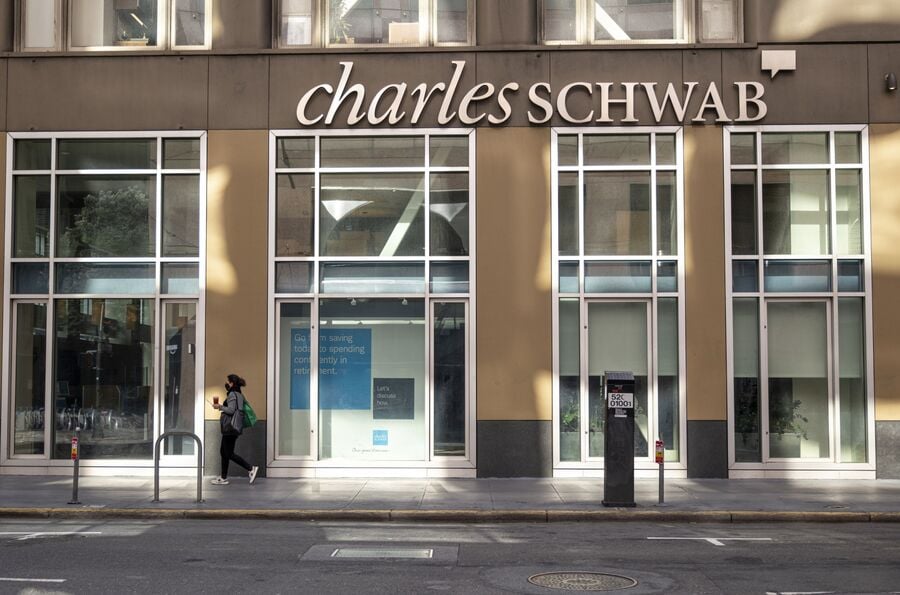
Charles Schwab Corp. said it’s experiencing temporarily lower net flows of client money as the brokerage sees attrition of some retail and advisory clients’ assets while it integrates TD Ameritrade into its business.
The company has stepped back from certain custodial relationships that Ameritrade had offered to institutional clients, Peter Crawford, chief financial officer at Charles Schwab, said in a statement Monday. The client attrition is in line with Schwab’s expectations for the deal when it was announced in 2019 and will subside in the first half of next year, Crawford said.
Schwab’s attrition amounts to about 4% of Ameritrade revenue prior to the deal, or around 1% of combined total client assets as of the end of last year, Crawford said.
The Westlake, Texas-based company repeated its expectation that client deposits will begin growing again later this year.
Schwab has faced pressure from investors in recent months, particularly after the March collapse of several midsize U.S. lenders focused attention on unrealized losses from securities held on bank balance sheets.
The Federal Reserve’s interest rate hikes over the past year have pressured the bank’s banking arm, a pivotal source of revenue, as some clients moved their money from the bank to other investment products, including money-market funds, in a process known as “cash sorting.”

Elsewhere, Wells Fargo Advisors adds a $400 million Morgan Stanley veteran in Naples as an ex-Cetera advisor goes independent with LPL

According to a federal charges Bradley Heppner, 60, received more than $150 million in payments through funneling money from GWG Holdings to a shell company.

A $1B fund allegedly skimmed 30% off the top, then swapped cash for locked-up stock.

Insiders allegedly rewrote projections three times in four days.

TCI Wealth Advisors also has also tapped JIFFYAI to unify onboarding and servicing, while TradePMR adds ICE market data to its Fusion advisor platform
Knighthead Life entered the market with a competitive MYGA. A strong launch earned advisor confidence and paved the way for FIAs.
As AI makes financial information more accessible than ever, Lana Hock explains why human judgment, trust, and empathy remain the qualities clients value most in a financial advisor

