
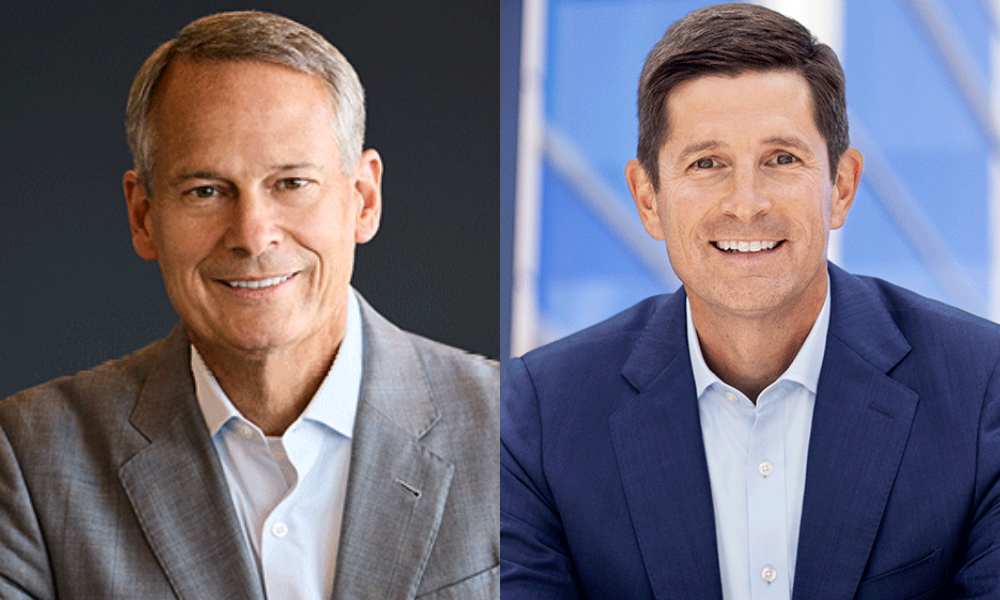
Long-time Charles Schwab CEO Walt Bettinger gave some farewell remarks to thousands of independent advisors Tuesday at the firm's Impact 2024 conference. And the forthcoming company leader, Rick Wurster, told them what to expect when he takes over – hinting at more access to cryptocurrencies and lending services and not competing for the same clients.
Speaking at what will be his final Impact conference appearance as CEO, Bettinger reflected on the realization that set him on a course to lead Schwab: He wasn’t really the best at anything at a company so big, and if he were to survive in the business, he would need to learn to coach people to become better.
That became apparent in 1996, a year after the retirement plan services firm he founded in 1982, The Hampton Company, was acquired by Charles Schwab, he said. His boss came to town for his annual review, treated him to dinner, and gave some candid feedback – Bettinger might have been the best at myriad roles at a small company, but at Schwab, that simply wasn’t the case for any of his skillsets. The message: Learn how to lead and build people up, or next year, you’re fired, Bettinger said.
“I needed to make that transition, from ‘doing,’ to helping others and coaching them,” he said.
That also meant being open to criticism, he said. As CEO, a role he’s held for 16 years, he’s asked for “brutally honest reports” from all of the company’s senior leaders every two weeks, he said.
“In my role, there are two tremendous threats of isolation,” he said. “One is people telling you what they you want to hear. And the other is people being afraid to tell you what they think you need to know.”
Bettinger told the company’s board of directors earlier this year of his plan to retire from the senior role. He will continue to be executive cochair of board of directors, along with company founder Charles Schwab.
And even as “this transition is a big deal,” since “Charles Schwab has had two CEOs for the last 50 years,” it isn’t a change for his own identity, he said. He did want the job and responsibilities that come with it, but he doesn’t think of himself as a CEO, he said.
“There are people who are in my position who get into trouble when they confuse the title they have with who they are as a person.”
He gave several thoughts for all of the independent advisors in the crowded room: Stay grounded, work on your emotional intelligence, be intellectually honest, and be aware of your constituencies.
On the latter, “you have to be masters at this as you build firms and you serve clients,” he said. “You might say the same thing to a variety of people, but each one hears it a little bit differently… Experts at constituency awareness think about all that before a word comes out of their mouths.”
Schwab president Rick Wurster, who is succeeding Bettinger in the CEO role at the beginning of 2025, spoke about life changes he and his family made to help support his daughter Faith, who was born with several disabilities. Wurster left a job in Hanover, NH at McKinsey where he worked “80 to 100 hours” a week for a position at Wellington Management in Boston, where he got on the fast track to leadership. But his family found that the best therapy for Faith was in the San Franscico Bay area, and their move to that city meant giving up the promising job for a less certain one at the same company, he said. He showed a recent video of his daughter to applause from the crowd, making a point that investing in people is important.
“Today, she’s a freshman at a four-year university, where she attends a program for kids with disabilities, to help them live independently,” he said.
At Wellington, he had his own moment of realization, when a university client showed him how stewardship of the school’s endowment helped it build an infinity pool. Helping individuals reach more modest financial goals was a better calling for him, he said.
That led him to Schwab, where much of the company’s focus has been investing in the business to help independent advisors grow, he said. That has meant hundreds of millions of dollars toward technology, tens of millions in marketing, and investments to help advisors find talent to add to their teams, he said.
“Collectively, you represent half of our assets and half of our growth,” he said. “But what’s more important to us is the sharing of our mission with you.”
He pointed to next year – the start of the second Trump administration – as a time of regulatory change that will ease requirements on bitcoin and other crypto assets.
“Clients can get exposure to bitcoin today in all kinds of ways at Schwab,” such as through future and spot-price ETFs, he said. But regarding direct investing in coins and spot-price trading, “we would like to be able to do that,” he said. “At some point, we will offer direct access to crypto.”
There will also likely be more lending services for high-net-worth clients, such as borrowing against collateral for alternative assets, he said. That would be a necessary change, given that independent advisors using Schwab for custody sometimes direct wealthy clients to JPMorgan or other banks for borrowing needs – only to have the lenders also offer wealth management services, he said.
“We are all in on lending. We want to do everything we can so that you don’t have to be in the position of having to introduce somebody who is a competitor.”
In that same regard, Schwab isn’t out to compete with advisors for clients, he said, extending the same offer that Bettinger made for advisors to contact him directly if they feel that has not been the case. Following the company’s incorporation of TD Ameritrade’s business, that has been a concern among some advisors who custodied with the acquired firm.
“If you ever feel like we’re competing with you, send me an email,” he said. Together, Schwab and the advisors who custody with it account for about 14 percent of the advice market, he said.
“There’s 86 percent of the market that we’re not touching,” he said. “Let’s go after that 86 percent together.”

Just over 10% of advisors' wealth clients come from defined contribution plans, as capacity, data and technology gaps block the bridge to wealth

Deal creates a $20B-plus custody platform for private market investing in IRAs, months after Schwab closed its Forge Global purchase

Despite the good times, advisors should tread carefully, said one veteran industry executive.

Gallagher data reveals a huge gap in financial confidence between employees who work with an advisor and those who don't.

PEP assets hit $34bn at year-end 2025 as advisors navigate mandate deadlines and a 48% employer interest rate.
Knighthead Life entered the market with a competitive MYGA. A strong launch earned advisor confidence and paved the way for FIAs.
As AI makes financial information more accessible than ever, Lana Hock explains why human judgment, trust, and empathy remain the qualities clients value most in a financial advisor

