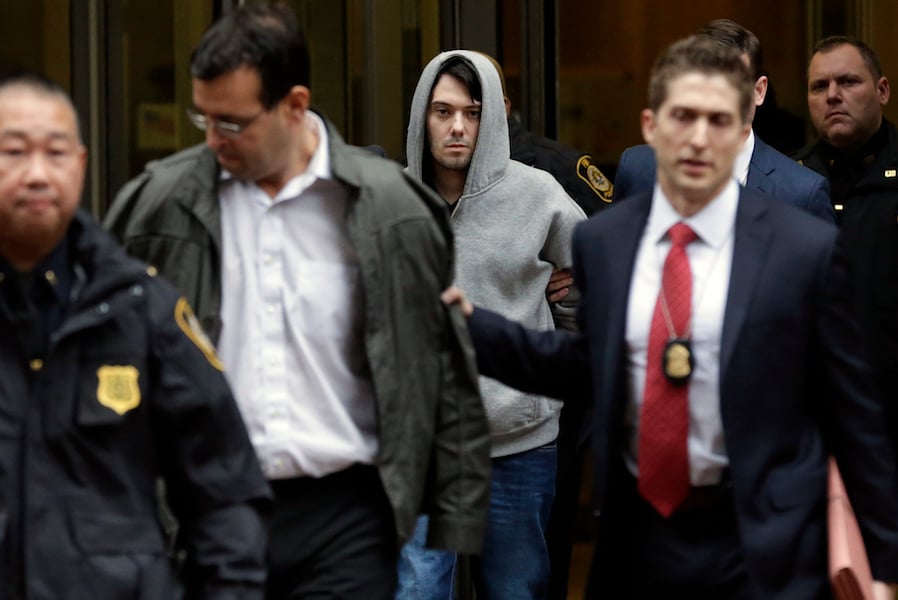
Martin Shkreli, the boyish drug company entrepreneur, who rocketed to infamy by jacking up the price of a life-saving pill from $13.50 to $750, was arrested by federal agents at his Manhattan apartment early Thursday morning and charged with securities fraud.
Shkreli, 32, ignited a firestorm over drug prices in September and became a symbol of defiant greed. The federal case against him has nothing to do with pharmaceutical costs but suggests he was running a Madoff-style Ponzi scheme on a much smaller scale. Prosecutors in Brooklyn charged him with illegally taking assets from Retrophin Inc., a biotechnology firm he started in 2011, and using it to pay debts from unrelated business dealings. He was later ousted from the company, where he'd been chief executive officer, and sued by its board.
(More: Texas REIT in free fall after Ponzi allegations)
SHELL GAME
Federal prosecutors accuse Mr. Shkreli of engaging in a complicated shell game after a
hedge fund he started lost millions. He is alleged to have made secret payoffs and set up sham consulting arrangements. A New York lawyer, Evan Greebel, also arrested early Thursday, is accused of conspiring with him.
Both Mr. Shkreli and Mr. Greebel appeared in Brooklyn federal court on Thursday afternoon and pleaded not guilty.
Spokeswomen for Katten Muchin Rosenman LLP where Mr. Greebel worked during the time in question, and Kaye Scholer, where he works now, declined comment. Mr. Greebel, who served as lead outside counsel to Retrophin from 2012 to 2014, joined Kaye Scholer in July, after the activities detailed in the indictment.
PONZI SCHEME
In a federal indictment and complaint by the Securities and Exchange Commission, authorities outline years of investment losses and lies Mr. Shkreli allegedly told investors almost from the moment he began managing money. By his mid-20s, they said, he got nine investors to place $3 million with him, lost their money and covered it up. At one point, his fund's accounts had a balance of $331.
He covered up his losses with scheme after scheme, telling investors that his returns were as high as 35.8 percent when he was down 18 percent. He used client money to pay for clothing, food and medical expenses and lied to the broker handling his fund's accounts, authorities said.
“Shkreli essentially ran his company like a Ponzi scheme where he used each subsequent company to pay off defrauded investors from the prior company,” Brooklyn U.S. Attorney Robert Capers said at a press conference. Mr. Shkreli was walked through a gaggle of photographers outside FBI headquarters in Manhattan.
AMERICAN DREAM?
Mr. Shkreli's extraordinary history — and current hold on the public imagination — makes the case more noteworthy than most involving securities fraud. The son of immigrants from Albania and Croatia who worked as janitors and raised him deep in working-class Brooklyn, Mr. Shkreli both epitomizes the American dream and sullies it. As a youth, he showed promise and independence and, after dropping out of an elite Manhattan high school, began his conquest of Wall Street before he was 20.
His name entered public consciousness after he raised the price more than 55-fold for Daraprim. It is the preferred treatment for a parasitic condition known as toxoplasmosis, which can be deadly for unborn babies and patients with compromised immune systems including those with HIV or cancer. His company, Turing Pharmaceuticals AG, bought the drug, moved it to a closed distribution system and instantly drove the price into the stratosphere.
The moves drew shocked rebukes from Congress, public-interest groups, doctors and presidential candidates, and cast a spotlight on the rising prices of older drugs. Donald Trump called Mr. Shkreli a “spoiled brat,” and the BBC dubbed him the “most hated man in America.”