
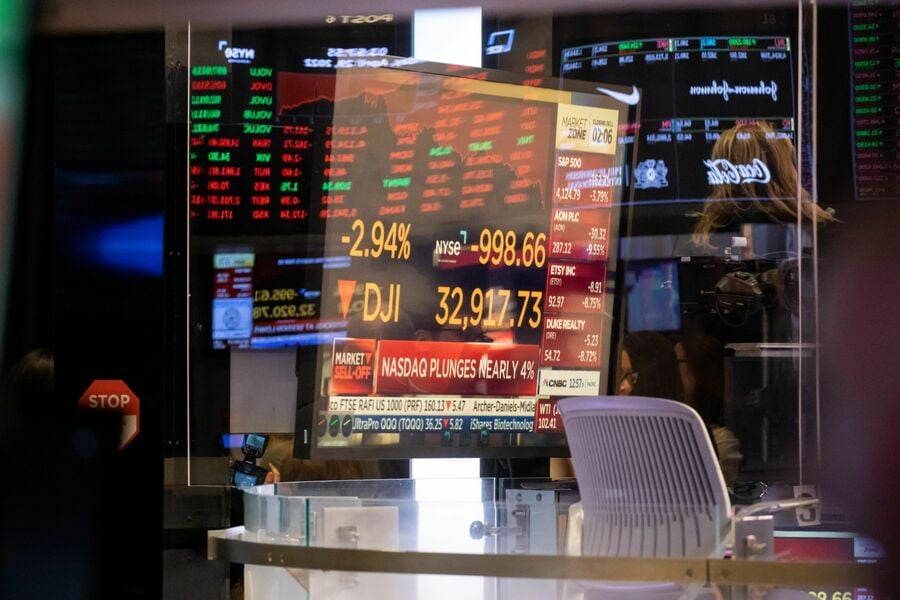
Global equity funds saw their biggest outflows in nine weeks as investors piled into cash amid fears that the U.S. economy could be headed for a recession.
About $16.8 billion exited global stock funds in the week through June 22, with U.S. equities seeing their first outflow in seven weeks at $17.4 billion, Bank of America Corp. said, citing EPFR Global data. Bonds saw redemptions of $23.5 billion, while investors moved $10.8 billion to cash and $0.6 billion to gold, the data show.
Bank of America’s custom bull and bear indicator remains at “maximum bearish,” strategists led by Michael Hartnett wrote in a note, which is a buy signal for stocks. For the year, investors have bought $195 billion of stocks and sold $193 billion of bonds, meaning capitulation has not been reached for equities, they said.
The U.S. stock market has struggled to meaningfully recover after it sank into a bear market last week, and the S&P 500 Index is still on track for its worst first half since 1970 amid fears of economic slowdown. Federal Reserve Chair Jerome Powell acknowledged this week that a soft economic landing was “very challenging.”
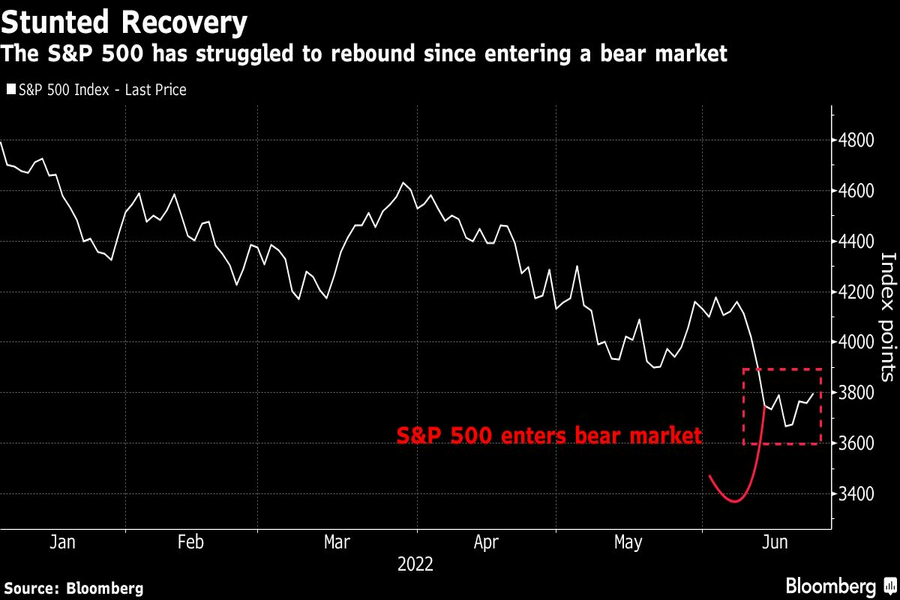
Despite the sell-off, strategists broadly believe equity markets haven’t seen a bottom. Hartnett said last week that based on past bear markets — defined as a 20% drop for the index from recent highs — the current one for the S&P 500 would end in October with the index at 3,000 points. That’s 21% below current levels.
Morgan Stanley strategist Michael J. Wilson also sees the index dropping to 3,000 to fully reflect the scale of economic contraction. And Societe Generale SA’s Manish Kabra said this week that a 1970’s style shock amid stagnation with higher inflation could send the index crashing more than 30% from current levels.
By trading style, U.S. small cap and large cap stocks led outflows. By sector, materials and energy saw the biggest redemptions. Technology, communication services and real estate had inflows.

A Nationwide survey finds 47% of GLP-1 users have never discussed the drugs’ financial impact with an advisor, even as many dip into savings.

The hundreds of millions of dollars from a sale of Inspired Healthcare properties does not mean an immediate windfall for investors.

Its SEC filings said one thing - a congressional probe said another.

Sham agreements allegedly padded revenue by 345%.

"Most pre-retirees are uncomfortable making key retirement income decisions without an advisor's help," said Chris Bailey of Cerulli.
Knighthead Life entered the market with a competitive MYGA. A strong launch earned advisor confidence and paved the way for FIAs.
As AI makes financial information more accessible than ever, Lana Hock explains why human judgment, trust, and empathy remain the qualities clients value most in a financial advisor

