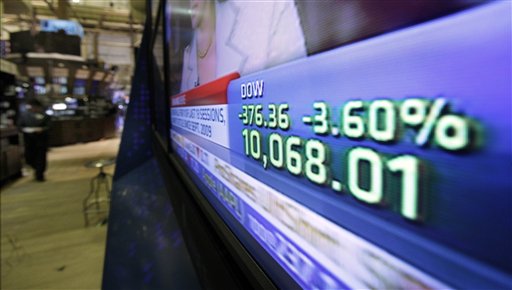
The stock market has had a huge selloff as more investors woke up to the possibility that economic problems such as Europe's debt crisis might spread around the world.
The Dow Jones industrial average is down 376 points, or 3.6 percent, at 10.068, its biggest one-day drop since February 2009. Meanwhile, interest rates are down sharply in the Treasury market as investors once again sought the safety of government debt.
With Thursday's drop, the Standard & Poor's 500 is down almost 12 percent from its 2010 high close of 1,217.28, reached April 23. The means the stock market has officially had a correction, a pullback of 10 percent or more from a recent high. It's the first correction since stocks recovered from the 12-year lows they hit in March 2009.
The S&P 500 is down 43, or 3.9 percent, at 1,071. The Nasdaq composite index is down 94, or 4.1 percent, at 2,204.
Only 153 stocks rose on the
New York Stock Exchange while almost 3,000 fell. Volume came to a very heavy 2.1 billion shares.
Analysts said there was no big event to set off Thursday's selling. More investors seemed to be grasping the possibility that the U.S. recovery could be in jeopardy. And many were realizing that the stock market's big rebound since March 2009 may not have been justified.
"The economic recovery story has started to look like a mirage and the new reality is a return to credit crunch conditions" like those seen during the financial crisis, said Tom Samuels, manager of the Palantir Fund in Houston. "If that's correct, stock prices are well ahead of economic reality."
Investors are concerned that the debt problems in European nations like Greece and Portugal will spill over to other countries, cause a cascade of massive losses for big banks and in turn halt the economic recovery in countries beyond Europe, including the U.S. They're also worried that China might take steps that will limit its economic growth, which would also affect the U.S. recovery. Analysts said the market is vulnerable to rumors about any of the major economies right now.
Investors appear increasingly convinced that European countries will need to adopt stringent spending cuts to pay down their heavy debt loads, independent market analyst Edward Yardeni said. Such cuts would likely to lead to long economic slump for those countries, a prospect that investors may now be accepting as reality as they sell stocks and the euro, the currency shared by 16 European nations, Yardeni said.
The euro, which has become a key indicator of confidence in Europe's economy, managed to rise to $1.2514 in late afternoon trading, a day after hitting $1.2146, a four-year low. But its advance didn't help stocks.
"The drop in the euro is the initial phase of a long-term, multi-year economic decline in Europe," Yardeni said. "It shows a declining confidence in the workability of the EU (European Union) monetary union, and that's why their stock markets are down."
"It's starting to look like one of these tragic stories were one person falls through the ice, then everyone else rushes in to help and ends up drowning," he added.
The market's slide over the past four weeks on worries about the global economy has been a painful reminder of the turbulent days during the 2008 financial crisis. On April 26, the Dow closed at its highest point since the market hit bottom on March 9, 2009. Since then, it has fallen nearly 1,000 points. It has fallen by at least 100 points in nine of the 18 trading days since its peak.
Shortly before the close, the Dow fell 314.84, or 3 percent, to 10,131.87. The index has fallen for nine of the past 12 days.
The S&P 500 fell 35.69, or 3.2 percent, to 1,079.36. The Nasdaq composite index fell 78.11, or 3.4 percent, to 2,220.26.
At the
New York Stock Exchange, only 154 stocks rose compared with 2,983 that fell. Volume came to a heavy 1.7 billion shares.
The market got some confirmation from a
Federal Reserve official that Europe's problems could be a "potentially serious setback." Fed Governor Daniel Tarullo said that if the debt crisis curbed lending and the flow of credit globally, that would endanger both the U.S. and global recoveries, he says.
"Although we view such a development as unlikely, the swoon in global financial markets earlier this month suggests it is not out of the question," he said in prepared remarks.
Analysts said traders were retreating from any investment thought to be too dangerous to own right now. That has meant heavy selling in stocks, commodities and troubled currencies like the euro.
"Investors are in the midst of a major de-risking period due to debt concerns in Europe and signs of a slowdown in China, and now that's accelerating," said Peter Boockvar, equity strategist at Miller Tabak. "The fundamental concern right now are these threats to global growth."
As investors pulled out of stocks and other risky investments like commodities, they moved into safer investments such as U.S. Treasurys. The yield on the benchmark 10-year Treasury note, which moves opposite its price, fell to 3.27 percent from 3.37 percent late Wednesday.
Commodities prices also fell as investors speculated that a weak world economy would curtail demand for raw materials. Crude oil fell $1.86 to $68.01 per barrel on the New York Mercantile Exchange.
Traders were trying to anticipate the scenarios that could occur as Europe struggles to contain its debt problems.
"There's a question out there now that potentially we could be talking about a collapse of the eurozone or countries breaking away from the euro," said Tim Quinlan, an economist at
Wells Fargo & Co. As recently as four months ago, that wasn't even considered a possibility, Quinlan said.
Such a stark change in views has unnerved investors. But analysts said they weren't seeing signs that fear is sweeping the market.
"These are not panic losses," said Todd Colvin, a vice president at MF Global Inc. in Chicago. "These guys are taking some profits off the table and taking some capital where they know it will be safe. And where's that? That's cash or even Treasurys."
Still, the Chicago Board Options Exchange's Volatility Index — known as the market's fear gauge — leaped 22 percent to its highest level since March 2009. The increase in the VIX signals that traders are bracing for more drops in the market.
The Labor Department's latest employment report added to worries about the global economy.
The department said new claims for unemployment benefits rose by 25,000 to 471,000, their largest amount in three months. That came as an unpleasant surprise to investors who were expecting a slight drop to 440,000. High unemployment remains one of the biggest obstacles to a sustained recovery in the U.S. The latest report snapped a streak of four straight weekly drops and again calls into question the strength of the job market.
Weekly claims have been stuck around 450,000 since January, unable to break closer to the 425,000 range that is considered a sign that employers are regularly hiring new workers.
A private research group reported an unexpected drop in its index of leading economic indicators. The Conference Board's index of future economic activity slipped in April for first drop since the stock market's bottom last year. Economists polled by Thomson Reuters had expected a gain. The slip signals that growth could slow this summer.
The demand for safety rose after Greek workers again took to the streets protesting recently approved budget cuts that were necessary for the country to receive a bailout. Greece was able to repay debt that came due Wednesday only because it had access to a rescue package from the European Union and International Monetary Fund.