
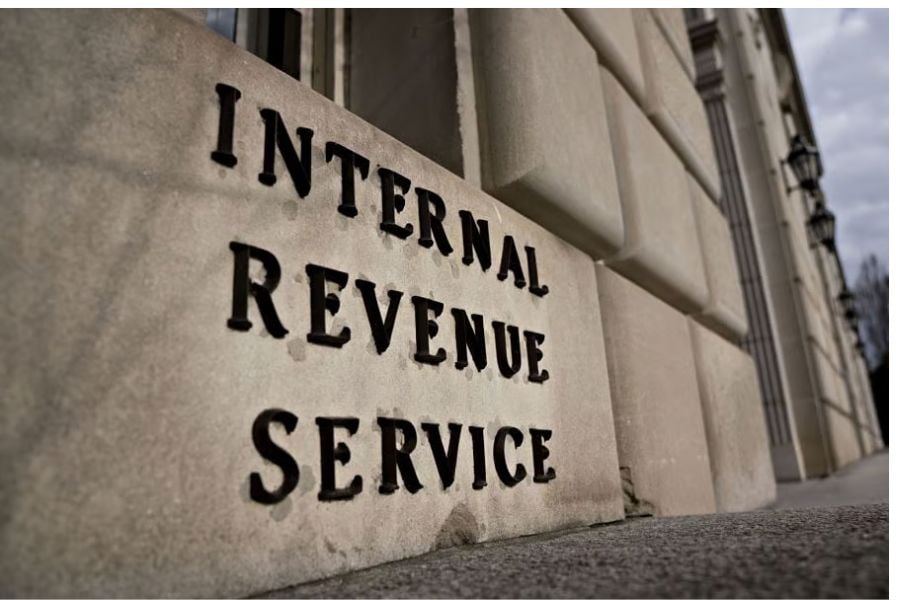
Former Treasury Secretary Lawrence Summers said that the Trump administration’s moves to downsize the Internal Revenue Service, along with other changes, are likely to incentivize reduced tax-payment compliance — potentially costing the federal government $1 trillion in lost revenues over a decade.
“We are threatening the basis of our tax system, which is based on voluntary compliance,” with the efforts to slash the IRS’s staff, Summers said on Bloomberg Television’s Wall Street Week with David Westin.
Summers said he’s currently conducting analysis on the issue, along with colleagues he didn’t specify. “I’d be surprised if we’re not on a path to sacrificing more than $1 trillion of revenue over the next decade because of this misguided, wanton attack on the IRS,” he said.
About 20,000 IRS workers, or roughly a fifth of the agency, opted to take a deferred resignation offer this month, Bloomberg reported last week. That came on top of about 4,700 employees who took an initial offer earlier this year. Roughly 7,300 probationary employees were separately put on administrative leave.
IRS leadership has also been in severe turmoil, with the agency now being run by its fifth acting commissioner since Trump took office in January. Treasury Secretary Scott Bessent on Friday announced the appointment of his deputy, Michael Faulkender, to take the role after reports that his predecessor had been installed at the urging of Elon Musk without Bessent’s knowledge. The Treasury chief said “trust must be brought back to the IRS.”
Summers, a Harvard University professor and paid contributor to Bloomberg TV, said of the downsizing initiative that “because of the incentive scheme, the most competent people — the people who can get the best jobs elsewhere — are the ones who are most likely to leave.”
Willingness of households and companies to comply with tax laws may also be affected by having “a president who’s completely delegitimizing government and who’s taking away the capacity of the IRS to process tax returns to audit when that’s necessary,” Summers said.
The former Treasury chief anticipates that “many more people” will shift income to cash payments, and fail to report them. Others will “engage in dubious transactions” with collaborators to “mis-value assets and avoid paying taxes,” he said. The use of “abusive tax shelters” will also climb, he predicted.
“It would be better not to be driving the economy from above-ground to underground in terms of American competitiveness,” Summers said. “I don’t think we’ve seen large consequences yet from from all of this. But the risks are very big.”
The Biden administration had championed a major funding increase for the IRS to pay for technological improvement and beefed up staffing. Republican lawmakers later clawed back some of that money. Bessent, for his part, told Senate Finance Committee members during his confirmation process that he supported the technological overhaul of the IRS, and that the agency “should enforce the tax code in an even-handed manner.”
The Budget Lab at Yale, a nonpartisan research group, forecast that laying off about 18,000 IRS employees would result in a net revenue loss of roughly $159 billion over ten years. That could rise to as much as $1.6 trillion over a decade if non-compliance were high, the group said.
A revenue hit from reduced tax compliance is “going to make our fiscal problem worse — or it’s going to force us into other kinds of damaging tax increases” down the road, Summers said.

Why advisors at every stage may have more leverage, flexibility, and strategic options than they realize.

A California team with four decades of combined experience and a Kentucky father-son practice headline this week's advisor movement.

From generative AI on trading desks to personalized portfolio tools, financial firms are spending big on AI, but measuring returns is proving harder.

The fast-growing RIA aggregator adds Transcend Capital Advisors, a multi-state firm with more than 1,000 client relationships.

Christopher Blotto moved this month to Janney Montgomery Scott.
Northern Trust’s Ken Lassner shows advisors how to convert volatility into after-tax portfolio gains
Dan Biagini of American Equity says the steady decline of pensions, longer lifespans and a reset in interest rates are rewriting how advisors build retirement income

