
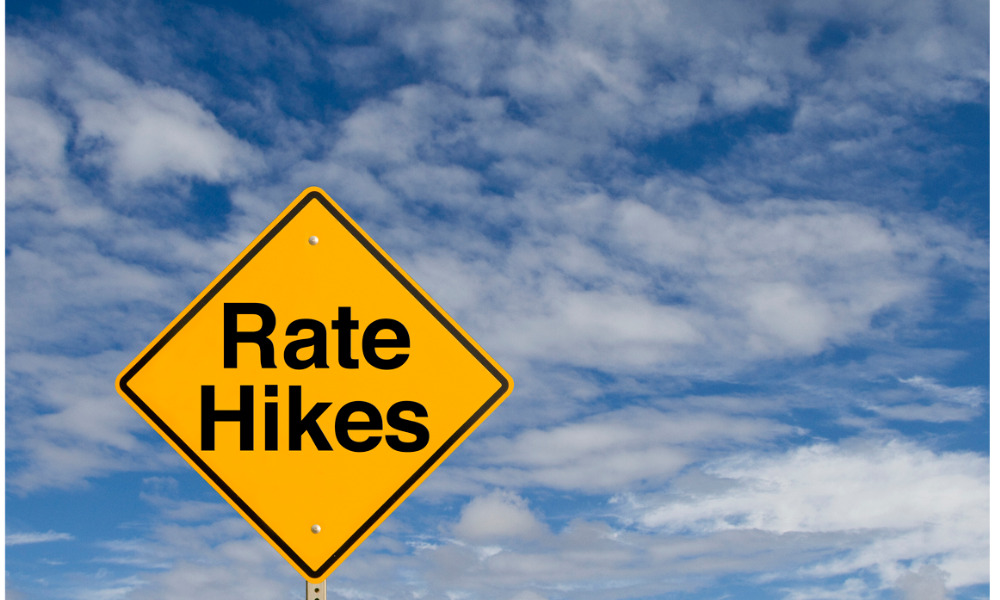
Federal Reserve Bank of Cleveland President Loretta Mester said the central bank will likely need to raise rates once more this year and then hold them at higher levels for some time to get inflation back to its 2% target.
However, Mester said the final decision will depend on how the economy evolves, pointing to a slowdown in China, the possibility of an extended strike by members of the United Auto Workers union and a potential government shutdown as risks to the outlook for inflation and growth.
“I suspect we may well need to raise the fed funds rate once more this year and then hold it there for some time as we accumulate more information on economic developments and assess the effects of the tightening in financial conditions that has already occurred,” Mester said Monday.
“Whether the fed funds rate needs to go higher than its current level and for how long policy needs to remain restrictive will depend on how the economy evolves relative to the outlook,” she said in remarks prepared for an event organized by the 50 Club of Cleveland, a group of business leaders and lawyers.
Mester, who does not vote on monetary policy this year, said the rate of inflation remains too high and the risks are still “tilted to the upside.” She said rising gas prices resonate strongly with consumers, who could expect inflation to start accelerating again.
Some consumers may adjust their spending so they can afford student-loan payments, which are resuming this month after more than three years because of a federal pause put in place during the pandemic, Mester said.
But she doesn’t expect that to cause a dramatic shift in the economy.
“There’s definitely going to be people who are going to now have to shift some of their spending to being paying off that debt,” Mester said. “That is a moderation of consumer spending, but it’s not going to be an abrupt change in what we’ve been seeing in the economy so far.”
Fed officials last month left the target range for its benchmark unchanged at 5.25% to 5.5%, a 22-year high. Projections published at the same time showed 12 out of 19 policymakers expected one more rate increase for this year, and fewer rate cuts in 2024 than previously anticipated, in part due to a better outlook for the labor market.
Several Fed officials speaking since the meeting have shared differing outlooks on the best path for rates. Earlier on Monday, Michael Barr, the Fed's vice chair for supervision, said the U.S. central bank is “likely at or very near” a level of interest rates that is sufficiently restrictive, echoing Chair Jerome Powell’s message that officials can proceed carefully on whether to hike again.
At a separate event before Barr’s, Fed Governor Michelle Bowman repeated that multiple interest-rate hikes may be required to get inflation down to the central bank’s goal even after data for August showed some of the slowest price increases since 2020.
And on Friday, New York Fed President John Williams suggested the central bank may be done raising interest rates, though he said policymakers would keep them high for “some time” to bring inflation down to the central bank’s 2% goal.

LPL Financial and Raymond James also add independent advisors from Osaic and Edward Jones in Michigan and Arizona.

The SEC-registered RIA advises on more than $1 billion in client assets, with no advisory fee through 2027 and no human financial advisors.

The four wirehouse firms lost 1,449 experienced advisors and recruited 932 in the first six months of the year, according to Diamond Consultants.

Merit's 10th Commonwealth addition deepens its Western New York reach, while another Hightower partner joins its Signature Wealth platform in Michigan.

Report on Climate Action 100+ signals risk for passive managers' 13G status heading into the 2027 proxy season.
Knighthead Life entered the market with a competitive MYGA. A strong launch earned advisor confidence and paved the way for FIAs.
As AI makes financial information more accessible than ever, Lana Hock explains why human judgment, trust, and empathy remain the qualities clients value most in a financial advisor

