

The financial advisory profession has reached a pivotal moment. After years of post-pandemic recovery, 2024 marked a return to strong, innovation-driven growth for advisory firms across the United States. Now, with the release of the 2025 InvestmentNews Advisor Benchmarking Study, firms of every size have access to the most comprehensive analysis of performance, profitability, and compensation trends shaping the industry.
Drawing on detailed survey data from 77 advisory firms nationwide, the study found that firms recorded striking growth in assets under management (AUM), revenues, and profitability in 2024, while many redefined their approaches to staffing, client relationships, and operational efficiency.
Fueled by strong US gross domestic product (GDP) expansion of 5.3 percent and favorable market conditions, advisory firms recorded an average 20.6 percent increase in AUM in 2024 – signaling a return to pre-pandemic levels.

Revenue growth was even more impressive, with median firm revenues soaring 30.5 percent, compared to just 3.9 percent the year before. Net new client relationships also rebounded, rising 15.2 percent, signaling renewed momentum in client acquisition and retention strategies.
Importantly, profitability strengthened alongside growth. Median operating profit margins rose to 27.8 percent, with larger firms enjoying margins close to 29 percent. Yet smaller firms held an advantage in owner income efficiency, underscoring the variety of successful business models across the profession.
One of the most powerful insights from this year’s study is the surge in productivity. For the first time, revenue per professional surpassed $1 million, reflecting the payoff from technology adoption, streamlined operations, and improved team structures. Top-performing firms demonstrated what scalable excellence looks like, serving nearly double the clients per professional compared to peers while holding overhead to just 25.7 percent of revenue.
The report also highlights sweeping changes in staffing and pay practices. Service and support advisors saw the largest salary increases in years – with base pay jumping 32 percent - reflecting heightened entry-level demands and a competitive talent market. Meanwhile, senior advisors and partners saw base pay stagnate or decline, with greater emphasis shifting toward incentive-based compensation tied to firm performance.
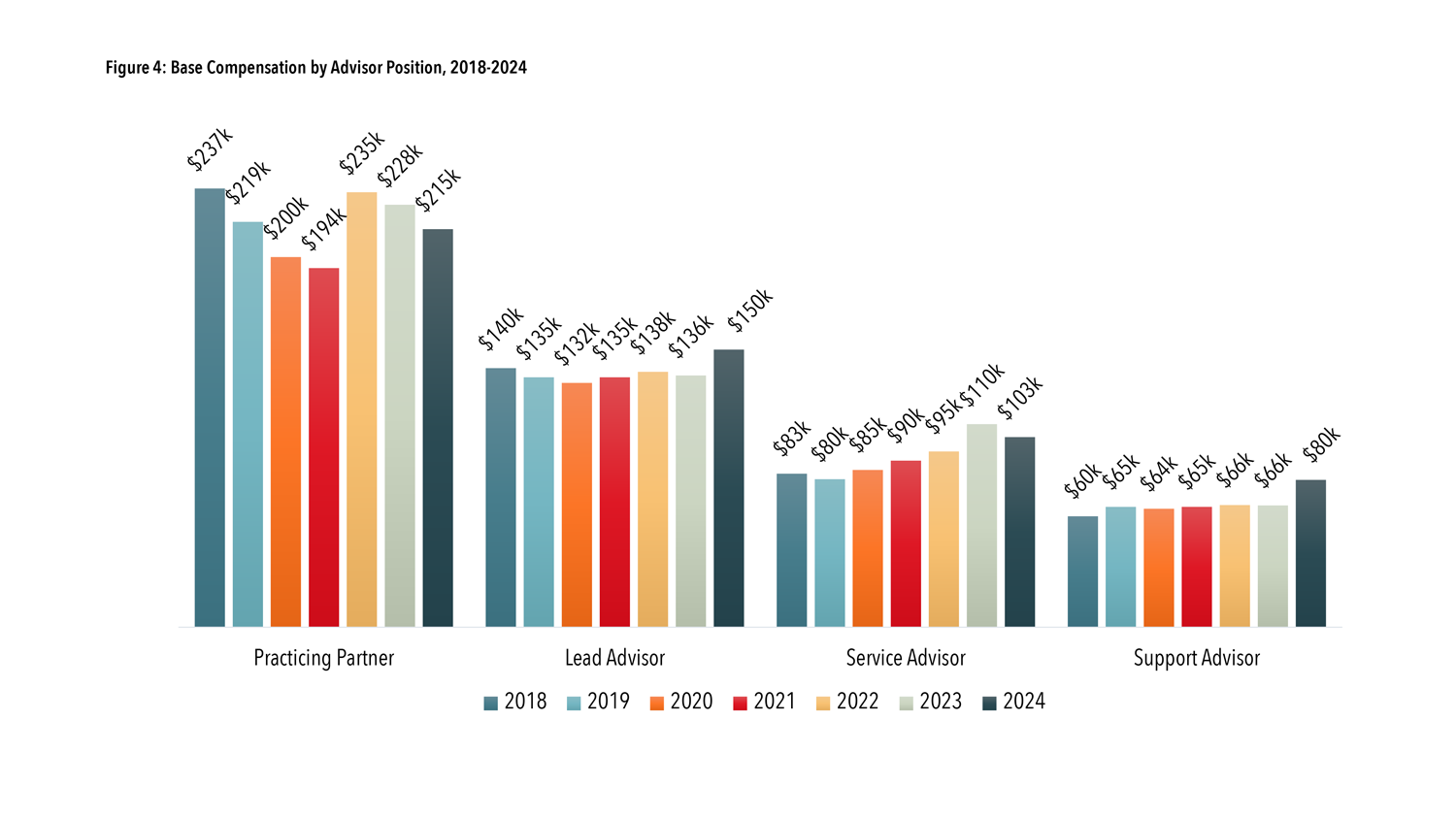
At the executive level, compensation growth has been striking. Chief operating officer (COO) pay has risen 38 percent since 2018, reflecting the increasing operational complexity of managing billion-dollar firms. Operations and marketing roles also experienced significant compensation growth, as firms doubled down on scalability, client experience, and business development.
For advisory leaders, the 2025 Advisor Benchmarking Study offers more than numbers - it provides a blueprint for navigating the future. From strategies to reduce client attrition and strengthen multigenerational relationships, to insights on leveraging technology and optimizing pricing, the study uncovers what separates top performers from the rest.
As the industry confronts generational transitions, regulatory shifts, and an increasingly competitive talent market, the firms that thrive will be those that embrace intentional growth, operational efficiency, and people-first leadership.
The 2025 InvestmentNews Advisor Benchmarking Study is your essential guide to understanding where the profession is headed—and how to get there first.

Iowa's Greenwood Wealth Partners exits D.M. Kelly as UBS and Ameriprise win Merrill Lynch recruits in California and Florida

Less than 1% of pool funds went to actual trading, CFTC says

Plus, SEIA builds a governed data foundation for its in-house AI and Snappy Kraken debuts a read-only marketing coworker for advisors.

He owes $364 million but pays $100 a month

Broadridge, Wedbush and Alaris Acquisitions have also filled senior wealth management roles with hires from J.P. Morgan, Osaic and SageView.
As AI makes financial information more accessible than ever, Lana Hock explains why human judgment, trust, and empathy remain the qualities clients value most in a financial advisor
Northern Trust’s Ken Lassner shows advisors how to convert volatility into after-tax portfolio gains
