
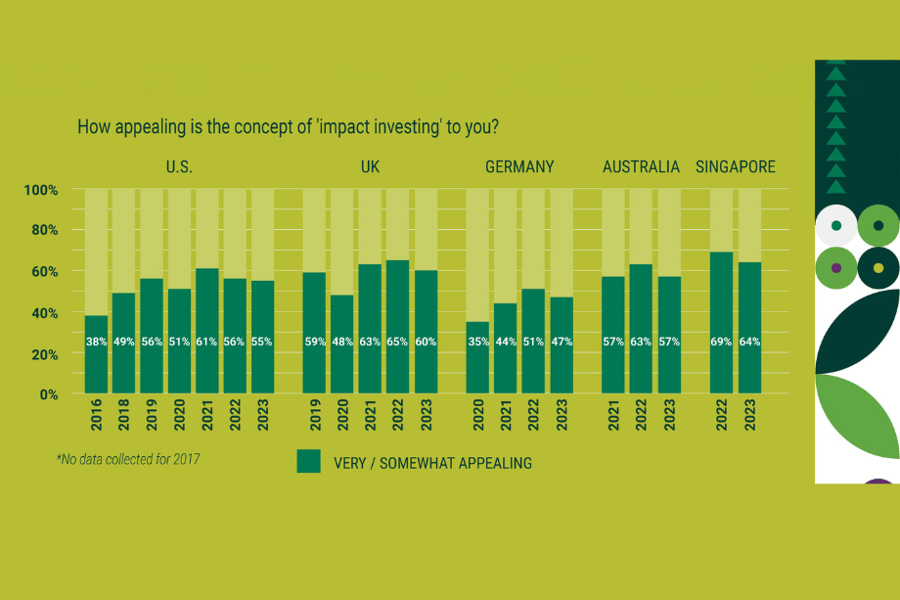
Are your clients willing to trade returns for impact? There’s a fair chance they will, according to new research from a global asset manager.
Forty percent of U.S. respondents to the seventh impact investing survey from American Century Investments said they would sacrifice higher returns if their investments were making an impact, rising 4% from the previous iteration of the study.
This puts American respondents above those in the U.K. (33%), Germany (31%), and Australia (29%) in this regard, but behind those in Singapore (47%). Across all countries polled, 67% of participants said they would sacrifice up to 10% of returns, most saying 6-10% would be their preference, but few would be willing to lose 16% or more.
But the report also found that interest in impact investing is declining across all markets included, although the U.S. saw the smallest decrease (-1%) while Australia saw the largest (-6%). While baby boomers’ interest has declined the most at -8% with Gen X at -5%, there is disparity among younger cohorts with millennials holding relatively steady at -1% but Gen Zs showing a -7% decrease.
There has also been a change in the driving cause behind impact investing. Healthcare has surpassed environment as the top concern overall.
In the U.S., greenwashing and the sustainability backlash both influenced interest in impact investing at higher levels than the prior year.
"In its earliest forms, impact investing often accepted lower expected returns to have a bigger impact, but our impact investment strategies emphasize sustainability-related attributes or outcomes in addition to delivering a financial return,” said Sarah Bratton Hughes, senior vice president and head of sustainable investing for American Century Investments. “Identifying impact-related factors that could affect a company's ability to stay competitive over the long term has the potential to add to returns. A willingness to give up as much as 10% of an expected return shows that impact investors expect to earn competitive returns and are making rational choices to realize an impact emphasis in addition to a financial return."

CFP, CFA and CPA holders could gain accredited investor status as regulators weigh wider private market access for advisory clients

DeepVest, Vanilla and Libretto roll out tools to help financial advisors launch firms, close estate plans and sharpen planning skills

“People aren't effectively using their wealth in retirement,” said David Blanchett of Prudential.

Second-generation NFL ref Shawn Hochuli co-founded IWM Partners in Irvine, California, a wealth management practice with more than $500M in client assets

U.S. seniors lose $28.3 billion annually as a result of financial exploitation, according to a 2023 AARP study.
As AI makes financial information more accessible than ever, Lana Hock explains why human judgment, trust, and empathy remain the qualities clients value most in a financial advisor
Northern Trust’s Ken Lassner shows advisors how to convert volatility into after-tax portfolio gains

