
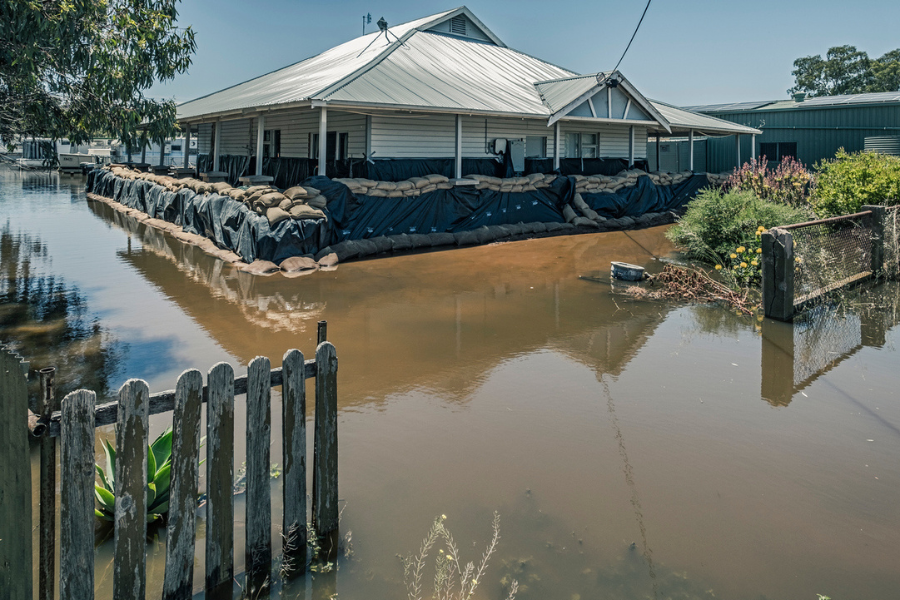
Roughly one in 37 homes are now considered seriously underwater in the US and that share is much higher across a swath of southern states, according to data out Thursday.
Nationally, 2.7% of homes carried loan balances at least 25% more than their market value in the first few months of the year. That’s up from 2.6% in the previous quarter, according to the first-quarter 2024 US Home Equity & Underwater Report from ATTOM, a real estate data firm.
While the share of these homes is ticking up, it remains much lower than before the pandemic, when the rate was more than twice as high.
Mortgages can generally become seriously underwater when someone overpays for a home, or when it is purchased with a small downpayment that doesn’t provide a sufficient buffer if the property falls in value.
During the pandemic, government stimulus and rising property prices were a huge boon to homeowners, but higher interest rates meant to curb inflation may be finally be helping to cool the housing market.
Several southern states saw shares of seriously underwater homes grow more than the rest of the country. Kentucky’s share jumped to 8.3% in the first few months of the year from 6.3% in the previous quarter. West Virginia’s share rose to 5.4% from 4.4% over the same period, while Oklahoma climbed to 6.1% from 5.5%, and Arkansas went up to 5.7% from 5.2%.
The states with the biggest increase in number of seriously underwater homes are also in the south. Kentucky is in first place with a year-over-year jump of more than 20,500 homes - nearly twice as many as second-place Mississippi and Oklahoma, coming in third.
Among metro areas with a population of at least 500,000, Baton Rouge, La. had the largest share of seriously underwater mortgages in the first quarter, with 13.4%. Neighboring New Orleans came in second with 7.3%, followed by Jackson, Miss., and Little Rock, Ark., with 6.5% and 6%, respectively. Syracuse, NY came in fifth, with 5.6% of homes seriously underwater.

LPL Financial and Raymond James also add independent advisors from Osaic and Edward Jones in Michigan and Arizona.

The SEC-registered RIA advises on more than $1 billion in client assets, with no advisory fee through 2027 and no human financial advisors.

95.8% of house trades were winners. For clients? The SEC says just 14.9%.

The complaint says Duolingo added friction on purpose, then lied about it.

The four wirehouse firms lost 1,449 experienced advisors and recruited 932 in the first six months of the year, according to Diamond Consultants.
Knighthead Life entered the market with a competitive MYGA. A strong launch earned advisor confidence and paved the way for FIAs.
As AI makes financial information more accessible than ever, Lana Hock explains why human judgment, trust, and empathy remain the qualities clients value most in a financial advisor

