U.S. stocks fell, with the Standard & Poor's 500 Index remaining near a 22-month low, as investors shunned risk worldwide amid concern that central-bank efforts to support growth are losing their potency.
Banks led the early retreat, with
Citigroup Inc. and
Bank of America Corp. falling more than 5 %.
Prudential Financial Inc. sank the most since 2013 after its profit missed analysts' estimates. Equities briefly extended losses as Boeing Co. tumbled 6.7% after people familiar with the matter said regulators are probing its accounting related to two of its best-known models of airliners.
The S&P 500 Index dropped 1.4% to 1,826.59 at 10:48 a.m. in New York, headed toward the longest losing streak since September as it extended declines to a fifth day. The Nasdaq Composite fell 0.9% to edge closer to a 20% drop from its record set in July. The Dow Jones Industrial Average lost 257.09 points, or 1.6%, to 15,682.10, on track the lowest since February 2014.
“Central bank policies and the uncertainty around their effectiveness is the big macro concern right now,” said Leo Grohowski, who helps manage more than $184 billion in client assets as chief investment officer of
BNY Mellon Wealth Management in New York. “There's a large disconnect right now between what the Fed might do and what they're saying and what the market is expecting. There's a lot of Fed uncertainty back on the table reminiscent of late last summer.”
Signals by central banks from Europe to Japan that additional stimulus is at the ready are failing to ease worries that global growth will keep slowing. An initial rally in U.S. stocks evaporated in the final hour of trading on Wednesday as speculation that the
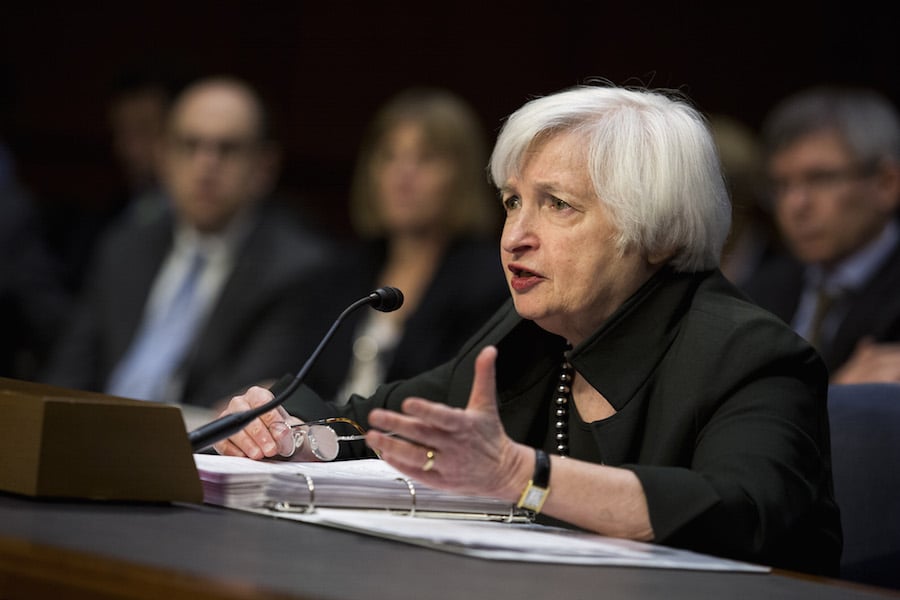
Federal Reserve will hold off longer on raising interest rates gave way to renewed concern over the strength of the U.S. economy. Fed Chair Janet Yellen told Congress yesterday that recent market turbulence may weigh on the outlook for the economy if it persists.
https://www.investmentnews.com/wp-content/uploads/assets/graphics src="/wp-content/uploads2016/02/CI103850211.JPG"
U.S. Stocks
The S&P 500 is 14% below its all-time high set in May, near its lowest level in two years. The Nasdaq Composite Index is almost 19% below its record set in July amid a 15% drop so far this year.
Declines in banks have been the biggest source of pain for U.S. equities in the market's latest rout: a gauge of financial shares on the S&P 500 has slumped more than 17% just this year, to its lowest level since 2013. With global stocks on the brink of a
bear market, trading volumes remain high and volatility is on the rise.
“Energy companies have passed the ball to financials, because that's where they get their money,” said John Manley, who helps oversee about $233 billion as chief equity strategist for
Wells Fargo Funds Management in New York. “When problems spring up anywhere, they inevitably find their way back to the financial sector.”
The U.S. earnings season hasn't provided much of a relief even though more than three-quarters of companies that have reported so far have exceeded analysts' profit estimates. Some 20 members of the S&P 500 are scheduled to release financial results today, American International Group Inc. and CBS Corp. Analysts estimate S&P 500 earnings fell 4.5% in the fourth quarter, and will continue to contract in the following two periods.
While the S&P 500's valuation of 15.4 times the forecast earnings of its members is in line with the average of the past five years, the measure has plunged 13% since the start of the year and is at the lowest level since October 2014. The gauge remains more expensive than developed markets in Europe, where the Stoxx 600 Index trades for 13.5 times estimated earnings. That's down from a record valuation of 17.4 times notched in June.
“We're far from seeing a turnaround in bearish sentiment and I think this will dominate markets for a while longer,” said Heinz-Gerd Sonnenschein, a strategist at Deutsche Postbank AG in Bonn, Germany. “People were looking for catalysts to trigger a lasting rebound, but so far nothing has worked -- not earnings season, economic data, central banks or very cheap valuations. Everyone is so nervous.”