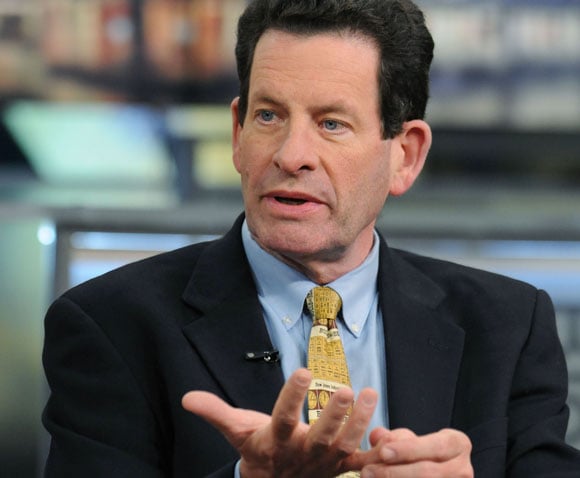
Billionaire investor Kenneth Fisher said the biggest U.S. companies will lead global stocks in 2011 even as returns diminish after an almost two-year bull market.
The Standard & Poor's 500 Index has risen 88 percent from its March 2009 low as the
Federal Reserve pledged to stimulate the economy and companies reported better-than-estimated earnings. The MSCI Emerging Markets Index advanced 134 percent, while the Russell 2000 Index of small companies rallied 130 percent during that period.
“America will do better than the rest of the world,” Fisher, 60, who oversees $41 billion at Woodside, California- based
Fisher Investments Inc., said in a Bloomberg Television interview today on “Surveillance Midday” with Tom Keene. “People will move away from small cap and emerging markets and more toward boring things that evidence quality.”
Increases in smaller companies that are more dependent on U.S. demand have preceded faster economic growth and the biggest equity rallies of the last two decades, data compiled by Bloomberg show. The Russell 2000 rose 25 percent in 2010, beating the S&P 500 by 13 percentage points. The last time the annual gain for the Russell 2000 was this much higher was in 2003, the first year of a bull market that lasted until 2007.
On the basis of profit, shares of larger companies are half as expensive as smaller stocks. The S&P 500 trades for 15.9 times reported income, while the Russell 2000's multiple is 34.8. The median ratios for the indexes since 1995 are 19 and 29.9, respectively, data compiled by Bloomberg show.
Timken Co., a U.S. maker of bearings and alloy steel products, is a company that will do well in a “middle phase” of a bull market, Fisher said. Profits are expected to increase for a fifth quarter when it reports earnings around Feb. 2, data compiled by Bloomberg show. The stock has risen almost fivefold since March 2009.
Fisher's predictions proved too bullish four years ago. “I'm on the wildly optimistic side of things,” Fisher told Bloomberg News at the end of March 2007. While the S&P 500 went on to rise 10 percent in six months to a record high, it then plunged as much as 57 percent through March 2009.
The investor, who correctly predicted in April 2009 that the S&P 500 would extend a rally that started in the previous month to between 60 percent and 70 percent, said he doesn't expect “high equity returns” in 2011.
“I do not think the bull market is over, but I expect this year to be frustrating for almost everyone,” Fisher said. “This is a year where returns are likely to be disappointing to bulls and bears alike.”
--Bloomberg News--