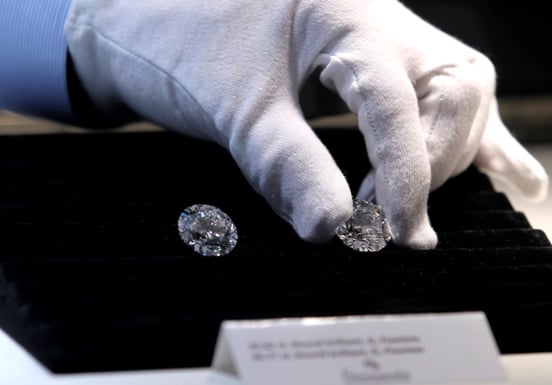
Former Rapaport Group executives are creating a fund that's looking to transform diamonds from the “talismans of magic” advertised by De Beers into commodity investments like copper and soybeans.
The precedents aren't good. Diamond Circle Capital Plc, the first publicly listed fund to invest in the stones, has plunged 49 percent since selling shares in 2008, compared with a drop of 14 percent in an index of overall prices for the gems. The first diamond investment
trust, set up in the 1980s, also collapsed.
Saul Singer, co-founder of Fusion Alternatives and a former research chief at Rapaport, the world's main provider of diamond prices, says conditions are right for his firm's new fund. He sees bottled-up demand from investors, locked out of a trade that sells diamonds through a closed network of dealers or in retailers. Prices have risen 11 percent in 2010, trailing gains in platinum, silver and gold.
“There is increased demand and increased interest from the investment community in diamonds,” Singer, 36, said in an interview. “The main goal is to put all the pieces together to create a marketable investment vehicle for the professional investment community.”
Fusion's 10-person team also includes Adam Schulman, former head of business development and marketing at Rapaport, and Raphael Bitterman, who ran international trading and compliance at the group. New York-based Rapaport has more than 10,000 clients in 70 countries.
Riding a Wave
Underpinning Fusion's plans is a steady decline in output of the rough diamonds that are fashioned into cut gems, and anticipation demand will outstrip supply. Diamond production slid 8.5 percent to 161.1 million carats in 2008 from 2005, RBC Capital Markets says, before slumping 30 percent last year as consumption tumbled following the world financial crisis.
Even before the collapse, output in Botswana, the biggest source, fell for three straight years through 2008, and in Australia production slid by more than half, RBC says.
Shrinking output also underscores diamonds' potential to ride a wave of surging prices of commodities such as gold and silver as central banks print money to buoy stagnant economies.
The U.S. and European banks' so-called quantitative easing debases their currencies and risks inflation, fueling investor demand for assets other than cash. “Savvy investors” may buy diamond funds to protect against losses on cash holdings, said Russell Mehta, chief operating officer of Rosy Blue (India) Pvt. Ltd., a unit of the world's biggest manufacturer of cut stones.
‘Crazy Prices'
“Whether it's the guy on the street, an investment banker or a client of a bank, they're all asking us, ‘How do we get into diamonds?,'” said Heno Kruger, head trader at Namakwa Diamonds Ltd., which owns mines in South Africa, Namibia and the Democratic Republic of Congo. “There's a lot of talk about diamonds. They're fetching crazy prices.”
Fusion faces skepticism from a trading community that Singer recognizes is “very closed, self-centric and complex,” and where reputation is paramount.
Antwerp's diamond district covers about a square mile of real estate containing more than 1,800 trading businesses that handle 80 percent of the world's rough stones sold each year and half of the polished gems. The Antwerp Diamond Bourse has been in operation since 1904, according to the exchange's website.
“We do not want to undermine the emotional and symbolic value of the diamond,” said Caroline Germain, a spokeswoman for the Antwerp World Diamond Centre, representing the industry in Belgium. “Diamonds should remain something magical, mystical, something that you buy and has value for eternity.”
‘Magic, Passion, Success'
Others in the industry are concerned the allure of the stones as luxury items, from the crown jewels worn by Queen Elizabeth II to the gems owned by Hollywood's Elizabeth Taylor, will be undermined if they trade like any other commodity.
“Diamonds are purchased for emotions,” said Varda Shine, chief executive officer of Diamond Trading Co. International, the rough-diamond distribution arm of De Beers, the second-biggest producer. “We don't think that diamonds being treated as an investment in the same way as gold is, is the answer.”
De Beers, in its bridal brochure, describes diamonds as “talismans of magic, passion and success,” citing the precious stones given by actor Richard Burton to Taylor and by Archduke Maximilian of Austria to Marie de Bourgogne in the 15th century.
Overall cut-diamond prices have climbed 14 percent since polishedprices.com supplied data from the start of 2002, compared with a threefold gain in platinum, fivefold in gold and almost sixfold in silver.
Jewelers' Loop
Part of the challenge of investing in diamonds is their worth varies depending on color, quality, cut and size, and the expert with jewelers' loupe in hand defines that value. Prices for a 3-carat internally flawless and colorless diamond are up 78 percent in 2010, while those for similar 1-carat gems rose 10 percent, according to polishedprices.com figures.
“I don't want to call a diamond a commodity, because it's not,” Namakwa's Kruger said. “As much as the investment community discusses the issue of commoditizing diamonds, those discussions are nowhere close to being solved. Things are done on a handshake and my word is my honor.”
The first diamond investment trust, set up by Thomson McKinnon Securities Inc. in the 1980s, was wound up after a slump in the market, according to reports by the New York Times and Reuters.
Fusion anticipates by investing in sufficient quantities of 1-to-4 carat diamonds of near-uniform quality, more easily valued than larger stones, it can avoid the pitfalls of erratic pricing.
Small Carat, Big Stick
A round polished 4-carat stone may fetch about $120,000, compared with the minimum $1 million gems bought by Diamond Circle when it sought to lure investors to the first publicly listed diamond fund. Diamond Circle Chairman Rupert Cottrell declined to comment when contacted by Bloomberg News.
“If there was a diamond fund that I trusted, I personally would be very happy putting some money in it,” said Charles Wyndham, founder of WWW International Diamond Consultants Ltd. and former director of De Beers' sales operation. “There aren't two cocoa beans that are the same. Diamonds like everything else create problems, and problems are there to be solved.”
—Bloomberg News—