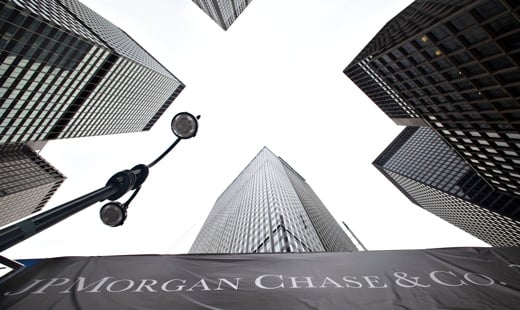

Would you believe $9B? JPMorgan trading loss said to be growing exponentially

Would you believe $9B? JPMorgan trading loss said to be growing exponentially
A report by the New York Times claims the trading loss at JPMorgan may be three times what CEO Jamie Dimon initially estimated
JUL 03, 2012
JPMorgan Chase & Co. (JPM) fell more than 6 percent in European trading after the New York Times reported the lender's trading losses from credit derivatives may total as much as $9 billion, exceeding the firm's initial estimate. The shares fell to $34.50 as of 1 p.m. in Frankfurt trading from their $36.78 close in New York yesterday. JPMorgan Chief Executive Officer Jamie Dimon said on May 10 the bank lost more than $2 billion on bets in credit markets taken by its chief investment office in London and that the loss could increase by as much as $1 billion this quarter. Dimon, 56, has said JPMorgan is in no rush to unwind the trades, even if adverse market moves produce bigger losses in the short term. The firm's losses have increased in recent weeks as JPMorgan sought to exit its holdings, the New York Times reported today, citing unidentified former traders and executives at the bank. The company has already closed out more than half of its positions, the newspaper said. “We are now in the realms of speculation in terms of the sheer scale,” said Christopher Wheeler, a London-based analyst at Mediobanca SpA, who has a 'neutral' recommendation on JPMorgan. “The final loss will be offset by a number of items including a debt-valuation adjustment gain and gains on the sale of some of their treasury securities. However, the larger the number, the more difficult it is to reduce the impact.” Dimon told lawmakers this month the company would be “solidly profitable” when it reports second-quarter earnings on July 13. Although the trading loss had grown to $2 billion for the quarter when the company disclosed it in May, the net loss for the CIO division at that time was $800 million. Dimon said the bank had $8 billion in gains in another trading portfolio within the CIO and had used $1 billion of that to offset the loss on the credit derivatives portfolio in London. --Bloomberg News--

Latest News

Private credit becoming 'big piece' of annuities, T. Rowe exec says

Goldman Sachs retirement survey finds 83% want guaranteed income, while the annuities providing that income increasingly hold private credit.

Zocks debuts Claude plugin with seven skills for financial advisors

The AI meeting assistant's Advisor Intelligence plugin turns client conversation data into annual reviews, tax scans and attrition alerts.

Stifel settles massive $30 million complaint involving star broker’s sale of structured products

Chuck Roberts and Stifel have been facing scrutiny due to sales of structured products and structured notes.

SEC floats CFP route to accredited investor status, fund rules refresh amid private market push

Among other updates, the proposals would let advisors to regulated funds earn performance fees and allow interval funds to offer monthly repurchases.

The Year Is 2046 and I’m a Financial Advisor 

What will financial advice look like 20 years from now? Evan Vladem explores how AI may transform wealth management while reinforcing the enduring value of human guidance, trust, and empathy. 

SPONSORED In the Age of AI, Trust Becomes the Advisor's Greatest Asset

As AI makes financial information more accessible than ever, Lana Hock explains why human judgment, trust, and empathy remain the qualities clients value most in a financial advisor

SPONSORED Direct indexing webinar targets tax-loss harvesting amid market swings

Northern Trust’s Ken Lassner shows advisors how to convert volatility into after-tax portfolio gains
