
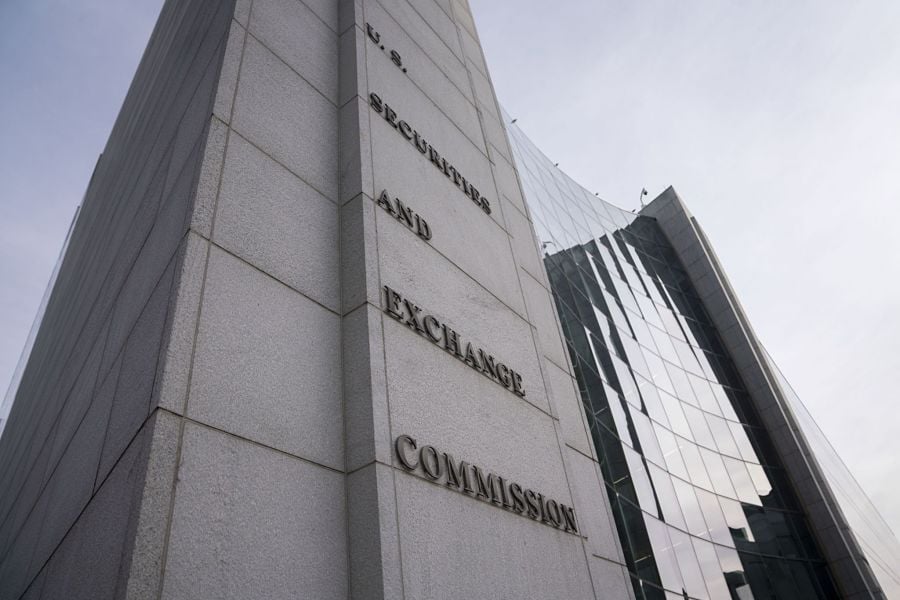
The Securities and Exchange Commission on a split vote Monday released a proposal to require public companies to disclose climate risks and greenhouse gas emissions.
The 510-page proposal would mandate for the first time that companies include on registration statements and periodic reports filed with the agency information about how risks associated with climate change could affect their business operations and financial performance.
The proposal requires disclosure of greenhouse gas emissions produced directly and indirectly by companies, as well as emissions related to suppliers and other affiliated firms. The proposal also would require financial statement metrics for climate risk and information about climate preservation targets and goals, according to a summary.
SEC Chairman Gary Gensler said the proposal responds to strong investor demand for more information about climate-related financial risks. Companies currently provide climate disclosures on a voluntary basis in different ways.
“If adopted, it would provide investors with consistent, comparable and decision-useful information for making their investment decisions and would provide consistent and clear reporting obligations for issuers,” Gensler said at an SEC open meeting. “Companies and investors alike would benefit from the clear rules of the road proposed in this release.”
The proposal was released for public comment by a 3-1 vote, with Gensler and the other two Democratic SEC commissioners, Allison Herren Lee and Caroline Crenshaw, in favor. The measure drew opposition and a sharp rebuke from SEC Commissioner Hester Peirce, the lone Republican on the panel.
In a 24-minute statement, Peirce asserted the proposal would undermine the SEC’s traditional approach to disclosures by requiring information that may not have any impact on a company’s business results. She charged the agency was bowing to the demands of climate activists.
“It forces investors to view companies through the eyes of a vocal set of stakeholders for whom a company’s climate reputation is of equal or greater importance than a company’s financial performance,” Peirce said during the open meeting. “The proposed rule dispenses with materiality in some places and distorts it in others.”
Peirce also warned that the SEC was exceeding its authority by going beyond financial markets regulation and getting involved in climate oversight. She said forcing companies to make climate disclosures may violate their free speech rights.
“This proposal steps outside our statutory limits by using the disclosure framework to achieve objectives that are not ours to pursue and by pursuing those objectives by means of disclosure mandates that may not comport with First Amendment limitations on compelled speech,” she said.
Her comments foreshadowed the lawsuits that are widely expected to be filed against the proposal. Gensler expressed confidence the measure would withstand legal scrutiny.
“In making decisions about disclosure requirements under the federal securities laws — including decisions about today’s climate-related disclosures — I am guided by the concept of materiality,” Gensler said. “As the Supreme Court has explained, information is material if ‘there is a substantial likelihood that a reasonable shareholder would consider it important’ in making an investment or voting decision, or if it would have ‘significantly altered the total mix of information available.”
The proposal will be open for public comment for 60 days, the SEC said. The agency could make changes to the measure before issuing a final rule in the coming months.
The proposal is one of the first by a government agency in the Biden administration's governmentwide effort to combat climate change.
The measure goes farther than anticipated because the SEC is creating its own climate disclosure framework, said Matt Paulson, a partner and environmental lawyer at Bracewell.
“It’s bolder and requires even more disclosure and a lot of issues I didn’t expect,” Paulson said.
For instance, the proposal requires disclosures about so-called Scope 3 greenhouse gas emissions, or those that are produced in a company’s supply chain. The proposal exempts some small companies and also provides a safe harbor from litigation.
“I have some concerns with how they framed safe harbor,” Paulson said.
He also was surprised the SEC asserted that Scope 1 and 2 greenhouse gas emissions do affect a company’s performance prospects.
“The materiality would appear to be assumed,” Paulson said.
The Investment Company Institute backed the mandatory Scope 1 and 2 greenhouse gas reporting.
“The enhanced disclosure that the proposal calls for will provide investors with comparable, consistent, qualitative, and quantitative information,” ICI president and CEO Eric J. Pan said in a statement. “We will carefully study the Commission’s multifaceted approach toward requiring Scope 3 disclosure in certain circumstances and appreciate that the SEC recognizes the many challenges that currently exist with reporting Scope 3 emissions.”
The American Securities Association warned that the SEC was prioritizing climate change over investment returns.
“Before any rule is finalized, the American public must understand exactly how the SEC plans to empirically prove its disclosures will impact global temperatures, our national security, and the cost of food, gas, heat, and other goods and services American citizens need to live,” ASA Chief Executive Chris Iacovella said in a statement.

A Nationwide survey finds 47% of GLP-1 users have never discussed the drugs’ financial impact with an advisor, even as many dip into savings.

The hundreds of millions of dollars from a sale of Inspired Healthcare properties does not mean an immediate windfall for investors.

"Most pre-retirees are uncomfortable making key retirement income decisions without an advisor's help," said Chris Bailey of Cerulli.

Also, Summit Wealth Group nabs a Commonwealth advisor in Tennessee, Oxford Financial adds two managing directors, and Verdence draws an ultra-high-net-worth advisor from Fidelity.

When advisors have tech to handle meeting prep and organization, it frees up time they can reinvest more thoughtfully into helping clients.
Knighthead Life entered the market with a competitive MYGA. A strong launch earned advisor confidence and paved the way for FIAs.
As AI makes financial information more accessible than ever, Lana Hock explains why human judgment, trust, and empathy remain the qualities clients value most in a financial advisor

