
This year’s frenzied rush for gold is turning out to be quite a boon for State Street Corp.
The asset manager’s $78 billion SPDR Gold Shares exchange-traded fund (GLD) is now making more money than any other product in the $4.6 trillion U.S. ETF market.
Annual revenues for the fund have jumped to about $312 million as of July 30, meaning it is outearning the world’s largest ETF. That’s another State Street vehicle, the $288 billion SPDR S&P 500 ETF Trust (SPY), which generates about $270 million.
A combination of GLD’s higher fees -- an expense ratio of 0.4% versus 0.095% for SPY -- and an almost relentless demand for the yellow metal have catapulted it from fourth on the revenue leader board in 2017, according to Bloomberg Intelligence data.
| Fund | Ticker | Total assets (bln) | Expense ratio | Annual revenue (mln) |
|---|---|---|---|---|
| SPDR Gold Shares | GLD | $77.877 | 0.4 | $311.508 |
| SPDR S&P 500 ETF Trust | SPY | $287.641 | 0.095 | $270.383 |
| Invesco QQQ Trust Series 1 | QQQ | $122.377 | 0.2 | $244.753 |
| iShares MSCI Emerging Markets ETF | EEM | $24.063 | 0.68 | $163.625 |
| iShares MSCI EAFE ETF | EFA | $47.737 | 0.32 | $152.760 |
Coronavirus-fueled market turmoil and the plunge in global bond yields have fueled 19 consecutive weeks of inflows to gold ETFs.
“It’s a perfect combination of record gold ETF demand and GLD being priced at more than double the industry weighted average expense ratio,” said Nate Geraci, president of investment-advisory firm the ETF Store. “If gold ETF demand continues, GLD can absolutely hold on to the top spot. But competition will ultimately chip away.”
From an issuer perspective, the current rankings may offer consolation amid the fund industry’s ongoing fee war.
Vanguard Group -- the second-largest ETF player behind BlackRock Inc. and arguably the cheapest -- doesn’t have a single product in the top 10. Its biggest offering, the $154 billion Vanguard S&P 500 ETF (VOO), is the 30th most profitable fund. The 0.03% expense ratio generates just $46 million per year.
The triumph of GLD highlights an aspect of competition in the market which is often overlooked: Investors tend to like funds with history.
State Street launched a less-expensive gold ETF in 2018, the SPDR Gold MiniShares ETF (GLDM), with an expense ratio of 0.18%. At $3.2 billion, the fund is still dwarfed by GLD, which began trading in 2004.
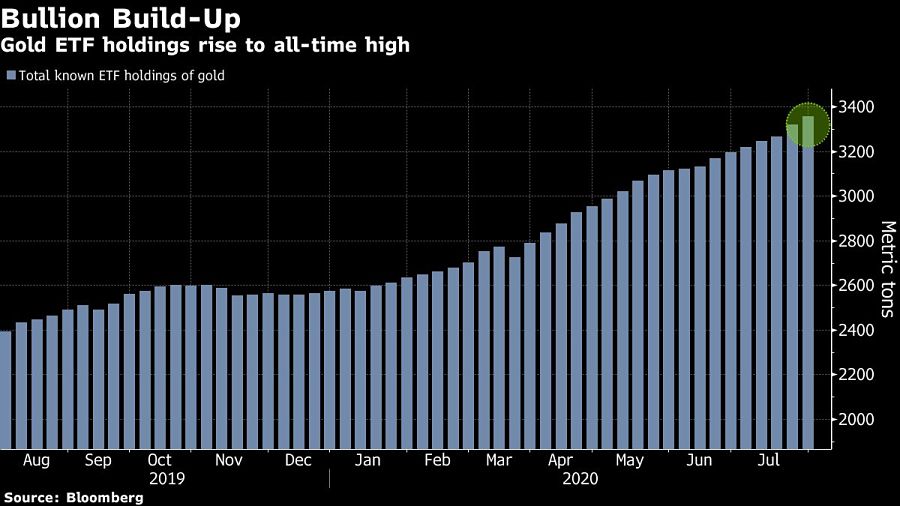
The unprecedented demand for gold ETFs could entice other issuers into the space, Geraci reckons. There are just 13 gold exchange-traded products listed in the U.S., with industry heavyweights such as Vanguard noticeably absent.
“I’m still surprised Vanguard hasn’t moved into physical gold ETF space,” Geraci said. “It seems ripe for another big player.”

Also, Orion has added BlackRock, Fidelity, and Vanguard to its custom portfolios suite, and RedBlack has set up a new headquarters after crossing a trillion-dollar milestone.

Also, New York-based Legacy Edge Advisors names its first-ever CEO, while Novare Capital Management hires a Vanguard veteran with a multigenerational planning focus.

Asset managers are racing to bring private market products to retirement plans, but cost and liquidity concerns linger.

Treasury's latest tax-exemption crackdown on private schools lands in the wake of a separate push to restrict refundable credits for some immigrant filers.

Workforce trust measures predicted which companies came out ahead during COVID-19. The same dynamic may now be playing out across the AI transition — and the data suggests the spread could be just as wide.
Northern Trust’s Ken Lassner shows advisors how to convert volatility into after-tax portfolio gains
Dan Biagini of American Equity says the steady decline of pensions, longer lifespans and a reset in interest rates are rewriting how advisors build retirement income

