

UBS Group warned that wealthy clients are turning increasingly risk-averse, adding to challenges for Switzerland’s largest bank as it embarks on the complex task of integrating Credit Suisse Group.
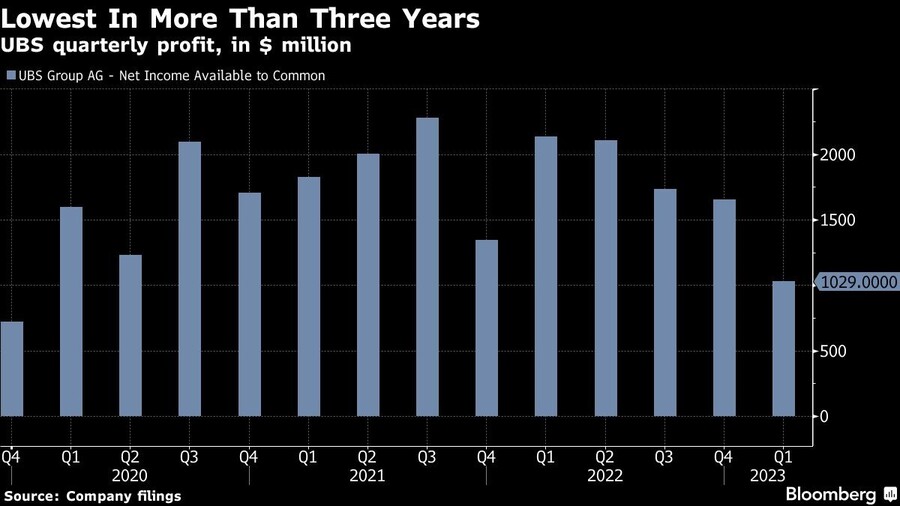
Shares of UBS fell as much as 5.4% in Zurich trading after the lender reported the weakest quarterly profit in more than three years, along with an outlook for interest income at the wealth unit that disappointed analysts.
That overshadowed $28 billion in new money from rich clients during the quarter, including $7 billion that came in the 10 days after the rescue of the smaller rival was announced late last month.
Retaining clients and assets is a key challenge for Sergio Ermotti, who was brought back as UBS chief executive as the bank embarks on an extensive restructuring following the historic deal. Credit Suisse revealed Monday that it borrowed far more from a central bank liquidity backstop than previously known, with clients continuing to flee after the deal was announced.
The inflows at UBS are “a sign of confidence of our clients,” Ermotti said in an interview with Bloomberg TV. The money didn’t come just from Credit Suisse clients, with the U.S. being a main driver, he said.
The new assets are an early indication of the scale of funds the combined firms will be able to retain. Credit Suisse clients had pulled about $53 billion from its wealth unit during the first quarter. Much of that didn’t end up with UBS, suggesting clients who had accounts with both banks are seeking to reduce their exposure following the deal.
UBS said it expects the takeover to close in May. The firm has been a beneficiary of Credit Suisse’s troubles, with wealthy clients adding $23.3 billion net new fee-generating assets already in the fourth quarter. It is now paying about 3 billion francs for a former competitor that finished March with a book value of 54 billion francs, giving it plenty of protection against losses.
Despite the new money that came in, revenue at the wealth business fell short of estimates, with UBS blaming “‘subdued” client activity that could continue into the second quarter. Ermotti said that the bank isn’t ruling out a potential recession later this year or early next year.
UBS fell 3.5% at 10:30 a.m. in Zurich, with analysts including Kian Abouhossein at JPMorgan Chase & Co. pointing to a weaker outlook for lending income at the wealth business. The bank also set aside $665 million for litigation tied to its role in selling mortgage securities before the financial crisis.
| Key figures for UBS’s first quarter: |
|---|
| Net income $1.03 billion; estimate $1.86 billion Wealth Management net new fee-generating assets $19.7 billion, estimate $17.67 billion Wealth Management total revenue $4.79 billion, estimate $4.9 billion Investment bank total revenue $2.35 billion, estimate $2.43 billion |
Still, “overall the results are in line with consensus expectations,” Abouhossein wrote. “More importantly, the wealth management unit remains a strong performer with the franchise well intact.”
In the investment bank, where traders and dealmakers had to contend with volatility from the banking crisis and uncertainty about the direction of interest rates, income from equities trading fell 23% from a year earlier, compared with 14% at the biggest U.S. firms. Fixed-income trading gained 0.8%, ahead of the 1% decline on Wall Street.
To finance the Credit Suisse deal, UBS has put its share buybacks on hold and recently won approval to use stock repurchased over the past year to pay for Credit Suisse. It had also launched a buyback of euro-denominated notes issued just before it agreed to take over its troubled rival, though most investors chose to hold on to the debt in a vote of confidence for the lender.
Ermotti said in the interview that he plans to resume the share buyback eventually, though it’s still too early to say when. “We are reiterating our intention to have a progressive cash dividend increase every year and we definitely have an intention to resume share buybacks when its appropriate,” he said.
Chairman Colm Kelleher has said that the integration will take as long as four years, and that the deal’s complexity makes it more challenging even than the emergency rescues forged during the height of the 2008 crisis. Kelleher said that there were “clearly” parts of Credit Suisse that had cultural issues, particularly the investment bank and some risk functions.
Bringing back Ermotti is part of a broader effort by UBS to build a management team with extensive institutional knowledge to oversee the integration. Christian Bluhm agreed to remain in his role as the bank’s chief risk officer, six months after announcing his departure, while his appointed successor Damian Vogel will now head risk control activities related to the integration.
Ermotti has also been holding talks with former UBS bankers including Tom Naratil about returning to the firm, people familiar with the matter have said. UBS also tapped strategy consultant Oliver Wyman for help on the integration, reconnecting Ermotti with former adviser Huw van Steenis, vice chair of the firm, who left the Swiss bank under former CEO Ralph Hamers, Bloomberg has reported.
During Ermotti’s first tenure as CEO, the bank pivoted away from investment banking and further toward wealth management, allowing it to make a predictable profit of between $4 billion and $8 billion every year for the past five years. The Swiss lender has said it plans to significantly cut Credit Suisse’s investment bank and ensure that its risk profile is more aligned with its own.

The new AI feature generates instant client portfolio talking points, slashing meeting prep time for advisors.

As Citizens expands its advisory footprint, the bank is also going after wealth trapped inside business ownership

The Forbes rankings are highly sought after by some advisors and firms for marketing purposes.

Meanwhile, an advisor tuck-in from Edward Jones expands Kestra's Washington, D.C.-area presence, and Janney deepens its Connecticut footprint with an experienced Wells Fargo advisor.

KFN Succession Center pairs advisors weighing retirement with buyers, as next-gen affordability keeps eroding industry-wide.
Northern Trust’s Ken Lassner shows advisors how to convert volatility into after-tax portfolio gains
Dan Biagini of American Equity says the steady decline of pensions, longer lifespans and a reset in interest rates are rewriting how advisors build retirement income

