
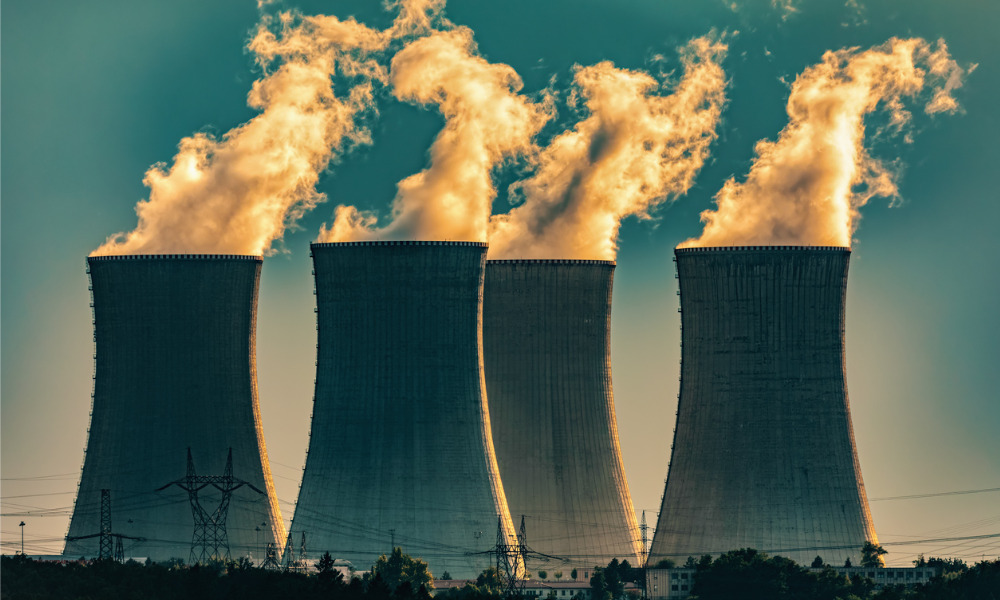
The US will lead a push at the COP28 climate summit to triple the amount of installed nuclear power capacity globally by 2050, marking a major turnaround for the controversial technology at the climate negotiations.
The declaration will call on the World Bank and other international financial institutions to include nuclear energy in their lending policies, according to a document seen by Bloomberg News. The US will likely be joined by the UK, France, Sweden, Finland and South Korea in the pledge to be signed Dec. 1 in Dubai, according to people familiar with the matter.
That will be followed a few days later by a nuclear industry commitment to triple generation resources from 2020 levels, said one of the people, who asked not to be named because the information isn’t public.
“Nuclear is 100% part of the solution,” John Kerry, the US special presidential envoy for climate, said at the Bloomberg New Economy Forum last week. “It’s clean energy.”
The countries recognize “the key role of nuclear energy in achieving global net-zero greenhouse gas emissions/carbon neutrality by or around mid-century,” a draft of the declaration says. “Nuclear energy is already the second-largest source of clean dispatchable baseload power, with benefits for energy security.”
The declaration is the latest sign of shifting sentiment toward nuclear power, which doesn’t produce carbon dioxide emissions, but has often been criticized over the waste it generates, the cost of building plants and potential security issues. Support has gained traction especially as clean back-up for renewable energy sources such as wind and solar. The countries will also commit to new technologies, such as small modular reactors.
The US sees such technology as possibly helping slash Africa’s emissions, while also adding more flexible generation capacity. The US is discussing nuclear cooperation agreements with Kenya and Ghana, and renewing a pact with South Africa, according to Joshua Volz, the US Department of Energy’s deputy assistant secretary for Europe, Eurasia, Africa and the Middle East.
The United Nations’ 28th Conference of the Parties, known as COP28, will take place in the United Arab Emirates, which is the only country in the Arabian Peninsula with a nuclear power program. It’s not clear if the hosts will sign.
The two-week summit due to start on Nov. 28 will include a “global stocktake” to track how far off course the world is to keeping global warming below 1.5C and what more needs to be done to close the gap. A report from the UN Tuesday showed that emissions are set to rise 9% by 2030, compared to 2010, putting the world potentially on course for warming of 2.8C.

Elsewhere, Wells Fargo Advisors adds a $400 million Morgan Stanley veteran in Naples as an ex-Cetera advisor goes independent with LPL

According to a federal charges Bradley Heppner, 60, received more than $150 million in payments through funneling money from GWG Holdings to a shell company.

A $1B fund allegedly skimmed 30% off the top, then swapped cash for locked-up stock.

Insiders allegedly rewrote projections three times in four days.

TCI Wealth Advisors also has also tapped JIFFYAI to unify onboarding and servicing, while TradePMR adds ICE market data to its Fusion advisor platform
Knighthead Life entered the market with a competitive MYGA. A strong launch earned advisor confidence and paved the way for FIAs.
As AI makes financial information more accessible than ever, Lana Hock explains why human judgment, trust, and empathy remain the qualities clients value most in a financial advisor

