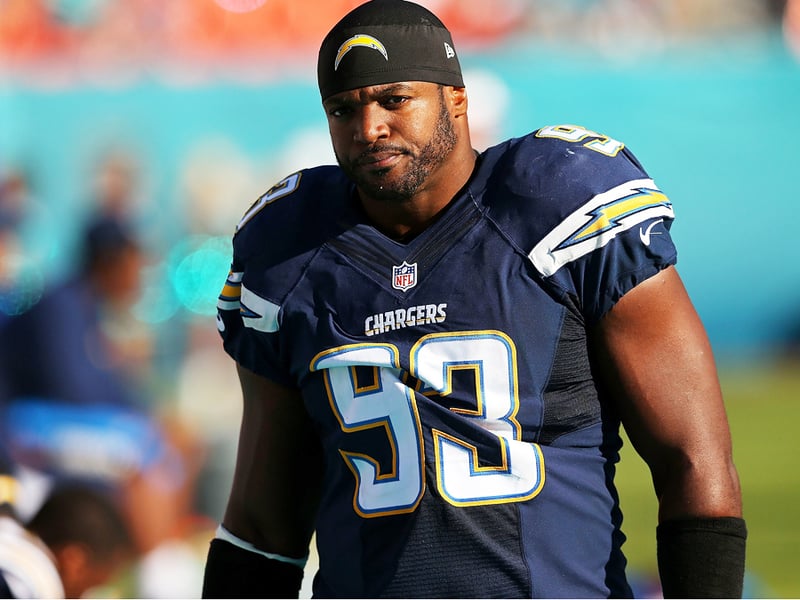
Bank of America Corp. has dodged a high-profile lawsuit brought by NFL star Dwight Freeney, who sued the company in February for $20 million in damages after a Merrill Lynch financial adviser allegedly played a role in leading him into a massive fraud that eventually brought him to the brink of bankruptcy.
A federal judge in the U.S. District Court for Central California, Margaret M. Morrow, sided with the bank's arguments that there were problems with the original complaint, primarily over the choice to name
Bank of America rather than Merrill Lynch, the subsidiary where the accused financial adviser worked.
Ms. Morrow cited case law that stated parent corporations were to be held liable for acts of a subsidiary “only in unusual circumstances.”
The financial adviser, Michael Bock, who is still working at a Miami branch office at Merrill Lynch, also had the complaints against him dismissed on the grounds that Mr. Freeney's case lacked “personal jurisdiction.” Ms. Morrow said that the complaint's allegations were insufficient to establish Mr. Bock's contact with California and the court's authority over him.
“We are pleased with the court's decision,” said a spokesman for
Bank of America Merrill Lynch, William P. Halldin.
20 DAYS
The relief may only be short-lived, however, as Ms. Morrow gave Mr. Freeney and his attorneys 20 days to file an amended complaint to address the issues.
An attorney for Mr. Freeney, Jeffrey B. Isaacs, said that they plan to refile and are “confident we can address the court's concerns.”
Mr. Isaacs
accused the bank of obfuscating its corporate structure so it could avoid liability for Merrill Lynch employees' actions.
“The problem here is created by the Byzantine structure of Bank of America and in particular its global wealth and investment management division,” he said. “You have this very confusing corporate structure, which Bank of America tries to hide behind to avoid liability.”
Mr. Isaacs said that they had initially avoided naming Merrill Lynch in an effort to simplify the filing and avoid litigation over the client relationship agreement with the wirehouse, which contains clauses on mandatory arbitration.
“It was really to keep the case as simple as possible given the layers and layers of corporate entities,” he said.
In the original complaint, Mr. Freeney asserted generally that his financial adviser, Mr. Bock, was “instrumental” in helping a former associate take advantage of Mr. Freeney, but Ms. Morrow wrote that the complaint “does not contain such allegations.”
FIRM AND ADVISER BLAMED
In the original claim, Mr. Freeney, along with his company Roof Group, claimed that the bank's global wealth and investment management unit played an “integral and indispensable part of the scheme.” He blamed the firm and Mr. Bock for “aiding and abetting” a fraudster who siphoned off more than $8.5 million from his accounts at the firm, according to the complaint.
“In 2010, Dwight Freeney authorized Bank of America to manage his assets, including his NFL salary,” said Mr. Isaacs, in a statement. “Two years later, Dwight had lost more than $20 million because of BofA's fraud scheme.”
It is the latest development in a series of court battles that have gone on since 2012, when the FBI arrested a former Merrill Lynch adviser, Eva Weinberg, and her associate, Michael Stern. Both are currently serving time in prison after pleading guilty to their roles in defrauding Mr. Freeney, according to the complaint.
Ms. Weinberg, who left Merrill Lynch in July 2010 to become a personal financial manager for Mr. Freeney, and Mr. Stern were engaged in an “elaborate and malevolent” scheme to defraud Mr. Freeney through a number of means, including stealing $2.2 million and having him take out a worthless $55 million life insurance policy with illegal kickbacks, the complaint said.
MERRILL DENIES WRONGDOING
Mr. Halldin reiterated the firm's original statement denying any wrongdoing.
“Although we sympathize with Mr. Freeney as the victim of a crime, the bank had nothing to do with the criminal scheme,” Mr. Halldin said in an emailed statement. “The primary wrongdoer never worked for the bank and any of its affiliates and the other person committed her criminal conduct after she left Merrill Lynch.”
Mr. Freeney, who also filed suit last year against his attorneys for allegedly failing to recognize the fraud, said in this suit that Bank of America and Mr. Bock were negligent in failing to protect him from the scheme, which, he alleged, began in January 2010, while Ms. Weinberg was still at Merrill Lynch.
While he was being recruited as a client that January, Bank of America and Mr. Bock fraudulently induced him to join the firm by withholding information from him that would have kept him from getting involved in the scheme, he said.
By 2010, for example, Ms. Weinberg had already testified in a separate court case that she had been assisting Mr. Stern in committing bankruptcy fraud.
Mr. Bock also concealed from him that he and Ms. Weinberg, who worked together in the firm's Coral Gables, Fla., office, were romantically involved and were married twice from 1998 to 2009, having divorced for a few months in 2006.
BEST INTERESTS
Mr. Freeney said Mr. Bock failed to act in his best interests and accused Mr. Bock of purchasing some $890,000 in securities without authorization.
Mr. Halldin said in April, however, that there was “no indication” that Mr. Bock had any involvement in the alleged scheme. Mr. Bock also denied the allegations on his BrokerCheck record.
“The allegations against Mr. Bock are unfounded and without merit,” according to the statement.
Mr. Freeney entered the NFL in 2002 as a first-round draft pick for the Indianapolis Colts, where he played defense for 11 seasons. He signed a $34 million contract in 2007. He is currently a free agent, according to Mr. Isaacs.
Mr. Freeney said he came to Bank of America in 2010 as a 29-year old because he had already had a number of bad experiences with prior financial managers and was seeking the help of a larger, well-established firm.