

Morgan Stanley wrapped up a week of wins for Wall Street trading desks, capitalizing on the Federal Reserve’s extraordinary rescue measures with record profit.
Fixed-income trading revenue almost tripled, driving a 73% jump in total trading that surged past expectations, according to a statement Thursday. That spurred firmwide revenue and earnings to all-time highs amid wild market swings caused by the coronavirus pandemic.
“It’s clear that a lot of people did well in light of client activity,” CFO Jonathan Pruzan said in an interview. While much of that has continued in the first few weeks of the third quarter, “we would expect a reversion to a more normalized level,” he said.
The gains brought the overall trading haul total for the five biggest U.S. investment banks to $33 billion, a windfall that helped all of them survive the brunt of the coronavirus pandemic with profits intact.
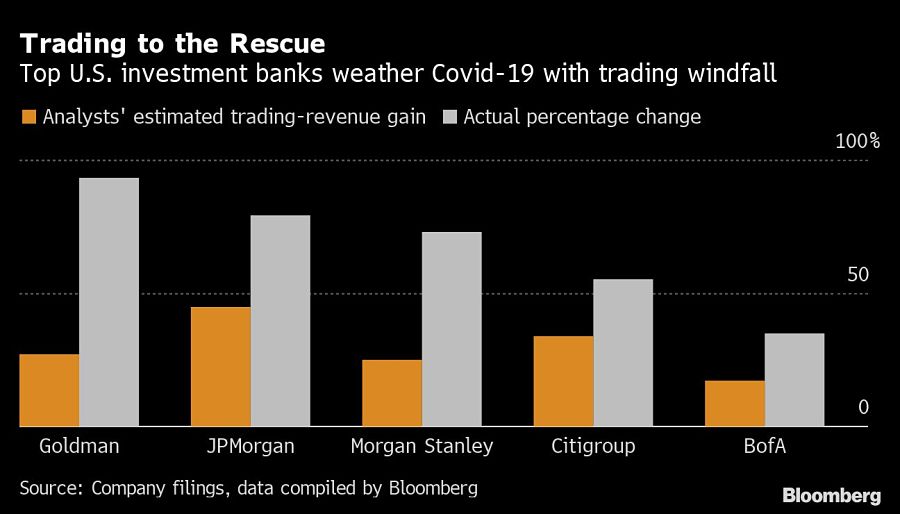
As the Covid-19 outbreak intensified earlier this year, the Fed cleared the way for companies to access desperately needed cash with programs that effectively served as credit backstops, allowing markets to thaw. That, in turn, spurred demand for Wall Street’s trading and underwriting services.
“Our decade long business transformation was intended to provide stability during times of serious stress,” Chief Executive James Gorman said in the statement. “The second quarter tested the model and we performed exceedingly well, delivering record results.”
Morgan Stanley’s trading gains come at a critical juncture for the bank, which is leaning on the business to shore up earnings as it makes a bigger pivot toward managing money for others. The bank’s pact to purchase ETrade Financial Corp. in February is set to be the biggest acquisition by a top U.S. bank since the financial crisis, and a sign of Gorman doubling down on the success of his firm’s Smith Barney purchase a decade ago.
Fixed-income trading revenue at Morgan Stanley came in at $3.03 billion, compared with the $1.81 billion analysts were predicting, based on estimates compiled by Bloomberg. Equities trading revenue rose to $2.62 billion, higher than the $2.27 billion average estimate.
Morgan Stanley’s stock is little changed since the start of the year, the best performance among the top five banks and a show of resilience that kept the firm’s market capitalization above that of Goldman Sachs Group Inc. -- a perennial rival -- for much of the year. Shares of the company, which had gained 8.1% since July 9, were little changed at 8:12 a.m. in early New York trading.
Investment bankers at the firm posted revenue of $2.05 billion on the strength of a 64% jump in underwriting revenue, as the firm took its share of the surge in new stock and debt issuance by corporate America.
Wealth management revenue, which typically accounts for about half of Morgan Stanley’s total, rose 6% to $4.68 billion.

“We needed to become a more agile and efficient organization,” said American Express CEO Stephen Squeri.

Examiners will scrutinize fee conflicts, complex products and super intelligence threats as broker-dealers face fresh Reg BI and AML reviews

New launches tackle succession planning, AI-driven email management and heir retention ahead of the great wealth transfer

For sellers weighing PE deals, due diligence shouldn't end with the offer on the table – the acquiring platform and the M&A advisor deserve a hard look as well.

South Carolina estate planning firm joins Osaic’s IBD network, citing succession planning tools and multigenerational growth resources.
Knighthead Life entered the market with a competitive MYGA. A strong launch earned advisor confidence and paved the way for FIAs.
As AI makes financial information more accessible than ever, Lana Hock explains why human judgment, trust, and empathy remain the qualities clients value most in a financial advisor

