The big four wirehouses saw market conditions that boosted fourth quarter profits to record levels subside in the first quarter of this year, but fast-rising fee revenues helped insure a collective 16% year-over-year increase in profits.
With the first quarter in the books and the earnings statements out for all four of the big brokerage firms, we created a series of charts to demonstrate how their advisory divisions' fared in the first quarter in terms of revenues, client assets, productivity and headcount versus their performance over the past few years.
The firms, which are not counting on a market rally to carry into 2014, have charted their own plans for growth. Whether through securing loans for clients, cost-cutting measures, expanding through acquisitions, or honing their service models, each wirehouse has staked divergent paths to continued profitability in the coming year.
In this new quarterly feature, we'll check in on their balance sheets and point out the trends.
1. Revenue rising
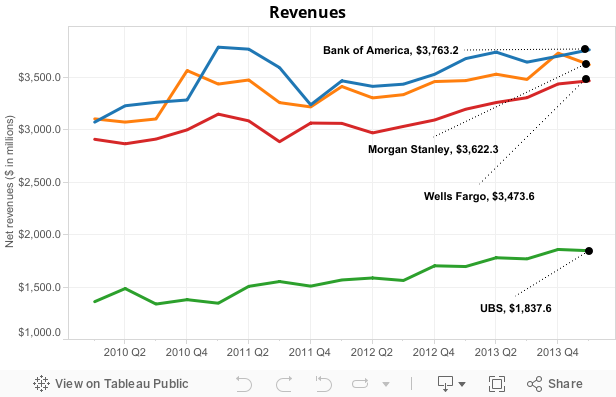
Revenues were up across the board. Commission revenues declined in the first quarter for many of the firms on the list, but that was offset by some dramatic quarter-over-quarter increases in fee-based revenue. As assets under management rose, so did the fees attached to client accounts. Firms have also been pushing to do more fee-based business as part of their efforts to do more
financial planning for clients. Moreover, the recurring fee revenue provides firms with a steadier source of income than commission and transaction revenue, which vary widely during the market's ups and downs.
2. Adviser productivity up
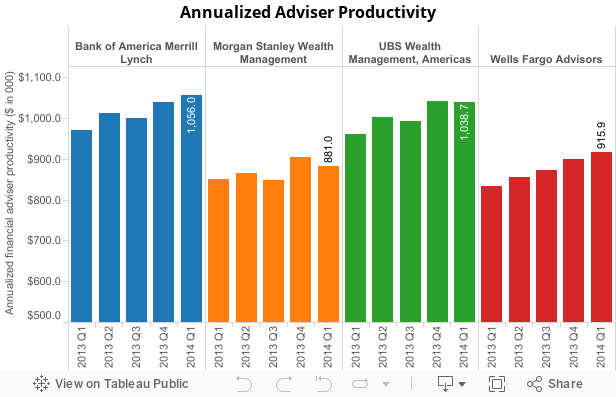
Revenue per adviser reached record levels at many of the firms in 2013 but fell slightly in the first quarter. Some firms reported a decline in trading revenue and increased market volatility. The trailing-12 month revenue for the first quarter this year was still well above where it was in the first quarter of 2013.
Bank of America Merrill Lynch reported the highest revenue per adviser, although
UBS has been steadily closing in.
UBS executives have said that they expect that productivity will continue to rise as
UBS advisers take on a greater focus on financial planning, which firms say helps add client assets and increase the depth of products and services provided.
3. Market conditions send client assets soaring
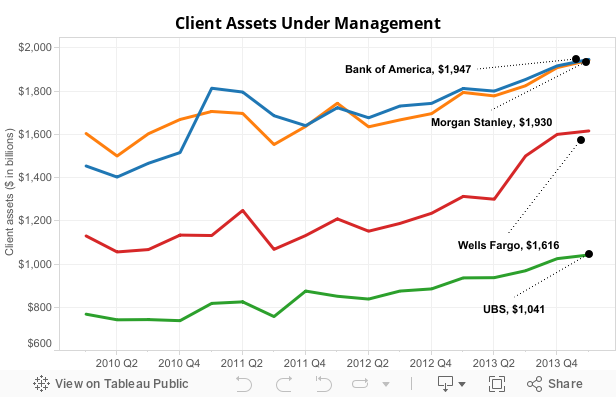
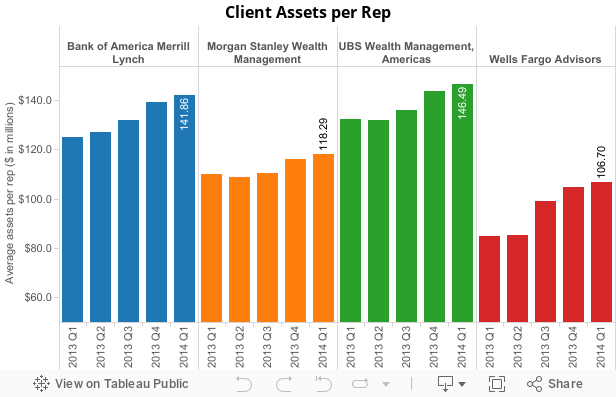
Client assets leapt up dramatically in 2013 and continued to reach new heights in the first quarter of this year. Morgan Stanley crept closer to Bank of America Merrill Lynch after trailing behind them since 2012. UBS is difficult to compare since it has around half as many advisers as its larger wirehouse competitors. In terms of assets per adviser, UBS remains competitive.
4. ... as well as client assets per adviser
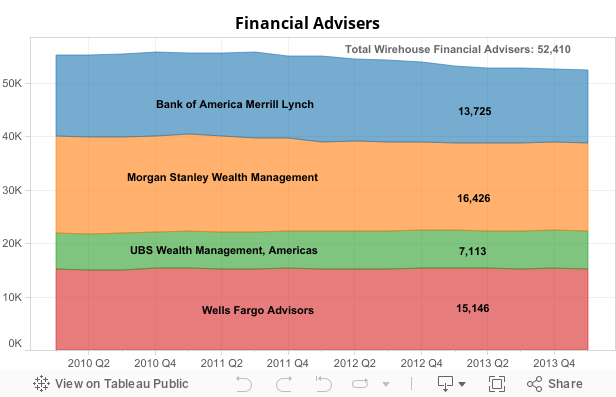
5. Adviser head count in decline
Note: Wells Fargo Advisors head count includes bank channel advisers.
Adviser headcount has declined slightly overall since 2010. UBS, however, has continued to grow following a turnaround in its wealth management division. The firm was losing advisers until CEO Robert McCann joined in 2009 and sought to change the direction.