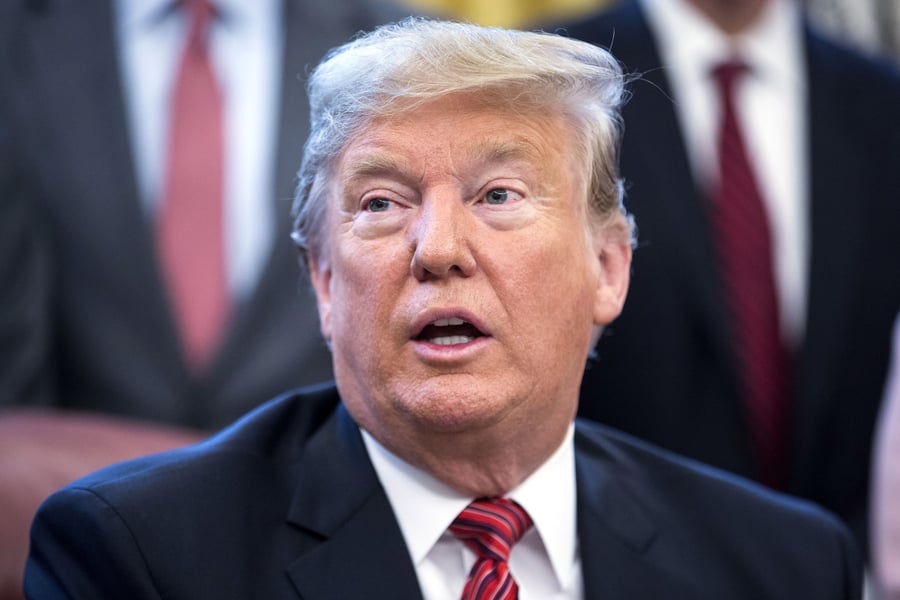
Whether you like him or not, President Donald J. Trump is having a measurable
impact on the financial markets, although maybe not in the ways he expects or would prefer.
"Trump has a particular talent for causing wedges, driving markets and providing leading signals," said Zak Selbert, chief executive and co-founder of Indexica, an alternative data firm that measures the impact of news reports on financial markets.
Mr. Trump is far from the sole focus of
Indexica, but he is providing the steadiest stream of quantifiable data.
Firms in the alternative data space like Indexica are obsessed with measuring things that have been difficult to measure. Some firms will measure credit card data or satellite imagery, for example. But Indexica uses textual data, where 90% of all information resides.
"It's the low-hanging fruit," Mr. Selbert said. "News data is narrating what's happening around the world."
Enter Mr. Trump.
"We built this under the assumption that anything can move markets," Mr. Selbert said. "It just turns out that Trump happens to move lots of markets."
What's unique and important to understand is that the Indexica analysis is not related to the president's social media activity or any social media reactions. Those often draw lots of attention but their impact on markets is usually short-lived.
"How Trump moves markets in the short term is that the markets react in three seconds and there's no way to predict that, so it's not helpful to pay attention to his tweets," Mr. Selbert explained. "We're paying attention to the broader conversation around Trump, because the news will continue to impact markets for weeks."
An example of how the research applies to investing is found in Indexica's BuzzSentiment metric, which measures the ratio of news related to the president.
While the metric found that most news reports related to Mr. Trump qualify as negative, the data show that a spike in the volume of news reports that are also negative toward the president is a dependable predictor of
market volatility.
"If you model the BuzzSentiment of Trump to a broad index like the S&P 500, we have found when the combination is such that Trump is being spoken about more often in a negative tone, equities become more volatile, which usually implies equities will decline," Mr. Selbert said. "The key is it has to be more than the moving average, because generally he is being spoken about a lot in a negative tone."
The
looming global trade war is another example of how the data are being applied.
"Some countries do well under a trade war and some won't, but you have to quantify what Trump says and how the news is responding, and then you look at how it peaks and evolves," Mr. Selbert said. "That gives you a predictive signal of how the markets react."
This kind of alternative data is currently most popular with
hedge fund managers but has the potential to migrate into retail-class products like mutual funds and exchange-traded funds.
The general idea is to identify leading indicators of asset movements, which could be anything from political news to weather-related items.
"Trump happens to come up a lot because he really moves markets in a systematic way," Mr. Selbert said. "He incites extreme levels of emotion and news discourse, and he takes up a lot of space, and the discourse around him is so erratic."
Of course, not everyone is sold on the idea that news reports about the president are indicators of market direction.
"While they attempted to quantify the Trump factor, they basically said it's all short-term noise," said Paul Schatz, president of Heritage Capital.
"Markets are like a flowing river," Mr. Schatz said. "They can be temporarily diverted or held back, but in the end, they will find their own levels and end up wherever they were going in the first place."