
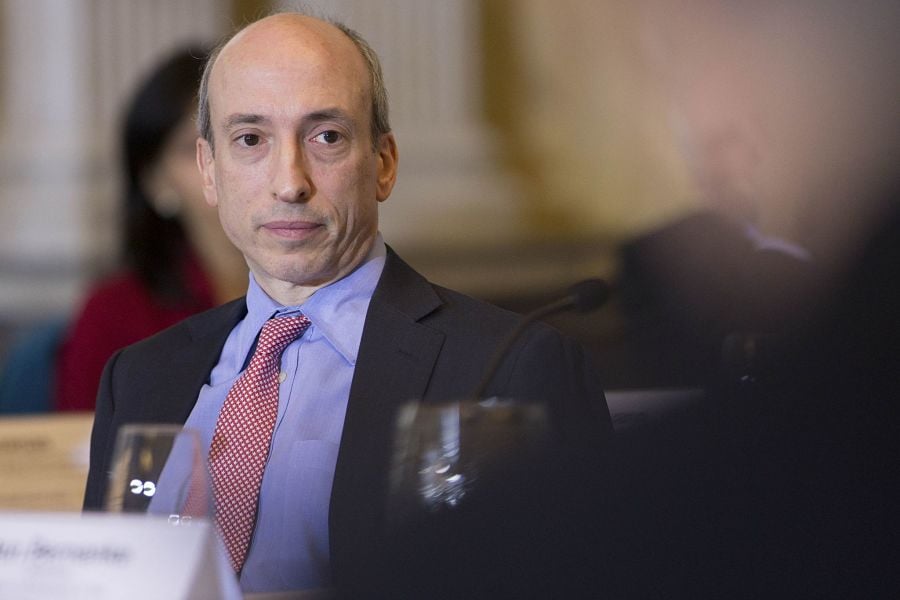
Securities and Exchange Commission Chairman Gary Gensler Tuesday called on Congress to grant the SEC more authority and resources to regulate the rapidly growing and volatile cryptocurrency sector.
The SEC has taken its authority as far as it can go and needs additional support from Congress to expand the agency's investors protection mandate, which traditionally has governed securities, so that it also addresses crypto trading, exchanges, lending and decentralized finance platforms, Gensler said in his remarks at the Aspen Security Forum.
Describing the crypto sector as “the Wild West,” Gensler said the crypto market involves many tokens, which may be unregistered securities, and leaves prices open to manipulation and millions of investors vulnerable to risks like fraud.
“We need additional Congressional authorities to prevent transactions, products and platforms from falling between regulatory cracks,” Gensler said. “We stand ready to work closely with Congress, the Administration, our fellow regulators, and our partners around the world to close some of these gaps.”
As of Monday, crypto assets were worth about $1.6 trillion, with 77 tokens worth at least $1 billion each and 1,600 with at least a $1 million market capitalization, according to CoinMarketCap.
If Congress grants the SEC more authority to regulate crypto, it would be an unprecedented expansion of the agency's investor protection mandate, said Ken Joseph, head of Americas compliance and regulatory consulting at Kroll. Joseph was previously at the SEC, where he served as one of the inaugural supervisors in the Division of Enforcement’s specialized asset management unit, and as a senior officer in the commission’s Office of Compliance Inspections and Examinations.
Joseph said he expects a territorial struggle with the Fed if the SEC’s powers are expanded. “There could be a fight among the federal agencies about who should hold that power,” he said. “Other federal agencies that might have a stake in this fight might want their agendas to be addressed as well.”
While the SEC has operated well under its current limitations, Joseph said, the regulatory infrastructure has not kept pace with financial innovation and Gensler recognizes that.
“Standing astride isn’t a sustainable place to be,” Gensler said. “For those who want to encourage innovations in crypto, I’d like to note that financial innovations throughout history don’t long thrive outside of our public policy frameworks.”
SEC Commissioner Hester Peirce has also made it clear that the regulator is taking ownership of the work that is needed to provide some comfort around custody issues in the crypto space.
Lawmakers are also attempting to warm up to the idea of a central bank digital currency as the meteoric rise of cryptocurrencies has created the context for understanding the potential value and risks of crypto, Sen. Elizabeth Warren, D-Mass., said during a congressional hearing in June.
The uncertain regulatory environment around cryptocurrencies and concerns about safe custody and fraud, along with crypto’s lack of history as a true currency, are all potential issues with Bitcoin and other digital currencies that continue to keep advisers on the sidelines.
Of the advisers surveyed for a white paper by InvestmentNews Research in partnership with Grayscale Investments, 37% say they would definitely reconsider recommending cryptocurrencies once they see more regulatory involvement.

CFP, CFA and CPA holders could gain accredited investor status as regulators weigh wider private market access for advisory clients

DeepVest, Vanilla and Libretto roll out tools to help financial advisors launch firms, close estate plans and sharpen planning skills

“People aren't effectively using their wealth in retirement,” said David Blanchett of Prudential.

Second-generation NFL ref Shawn Hochuli co-founded IWM Partners in Irvine, California, a wealth management practice with more than $500M in client assets

U.S. seniors lose $28.3 billion annually as a result of financial exploitation, according to a 2023 AARP study.
As AI makes financial information more accessible than ever, Lana Hock explains why human judgment, trust, and empathy remain the qualities clients value most in a financial advisor
Northern Trust’s Ken Lassner shows advisors how to convert volatility into after-tax portfolio gains

