
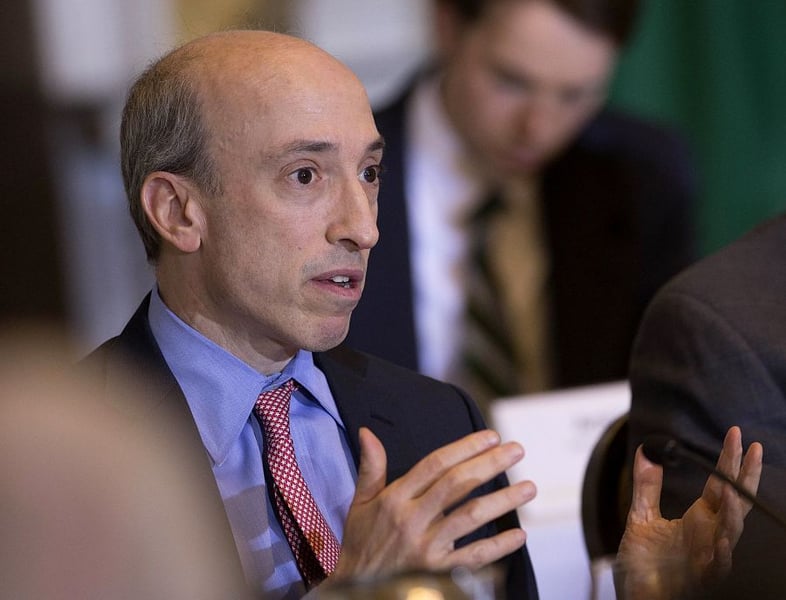
Securities and Exchange Commission Chairman Gary Gensler on Tuesday defended the agency’s efforts to expand environmental, social and governance disclosures against charges from Republican lawmakers that the agency is pursuing a social policy agenda.
In his first appearance before the Senate Banking Committee as SEC chief, Gensler was pressed by Republicans about the agency’s pending rule proposals regarding public company disclosures about climate risk and human capital management.
The GOP legislators asserted the agency was going beyond its authority to promote liberal issues unrelated to financial regulation. The most pointed criticism during the banking committee hearing came from Sen. John Kennedy, R-La., who suggested the SEC was being paternalistic in its ESG push.
“As to the people and the companies that you regulate as chairman of the SEC, do you consider yourself to be their daddy?’ Kennedy asked Gensler.
Gensler replied: “No. No.”
Kennedy continued: “Why do you impose your personal preferences about cultural issues and social issues on companies and, therefore, their customers and their workers — like climate change and the Second Amendment?”
Gensler countered that the SEC is reacting to the soaring popularity of sustainable investing and investor demand for more ESG information.
“What I’ve been trying to do is say, if investors want information about climate risk, and it looks like tens of trillions of dollars of assets under management are asking, we at the SEC have a role to put [a proposal] out to notice and comment, do the economic analysis and really see what investors are saying,” Gensler told Kennedy. “It’s really in that narrow set of chalk lines that we’re operating.”
The SEC has significantly stepped up its ESG oversight since the beginning of year, an effort that has dovetailed with the Biden administration’s government-wide efforts to combat climate change.
In addition to the pending disclosure proposals, the agency has been examining investment advisers regarding how they market and execute ESG investing and has established a climate and ESG enforcement task force.
The SEC moves have made Republicans — on Capitol Hill as well at the SEC — bristle.
“Even President Obama’s SEC chair, Mary Jo White, opposed using the SEC’s disclosure powers for the purpose of ‘exerting societal pressure on companies to change behavior, rather than to disclose financial information that primarily informs investment decisions,’” Sen. Patrick Toomey, R-Pa. and ranking member of the committee, said in his opening statement. “That’s exactly what you’re doing.”
Panel Democrats promoted the SEC’s work on climate risk and human capital disclosure proposals, which are likely to be released by the end of the year.
“I don’t see climate-risk disclosure as a social issue,” said Sen. Tina Smith, D-Minn. “I see it as a systemic risk that investors face because of climate change, and it’s important that we all understand that.”
Gensler said his goal is to make climate and other ESG disclosures consistent and comparable among companies.
The hearing lasted almost two hours and covered a range of items on the SEC’s agenda. One issue that came up frequently was cryptocurrency.
“Currently, we just don’t have enough investor protection in crypto finance, issuance, trading or lending,” Gensler said in his prepared testimony. “This asset class is rife with fraud, scams and abuse in certain applications. We can do better.”
But several Republican lawmakers cautioned Gensler not to go too far in regulating cryptocurrency and stifle innovation in the sector.
Toomey pressed Gensler on inconsistencies related to determining whether a digital asset is a security, a designation that would subject it to stricter regulation.
“We need to have clarity on this,” Toomey said.

Richardson firm joins as Kestra builds out its platform with new leadership, technology, and expanded planning tools.

Retiring RIA seller David Laidlaw alleges the Carnegie valued his stake on $11.7 million EBITA while pitching potential buyers on $21.3 million.

New tool gives RIAs and family offices AI help vetting private market deals, with some users reportedly halving review time.

Investors got projected returns dressed up as real ones, SEC says

Parents must still act to get the $1,000 federal seed and employer contributions, giving financial advisors a role in the rollout.
As AI makes financial information more accessible than ever, Lana Hock explains why human judgment, trust, and empathy remain the qualities clients value most in a financial advisor
Northern Trust’s Ken Lassner shows advisors how to convert volatility into after-tax portfolio gains

