
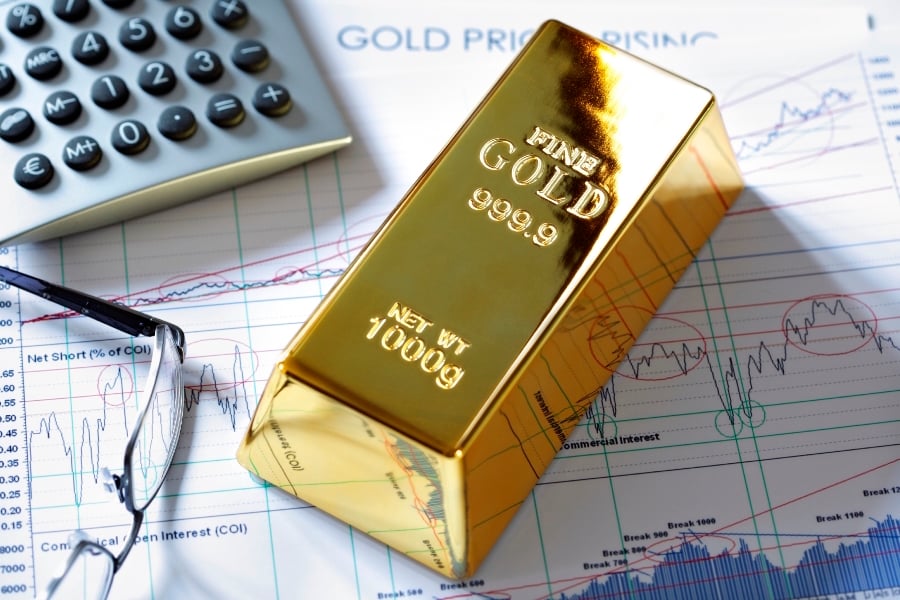
As Russia's invasion of Ukraine pushes financial markets to the brink after what has already been a rough start to the year for stocks, gold has emerged once again as the rock of stability.
The precious metal’s 4.3% gain this year compares to an 11% drop by the S&P 500 Index and reminds doubters that the age-old safe haven strategy still carries some weight.
“We’ve liked gold on and off for a long time — on during deflation and turmoil, and off during a growing economy,” said Dennis Nolte, vice president of Seacoast Investment Services.
“Now, of course, people are flocking to safe havens,” Nolte said. “It’s more of a currency than a commodity, so it will do well during tank invasions and recessions, which means we like it now.”
Even with that said, he believes the price of gold, at around $1,925 an ounce, is “overbought.”
“If we were traders, we’d sell some today,” he added.
Paul Schatz, president of Heritage Capital, said, “Gold is certainly getting a lot of interest as a safe haven because of what’s going on with Russia, but that is not the real story.”
Schatz started the year forecasting that the price of gold would reach or exceed $2,000 an ounce “because I thought the economy was slowing, earnings growth was slowing and inflation was rolling over.”
“Even though gold is spiking right now because Russia invaded Ukraine, it had already been rallying and it was in a good position to further rally,” he added. “Now people ask should they buy gold now. I will give the same answer to those who ask if they should sell stocks now because Russia invaded Ukraine and the stock market is plunging. The simple answer is with much of this stuff, you need to take action before events unfold.”
George Milling-Stanley, chief gold strategist at State Street Global Advisors, isn't surprised investors have been parking money in gold.
“I think everybody has thought of gold for thousands of years as a potential safe haven when other assets are under threat,” he said.
However, Milling-Stanley added that while allocations to gold are sometimes tactical or temporary, any gold positions now might be best viewed as strategic.
“I think this [Ukraine] situation will be with us for quite some time,” he said. “This is serious, no question about that. It’s gone further than most people expected, and it will change a lot of things.”
While the most popular way to gain exposure to gold is through the $63 billion SPDR Gold Shares ETF (GLD), there are other options that might be more appealing to financial advisers, said Todd Rosenbluth, director of mutual fund and ETF research at CFRA.
The $4.6 billion SPDR Gold MiniShares ETF (GLDM) is a lower-cost version of GLD, charging 18 basis points instead of the 40 bps for GLD. Another option is the $1.3 billion iShares Gold Trust Micro ETF (IAUM) at 15 bps.

The financial advice industry has been facing inquiries into its cash sweep programs for years now.

Investor money allegedly went to strip clubs, exotic cars, and landscaping

Procyon adds $415 million in assets under management in New Jersey while Savant picks up a $213 million Southern California planning firm

With a growing number of real estate-rich Baby Boomers aging into retirement, some advisors may be failing to consider all the options available for those clients' assets.

Cornerstone Advisors study reveals compliance bottlenecks stall campaigns weeks after customer opportunities close.
As AI makes financial information more accessible than ever, Lana Hock explains why human judgment, trust, and empathy remain the qualities clients value most in a financial advisor
Northern Trust’s Ken Lassner shows advisors how to convert volatility into after-tax portfolio gains

